
All posts
Visualizing the Evolution of Working Sets
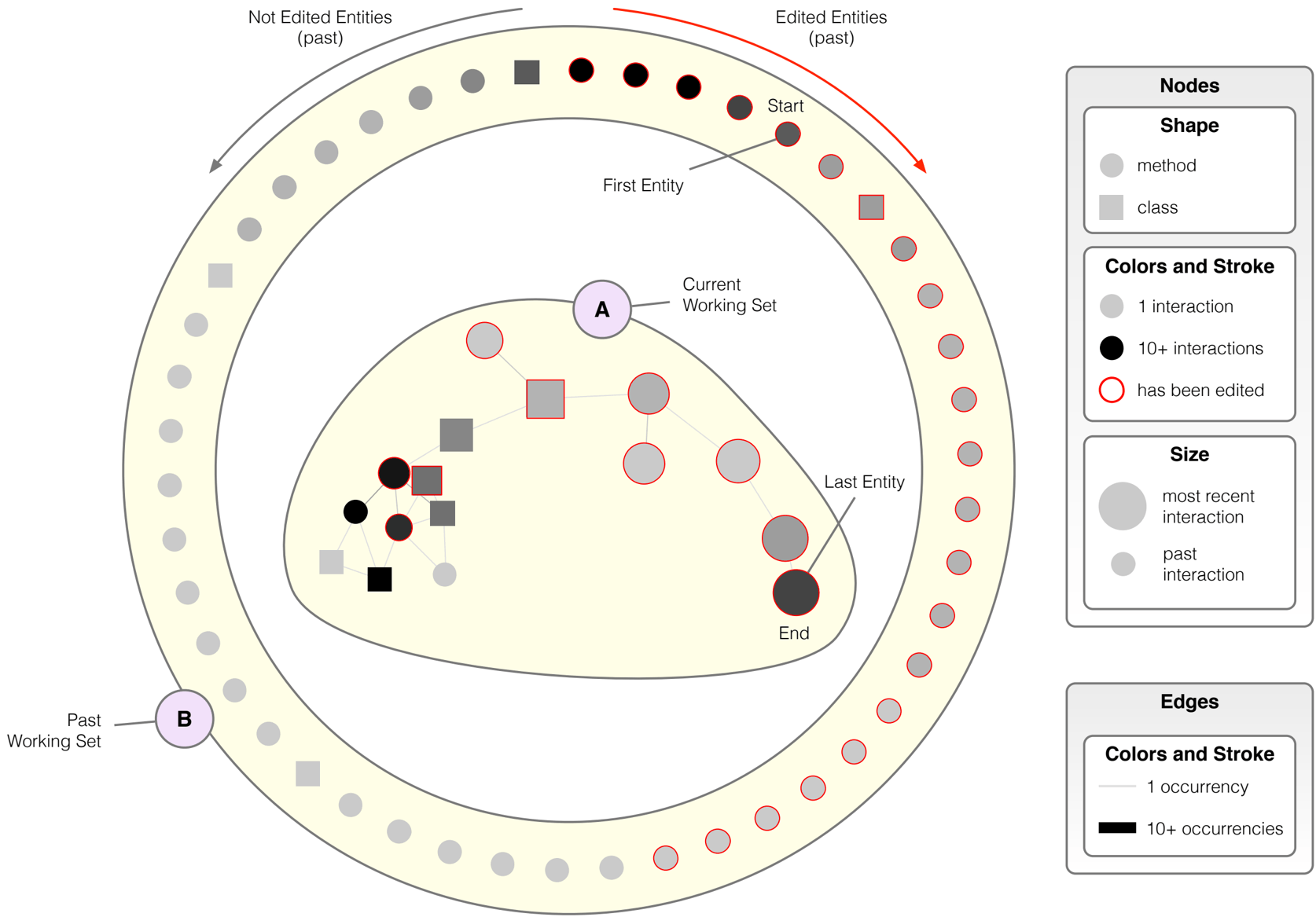
As part as their daily work, developers interact with Integrated Development Environments (IDE), generating thousands of events. Together with other aspects of development, this data also captures the modus operandi of the developer, including all the program entities she interacted with during a development session. This \"working set" (or context) is leveraged by developers to create and maintain their mental model of the software system at hand. Understanding how developers navigate and interact with source code during a development session is an open question. We present a novel visual approach to understand how working sets evolve during a development session. The visualization incrementally depicts all the program entities involved in a development session, the intensity of the developer activity on them, and the navigation paths that occurred between them. We visualized more than a thousand development sessions, and categorized them according to their visual properties.
Mining and Modelling Unstructured Data
31st IEEE/ACM International Conference on Automated Software Engineering (ASE 2016)
What Makes a Satisficing Bug Report?
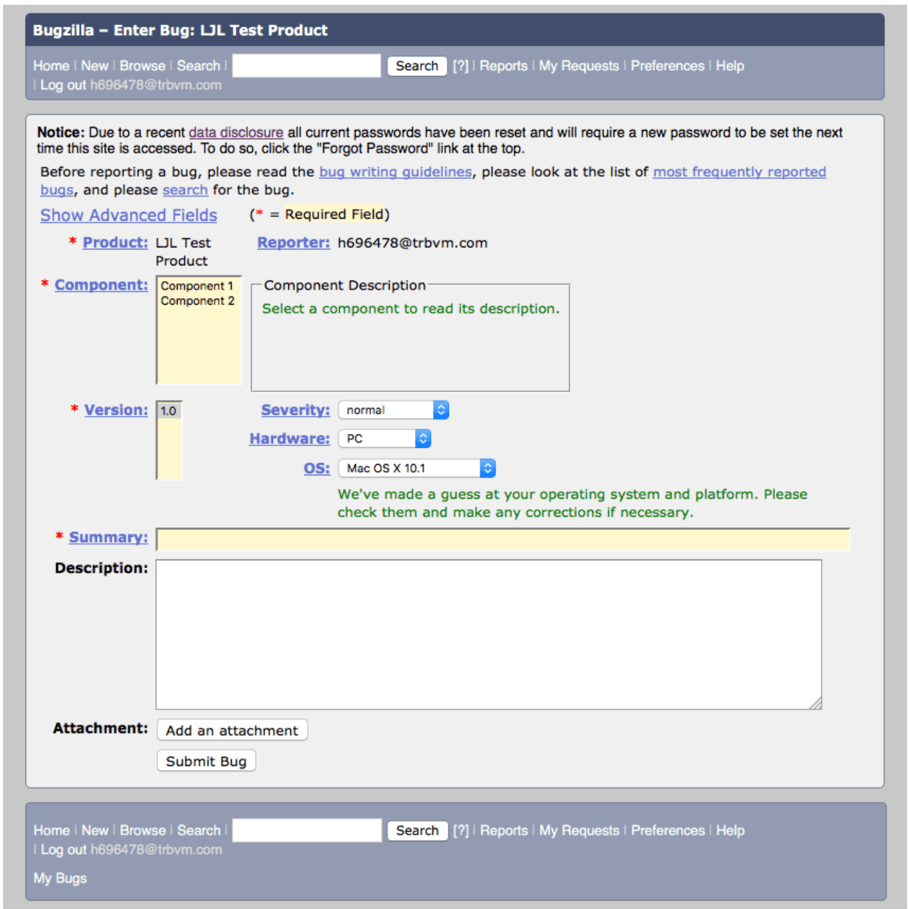
To ensure quality of software systems, developers use bug reports to track defects. It is in the interest of users and developers that bug reports provide the necessary information to ease the fixing process. Past research found that users do not provide the information that developers deem ideally useful to fix a bug. This raises an interesting question: What is the satisficing information to speed up the bug fixing process? We conducted an observational study on the relation between provided report information and its lifetime, considering more than 650,000 reports from open-source systems using popular bug trackers. We distilled a meta-model for a minimal bug report, establishing a basic layer of core features. We found that few fields influence the resolution time and that customized fields have little impact on it. We performed a survey to investigate what users deem easy to provide in a bug report.
Taming the IDE with Fine-grained Interaction Data
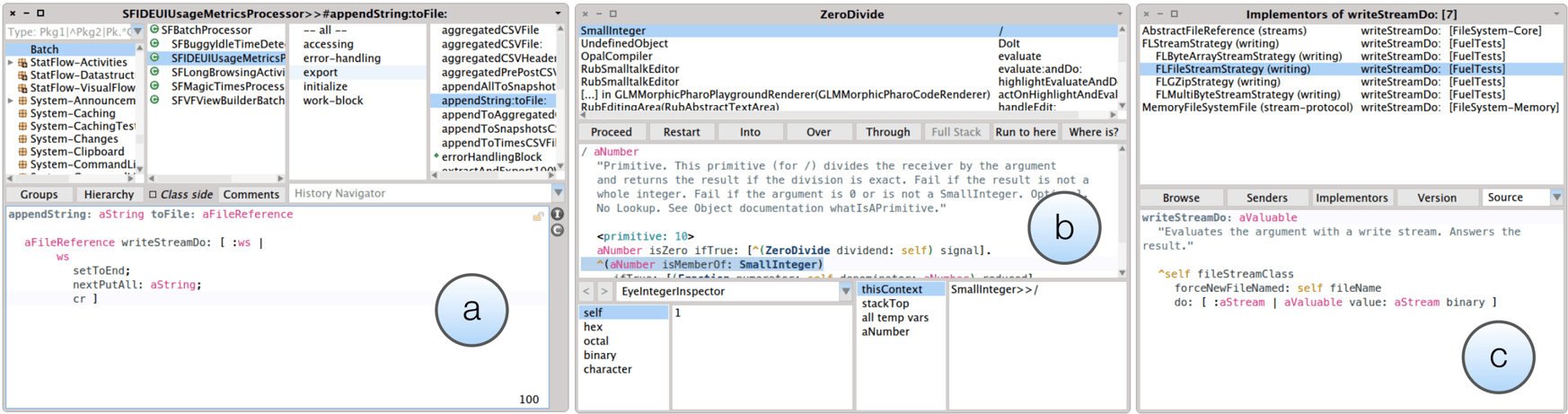
Integrated Development Environments (IDEs) lack effective support to browse complex relationships between source code elements. As a result, developers are often forced to exploit multiple user interface components at the same time, bringing the IDE into a complex, \"chaotic" state. Keeping track of these relationships demands increased source code navigation and cognitive load, leading to productivity deficits documented in observational studies. Beyond small-scale studies, the amount and nature of the chaos experienced by developers in the wild is unclear, and more importantly it is unclear how to tame it. Based on a dataset of fine-grained interaction data, we propose several metrics to characterize and quantify the "level of chaos" of an IDE. Our results suggest that developers spend, on average, more than 30% of their time in a chaotic environment, and that this may affect their productivity. To support developers, we devise and evaluate simple strategies that automatically alter the UI of the IDE. We find that even simple strategies may considerably reduce the level of chaos both in terms of effective space occupancy and time spent in a chaotic environment.
Too Long; Didn't Watch! Extracting Relevant Fragments from Software Development Video Tutorials
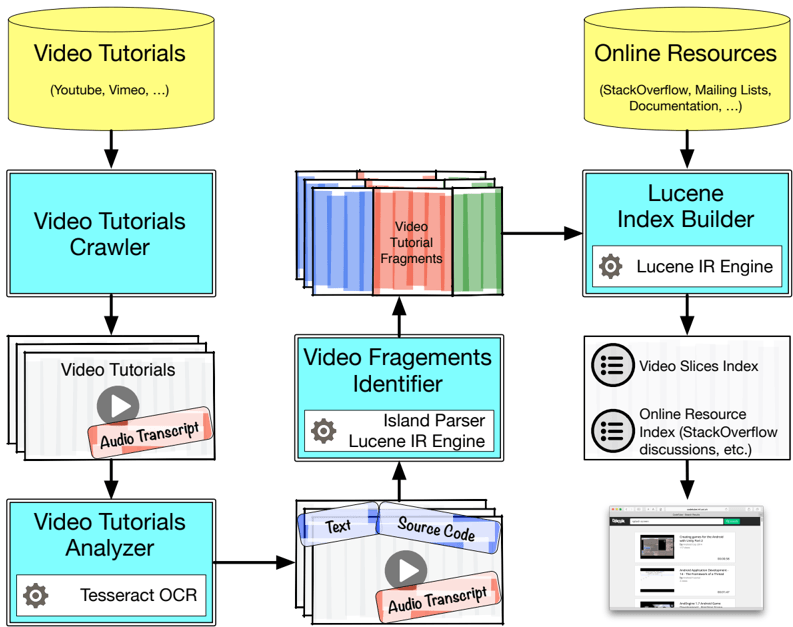
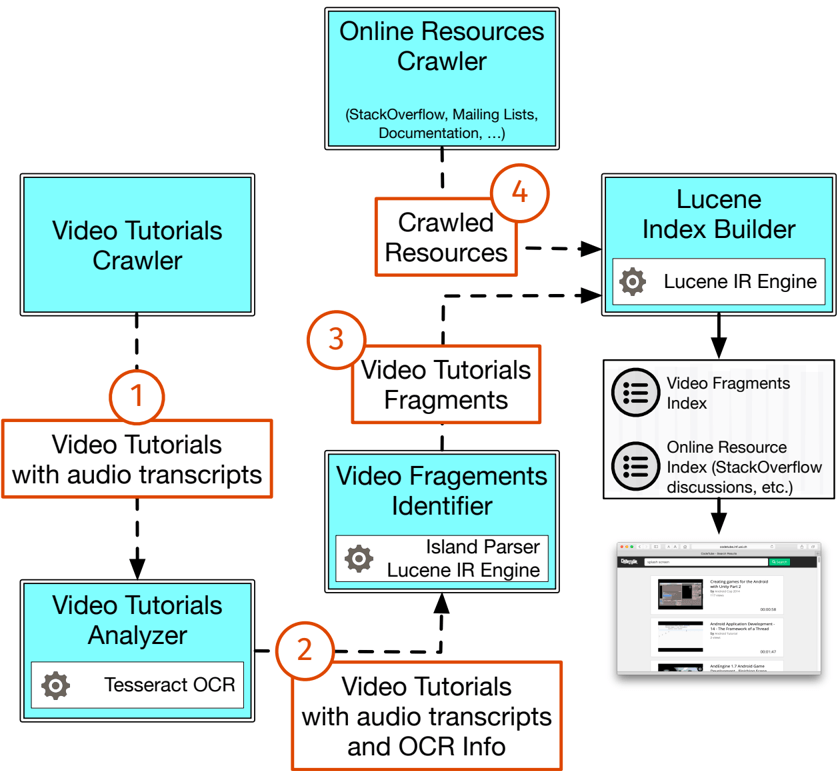
When knowledgeable colleagues are not available, developers resort to offline and online resources, e.g. tutorials, mailing lists, and Q&A websites. These, however, need to be found, read, and understood, which takes its toll in terms of time and mental energy. A more immediate and accessible resource are video tutorials found on the web, which in recent years have seen a steep increase in popularity. Nonetheless, videos are an intrinsically noisy data source, and finding the right piece of information might be even more cumbersome than using the previously mentioned resources. We present CodeTube, an approach which mines video tutorials found on the web, and enables developers to query their contents. The video tutorials are split into coherent fragments, to return only fragments related to the query. These are complemented with information from additional sources, such as Stack Overflow discussions. The results of two studies to assess CodeTube indicate that video tutorials - if appropriately processed - represent a useful, yet still under-utilized source of information for software development.
CodeTube: Extracting Relevant Fragments from Software Development Video Tutorials
Nowadays developers heavily rely on sources of informal documentation. Examples include Q&A forums, slides, or video tutorials, the latter being particularly useful to provide introductory notions for a piece of technology. The current practice is that developers have to browse sources individually, which in the case of video tutorials is cumbersome, as they are lengthy and cannot be searched based on their contents. We present CodeTube, a Web-based recommender system that analyzes the contents of video tutorials and is able to provide, given a query, cohesive and self-contained video fragments, along with links to relevant Stack Overflow discussions. CodeTube relies on a combination of textual analysis and image processing applied on video tutorial frames and speech transcripts to split videos into cohesive fragments, index them and identify related Stack Overflow discussions.
Measuring Navigation Efficiency in the IDE
While coding, developers construct and maintain mental models of software systems to support the task at hand. Although source code is the main product of software development, the process involves navigating and inspecting entities beyond the ones that are edited by the end of a task. Developers use various user interfaces (UI) offered by the Integrated Development Environment (IDE) to navigate the complex, and often hidden, relationships between program entities. These UIs impose fixed navigation costs, in terms of the number of interactions that a developer is required to perform to reach an entity of interest. It is unclear to what extent the actual navigation effort differs from an ideal setting, and if there is any room for actual improvement. We present a preliminary empirical study, where we analyzed a corpus of IDE interaction data coming from 6 developers totaling more than 20 days of development activity. To measure the navigation efficiency, we compute a combination of different ideal settings and compare them against the observed navigation events. Our findings reveal that, on average, developers perform 1.5 to 19 times more navigation events than the ideal case. While different factors make the ideal setting unfeasible, we believe that this calls for novel approaches to support the navigation in integrated development environments.