All posts
SMScom: Self-Managing Situated Computing
Methods and tools for the design, validation, and operation of dependable self-managing situated software.

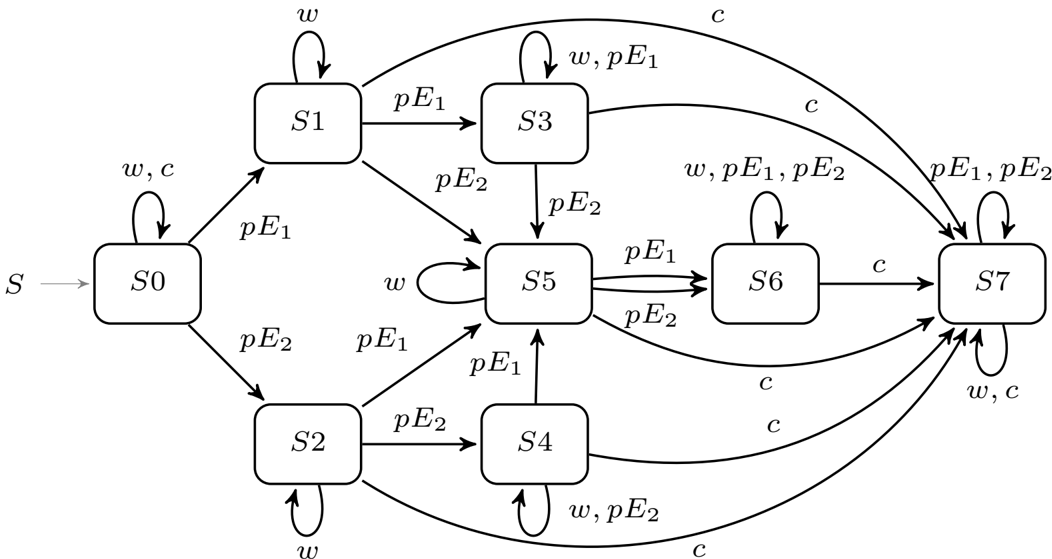
Detecting component changes at run time with behavior models
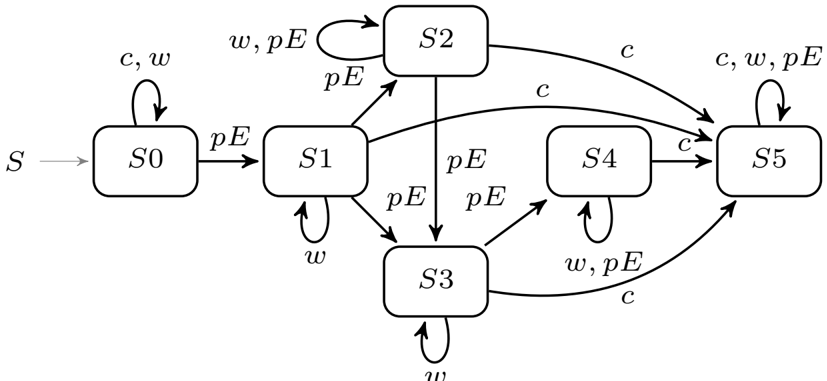
Modern software systems are composed of several services which may be developed and maintained by third parties and thus they can change independently and without notice during the system’s runtime execution. In such systems, changes may possibly be a threat to system functional correctness, and thus to its reliability. Hence, it is important to detect them as soon as they happen to enable proper reaction. Change detection can be done by monitoring system execution and comparing the observed execution traces against models of the services composing the application. Unfortunately, formal specifications for services are not usually provided and developers have to infer them. In this paper we propose a methodology which exactly addresses these issues by using software behavior models to monitor component execution and detect changes. In particular, we describe a technique to infer behavior model specifications with a dynamic black box approach, keep them up-to-date with run time observations and detect behavior changes. Finally, we present a case study to validate the effectiveness of the approach in component change detection for a component that implements a complex, real communication protocol.
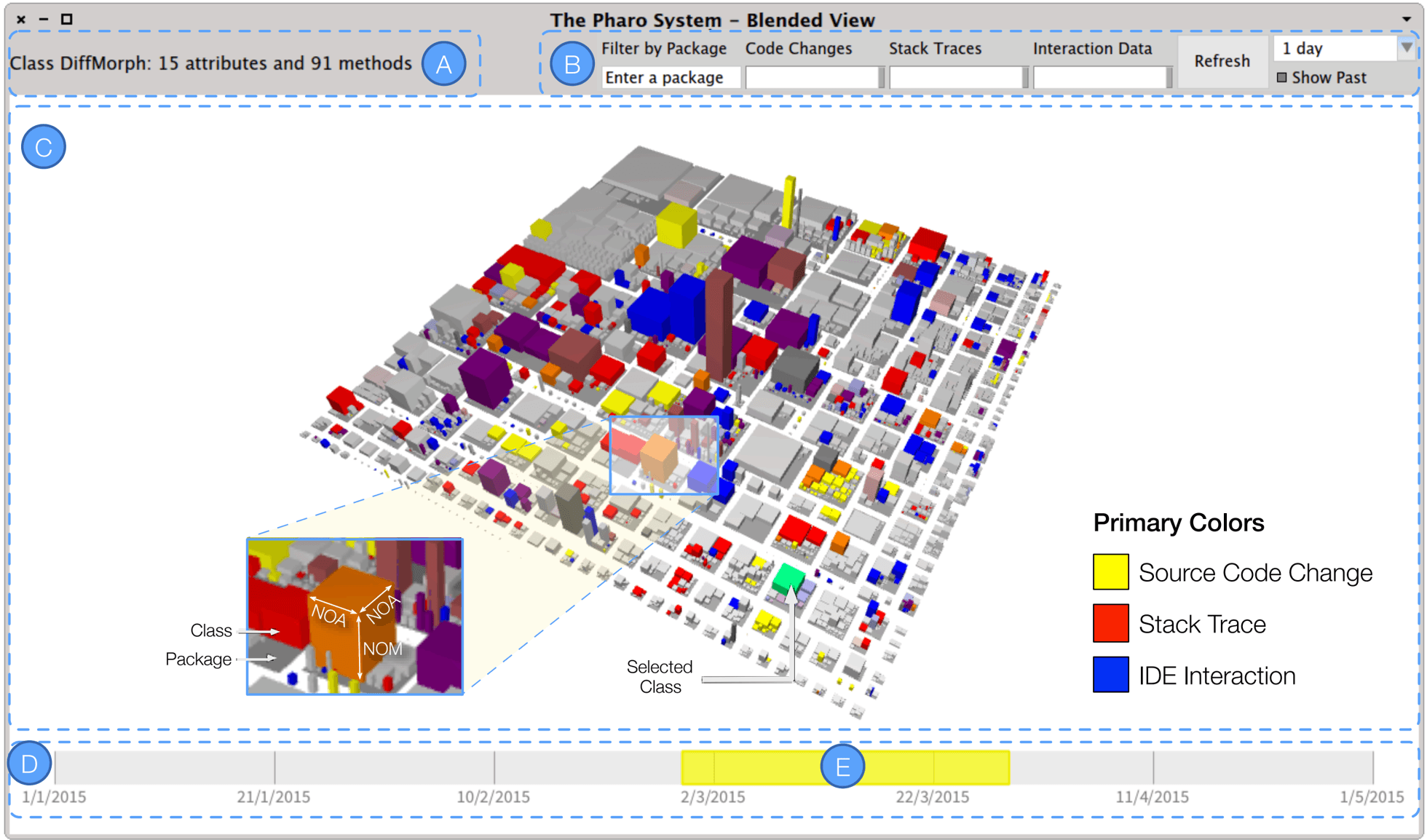
HI-SEA: Holistic Immersive Software Evolution Ambient
A holistic immersive ambient for software evolution, integrating the data around a project into a visual environment for analysis and intelligent recommendations.
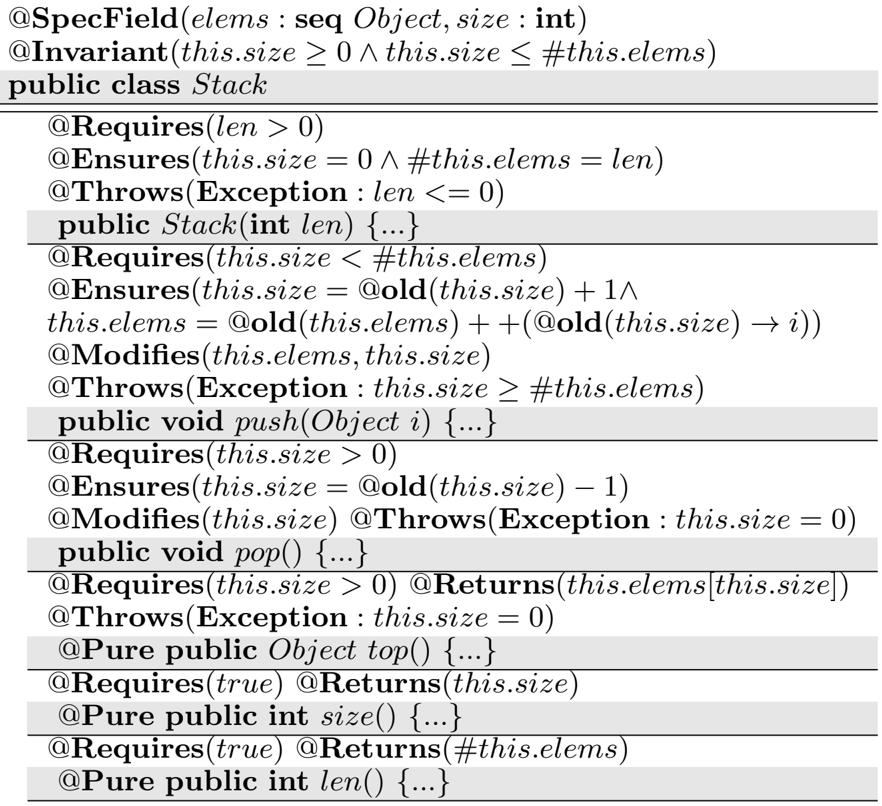
Behavioral validation of JFSL specifications through model synthesis
Contracts are a popular declarative specification technique to describe the behavior of stateful components in terms of pre/post conditions and invariants. Since each operation is specified separately in terms of an abstract implementation, it may be hard to understand and validate the resulting component behavior from contracts in terms of method interactions. In particular, properties expressed through algebraic axioms, which specify the effect of sequences of operations, require complex theorem proving techniques to be validated. In this paper, we propose an automatic small-scope based approach to synthesize incomplete behavioral abstractions for contracts expressed in the JFSL notation. The proposed abstraction technique enables the possibility to check that the contract behavior is coherent with behavioral properties expressed as axioms of an algebraic specifications. We assess the applicability of our approach by showing how the synthesis methodology can be applied to some classes of contract-based artifacts like specifications of data abstractions and requirement engineering models.
Runtime Monitoring of Component Changes with Spy@Runtime
We present Spy@Runtime, a tool to infer and work with behavior models. Spy@Runtime generates models through a dynamic black box approach and is able to keep them updated with observations coming from actual system execution. We also show how to use models describing the protocol of interaction of a software component to detect and report functional changes as soon as they are discovered. Monitoring functional properties is particularly useful in an open environment in which there is a distributed ownership of a software system. Parts of the system may be changed independently and therefore it becomes necessary to monitor the component's behavior at run time.
Extracting structured data from natural language documents with island parsing
The design and evolution of a software system leave traces in various kinds of artifacts. In software, produced by humans for humans, many artifacts are written in natural language by people involved in the project. Such entities contain structured information which constitute a valuable source of knowledge for analyzing and comprehending a system's design and evolution. However, the ambiguous and informal nature of narrative is a serious challenge in gathering such information, which is scattered throughout natural language text. We present an approach-based on island parsing-to recognize and enable the parsing of structured information that occur in natural language artifacts. We evaluate our approach by applying it to mailing lists pertaining to three software systems. We show that this approach allows us to extract structured data from emails with high precision and recall.
Runtime Monitoring of Functional Component Changes with Behavior Models
We consider the problem of run-time discovery and continuous monitoring of new components that live in an open environment. We focus on extracting a formal model—which may not be available upfront—by observing the behavior of the running component. We show how the model built at run time can be enriched through new observations (dynamic model update). We also use the inferred model to perform run-time verification. That is, we try to identify if any changes are made to the component that modify its original behavior, contradict the previous observations, and invalidate the inferred model.
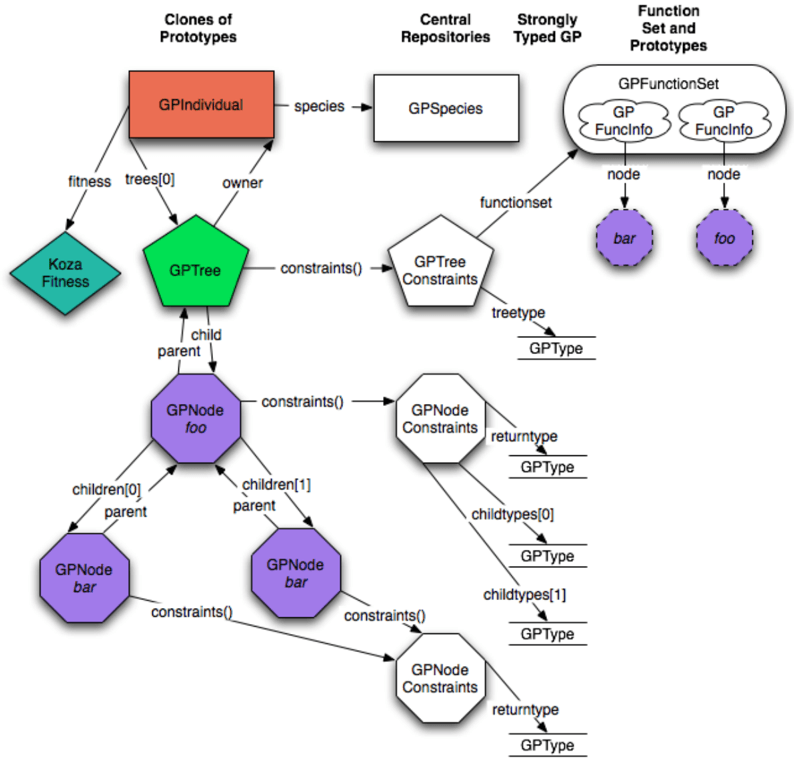
Dynamic Synthesis of Program Invariants using Genetic Programming
Symbolic program manipulation plays a key role in program comprehension and verification. Logic formulae are used to represent the program' s state and transformation rules describe the effect of statement executions on the program's state. A well-known problem arises in the case of loops, since the number of iterations is generally unknown. The effect of a loop is therefore abstracted into a loop invariant, whose derivation cannot in general be automated and requires human ingenuity. In this paper, we present a preliminary approach that in tegrates genetic programming into the synthesis of invariant formula that describes the behavior of a loop. We present a specific representation of formulae that works well with loops manipulating arrays. The technique has been validated with a set of relevant examples with increasing complexity. The preliminary results are promising and show the feasibility of our approach.