Conference
Browse all content in this category
Supporting Software Developers with a Holistic Recommender System
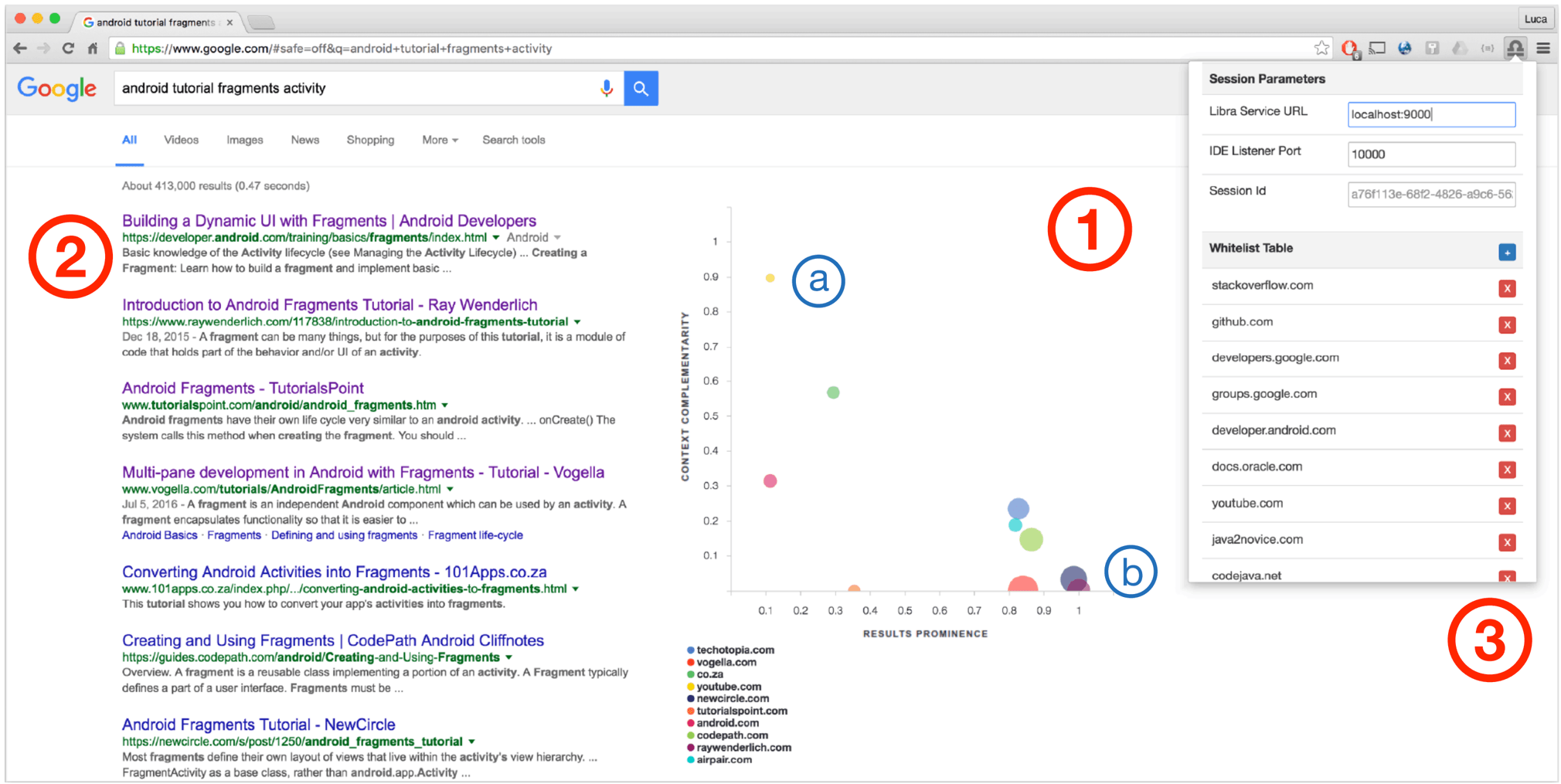
The promise of recommender systems is to provide intelligent support to developers during their programming tasks. Such support ranges from suggesting program entities to taking into account pertinent QnA pages. However, current recommender systems limit the context analysis to change history and developers' activities in the IDE, without considering what a developer has already consulted or perused, e.g., by performing searches from the Web browser. Given the faceted nature of many programming tasks, and the incompleteness of the information provided by a single artifact, several heterogeneous resources are required to obtain the broader picture needed by a developer to accomplish a task. We present Libra, a holistic recommender system. It supports the process of searching and navigating the information needed by constructing a holistic meta-information model of the resources perused by a developer, analyzing their semantic relationships, and augmenting the web browser with a dedicated interactive navigation chart. The quantitative and qualitative evaluation of Libra provides evidence that a holistic analysis of a developer's information context can indeed offer comprehensive and contextualized support to information navigation and retrieval during software development.
How to Gamify Software Engineering
Software development, like any prolonged and intellectually demanding activity, can negatively affect the motivation of developers. This is especially true in specific areas of software engineering, such as requirements engineering, test-driven development, bug reporting and fixing, where the creative aspects of programming fall short. The developers' engagement might progressively degrade, potentially impacting their work's quality. Gamification, the use of game elements and game design techniques in non-game contexts, is hailed as a means to boost the motivation of people for a wide range of rote activities. Indeed, well-designed games deeply involve gamers in a positive loop of production, feedback, and reward, eliciting desirable feelings like happiness and collaboration. The question we investigate is how the seemingly frivolous context of games and gamification can be ported to the technically challenging and sober domain of software engineering. Our investigation starts with a review of the state of the art of gamification, supported by a motivating scenario to expose how gamification elements can be integrated in software engineering. We provide a set of basic building blocks to apply gamification techniques, present a conceptual framework to do so, illustrated in two usage contexts, and critically discuss our findings.
Visualizing the Evolution of Working Sets
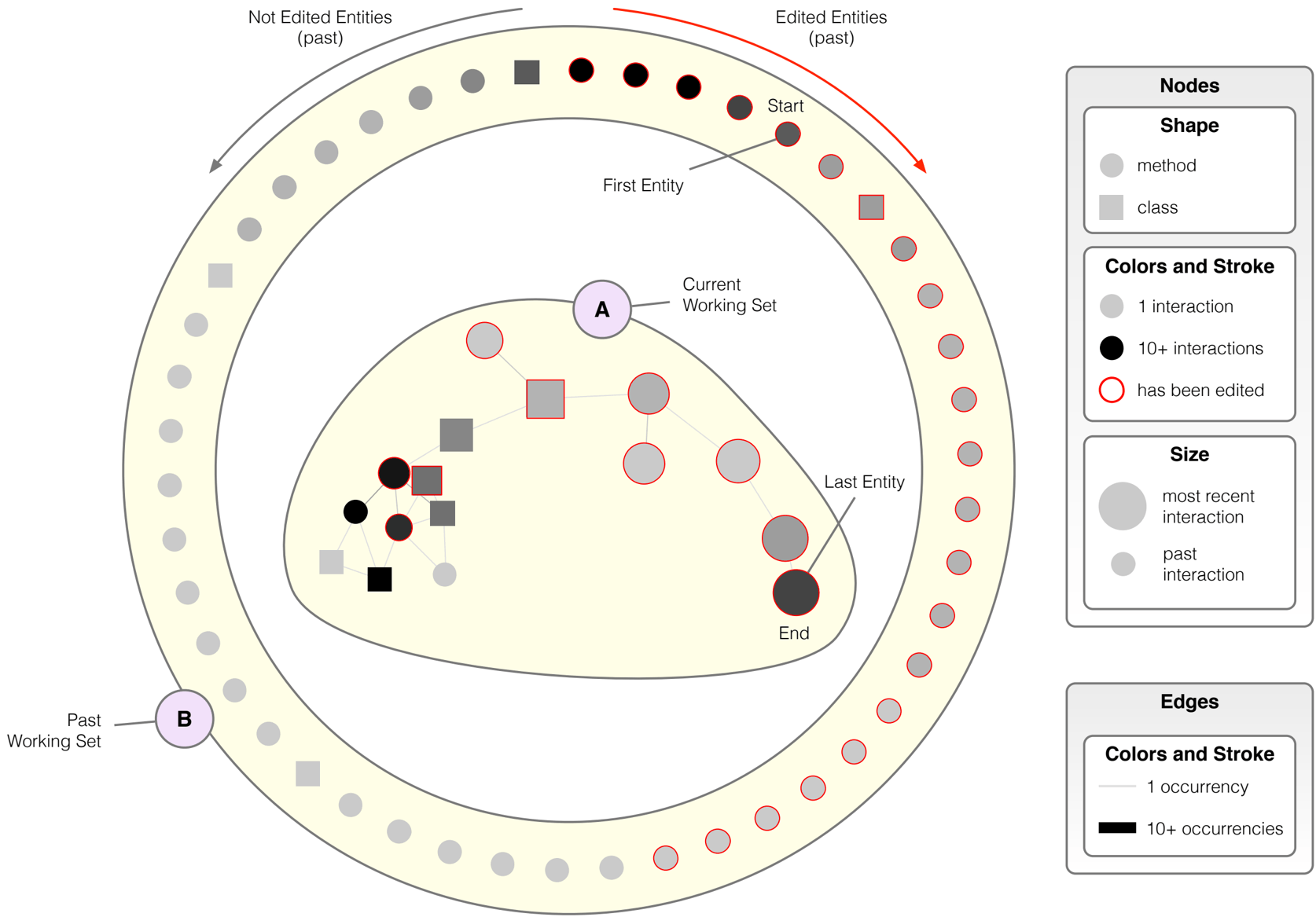
As part as their daily work, developers interact with Integrated Development Environments (IDE), generating thousands of events. Together with other aspects of development, this data also captures the modus operandi of the developer, including all the program entities she interacted with during a development session. This \"working set" (or context) is leveraged by developers to create and maintain their mental model of the software system at hand. Understanding how developers navigate and interact with source code during a development session is an open question. We present a novel visual approach to understand how working sets evolve during a development session. The visualization incrementally depicts all the program entities involved in a development session, the intensity of the developer activity on them, and the navigation paths that occurred between them. We visualized more than a thousand development sessions, and categorized them according to their visual properties.
What Makes a Satisficing Bug Report?
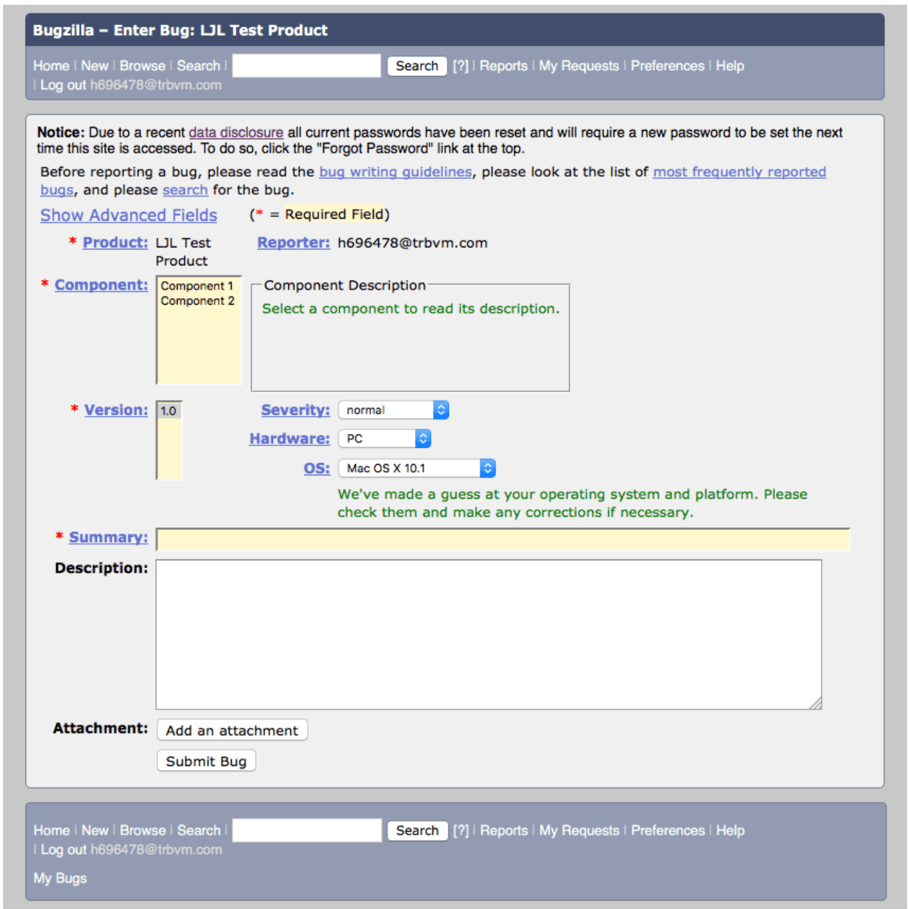
To ensure quality of software systems, developers use bug reports to track defects. It is in the interest of users and developers that bug reports provide the necessary information to ease the fixing process. Past research found that users do not provide the information that developers deem ideally useful to fix a bug. This raises an interesting question: What is the satisficing information to speed up the bug fixing process? We conducted an observational study on the relation between provided report information and its lifetime, considering more than 650,000 reports from open-source systems using popular bug trackers. We distilled a meta-model for a minimal bug report, establishing a basic layer of core features. We found that few fields influence the resolution time and that customized fields have little impact on it. We performed a survey to investigate what users deem easy to provide in a bug report.
Taming the IDE with Fine-grained Interaction Data
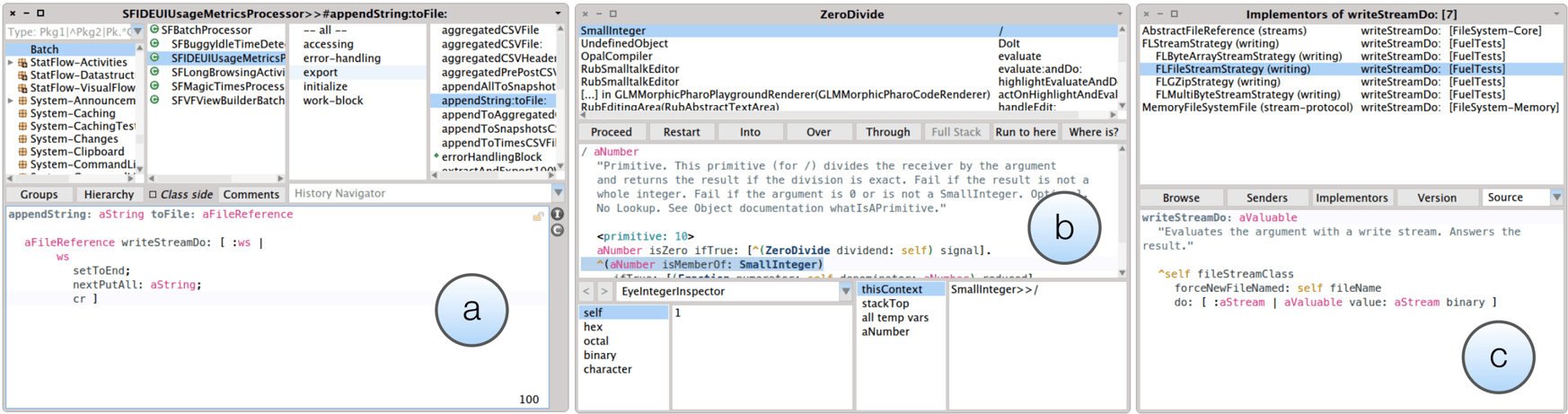
Integrated Development Environments (IDEs) lack effective support to browse complex relationships between source code elements. As a result, developers are often forced to exploit multiple user interface components at the same time, bringing the IDE into a complex, \"chaotic" state. Keeping track of these relationships demands increased source code navigation and cognitive load, leading to productivity deficits documented in observational studies. Beyond small-scale studies, the amount and nature of the chaos experienced by developers in the wild is unclear, and more importantly it is unclear how to tame it. Based on a dataset of fine-grained interaction data, we propose several metrics to characterize and quantify the "level of chaos" of an IDE. Our results suggest that developers spend, on average, more than 30% of their time in a chaotic environment, and that this may affect their productivity. To support developers, we devise and evaluate simple strategies that automatically alter the UI of the IDE. We find that even simple strategies may considerably reduce the level of chaos both in terms of effective space occupancy and time spent in a chaotic environment.
Too Long; Didn't Watch! Extracting Relevant Fragments from Software Development Video Tutorials
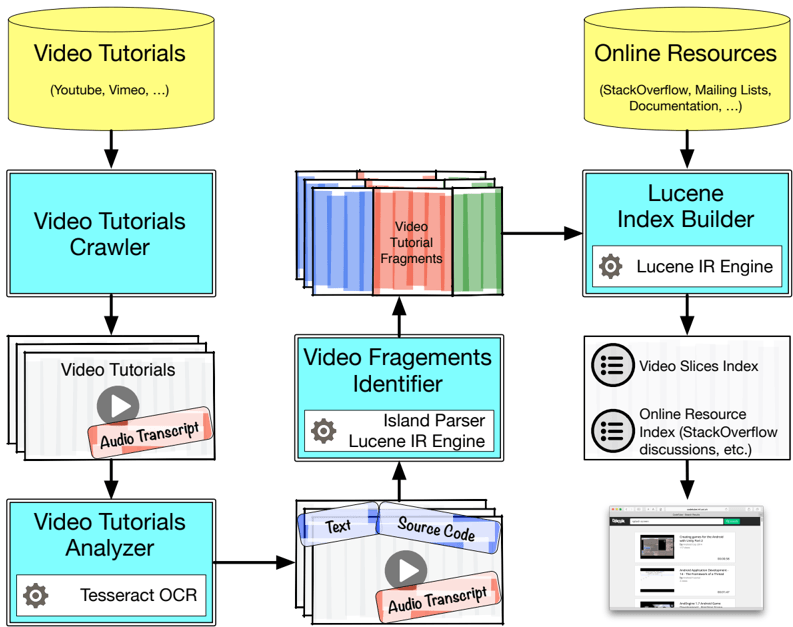
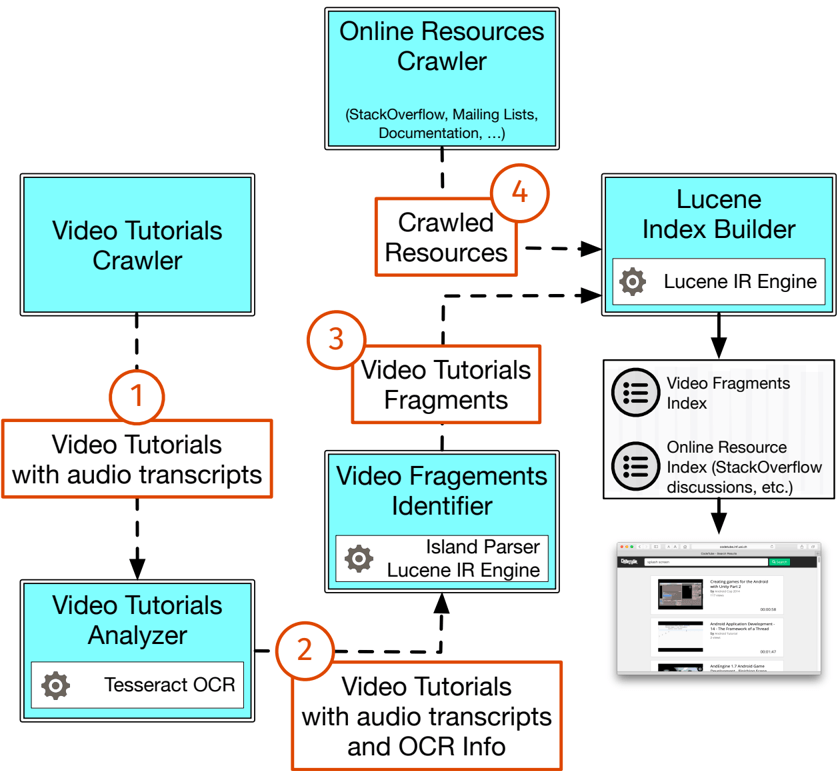
When knowledgeable colleagues are not available, developers resort to offline and online resources, e.g. tutorials, mailing lists, and Q&A websites. These, however, need to be found, read, and understood, which takes its toll in terms of time and mental energy. A more immediate and accessible resource are video tutorials found on the web, which in recent years have seen a steep increase in popularity. Nonetheless, videos are an intrinsically noisy data source, and finding the right piece of information might be even more cumbersome than using the previously mentioned resources. We present CodeTube, an approach which mines video tutorials found on the web, and enables developers to query their contents. The video tutorials are split into coherent fragments, to return only fragments related to the query. These are complemented with information from additional sources, such as Stack Overflow discussions. The results of two studies to assess CodeTube indicate that video tutorials - if appropriately processed - represent a useful, yet still under-utilized source of information for software development.
CodeTube: Extracting Relevant Fragments from Software Development Video Tutorials
Nowadays developers heavily rely on sources of informal documentation. Examples include Q&A forums, slides, or video tutorials, the latter being particularly useful to provide introductory notions for a piece of technology. The current practice is that developers have to browse sources individually, which in the case of video tutorials is cumbersome, as they are lengthy and cannot be searched based on their contents. We present CodeTube, a Web-based recommender system that analyzes the contents of video tutorials and is able to provide, given a query, cohesive and self-contained video fragments, along with links to relevant Stack Overflow discussions. CodeTube relies on a combination of textual analysis and image processing applied on video tutorial frames and speech transcripts to split videos into cohesive fragments, index them and identify related Stack Overflow discussions.
Use at Your Own Risk: The Java Unsafe API in the Wild
Java is a safe language. Its runtime environment provides strong safety guarantees that any Java application can rely on. Or so we think. We show that the runtime actually does not provide these guarantees—for a large fraction of today's Java code. Unbeknownst to many application developers, the Java runtime includes a \"backdoor" that allows expert library and framework developers to circumvent Java's safety guarantees. This backdoor is there by design, and is well known to experts, as it enables them to write high-performance systems-level code in Java. For much the same reasons that safe languages are preferred over unsafe languages, these powerful but unsafe capabilities in Java should be restricted. They should be made safe by changing the language, the runtime system, or the libraries. At the very least, their use should be restricted. This paper is a step in that direction. We analyzed 74 GB of compiled Java code, spread over 86,479 Java archives, to determine how Java’s unsafe capabilities are used in real-world libraries and applications. We found that 25% of Java bytecode archives depend on un- safe third-party Java code, and thus Java's safety guarantees cannot be trusted. We identify 14 different usage patterns of Java’s unsafe capabilities, and we provide supporting evidence for why real-world code needs these capabilities. Our long-term goal is to provide a foundation for the design of new language features to regain safety in Java.