Journal
Browse all content in this category
Automatic Identification and Classification of Software Development Video Tutorial Fragments
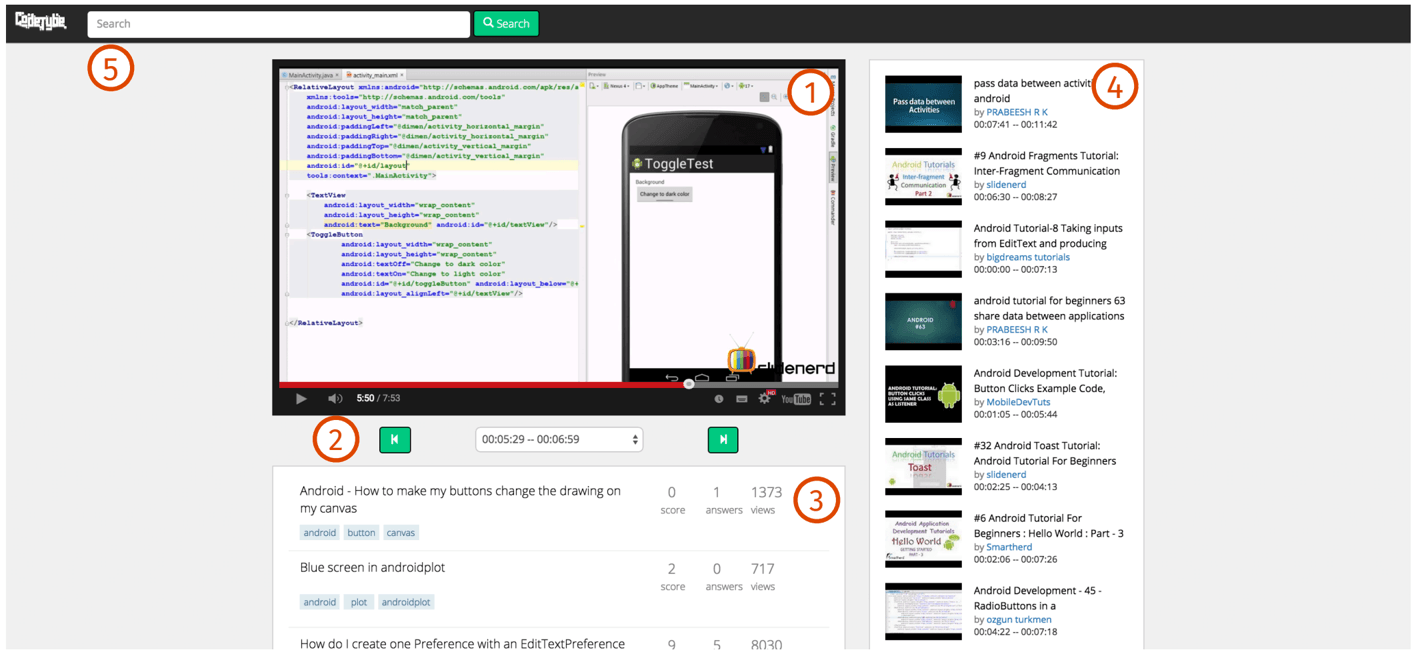
Software development video tutorials have seen a steep increase in popularity in recent years. Their main advantage is that they thoroughly illustrate how certain technologies, programming languages, etc. are to be used. However, they come with a caveat: there is currently little support for searching and browsing their content. This makes it difficult to quickly find the useful parts in a longer video, as the only options are watching the entire video, leading to wasted time, or fast-forwarding through it, leading to missed information. We present an approach to mine video tutorials found on the web and enable developers to query their contents as opposed to just their metadata. The video tutorials are processed and split into coherent fragments, such that only relevant fragments are returned in response to a query. Moreover, fragments are automatically classified according to their purpose, such as introducing theoretical concepts, explaining code implementation steps, or dealing with errors. This allows developers to set filters in their search to target a specific type of video fragment they are interested in. In addition, the video fragments in CodeTube are complemented with information from other sources, such as Stack Overflow discussions, giving more context and useful information for understanding the concepts.
Mining structured data in natural language artifacts with island parsing
Software repositories typically store data composed of structured and unstructured parts. Researchers mine this data to empirically validate research ideas and to support practitioners' activities. Structured data (e.g., source code) has a formal syntax and is straightforward to analyze; unstructured data (e.g., documentation) is a mix of natural language, noise, and snippets of structured data, and it is harder to analyze. Especially the structured content (e.g., code snippets) in unstructured data contains valuable information. Researchers have proposed several approaches to recognize, extract, and analyze structured data embedded in natural language. We analyze these approaches and investigate their drawbacks. Subsequently, we present two novel methods, based on scannerless generalized LR (SGLR) and Parsing Expression Grammars (PEGs), to address these drawbacks and to mine structured fragments within unstructured data. We validate and compare these approaches on development emails and Stack Overflow posts with Java code fragments. Both approaches achieve high precision and recall values, but the PEG-based one achieves better computational performances and simplicity in engineering.
The Tragedy of Defect Prediction, Prince of Empirical Software Engineering Research
If measured by the number of published papers, defect prediction has become an important research field over the past decade, with many researchers continuously proposing novel approaches to predict defects in software systems. However, most of these approaches have had a noticeable lack of impact on industrial practice. This lack of impact is because something is intrinsically wrong in how defect prediction approaches are evaluated.
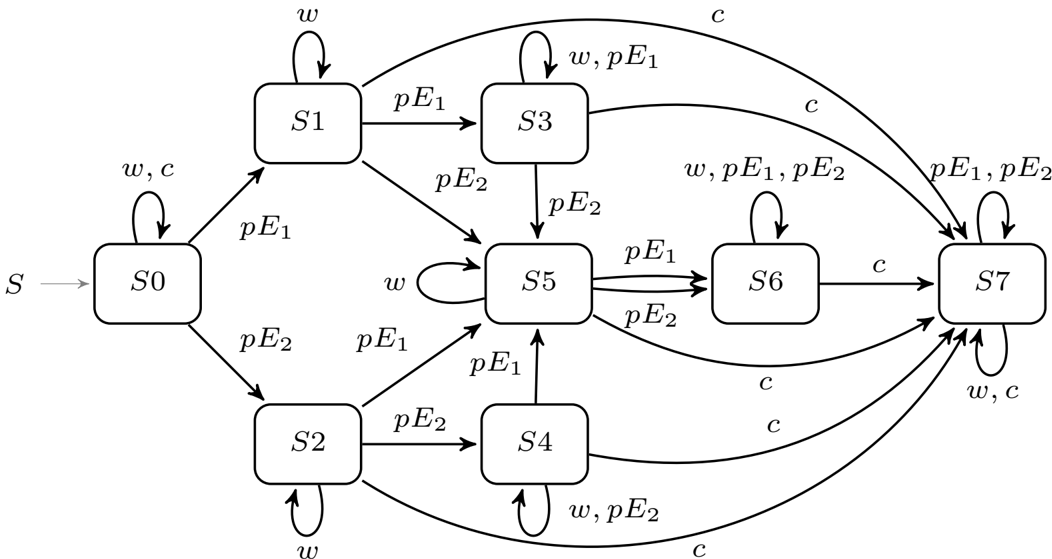
Detecting component changes at run time with behavior models
Modern software systems are composed of several services which may be developed and maintained by third parties and thus they can change independently and without notice during the system’s runtime execution. In such systems, changes may possibly be a threat to system functional correctness, and thus to its reliability. Hence, it is important to detect them as soon as they happen to enable proper reaction. Change detection can be done by monitoring system execution and comparing the observed execution traces against models of the services composing the application. Unfortunately, formal specifications for services are not usually provided and developers have to infer them. In this paper we propose a methodology which exactly addresses these issues by using software behavior models to monitor component execution and detect changes. In particular, we describe a technique to infer behavior model specifications with a dynamic black box approach, keep them up-to-date with run time observations and detect behavior changes. Finally, we present a case study to validate the effectiveness of the approach in component change detection for a component that implements a complex, real communication protocol.