AI & LLMs
Browse all content with this tag
A Taxonomy of Design Quality in Super Mario Maker 2
Thanks to its popularity, Super Mario Maker 2 (SMM2) features myriad user-designed platforming levels that span a broad range of styles, genres, difficulty, and quality. This paper is a first attempt at charting out this vast landscape of levels, with the goal of exploring the main concepts that characterize design quality. To this end, we first selected 500 videos by popular YouTube streamers that play SMM2 levels. With the help of an LLM, we extracted and clustered by topic segments where the streamer comments about the design of the level they are playing. Then, we applied a grounded theory coding process to extract the concepts emerging in these segments, and we combined and organized them hierarchically. The resulting taxonomy identifies the main abstract concepts that pertain to the design of a level in SMM2 and its resulting quality, as well as several concrete elements of the game that belong to each abstract category. Besides illustrating the underlying dimensions that characterize design quality in SMM2, our results also illuminate the diverse landscape of player-designed levels in the game.
FairLex: AI-Based Assistant for Legal Compliance and Sustainability Challenges in the Fashion Industry
Francesco De Vito · Master of Science in Software & Data Engineering
A Customized RAG-Based Chatbot for iCorsi
Gianluca Maragliano · Master of Science in Software & Data Engineering
Large Language Models for Automated Requirement Classification
Loren Shukry · Bachelor of Science in Informatics
AI-Driven Analysis and Optimization of Fairness in Competitive Video Games
Federico Lagrasta · Master of Science in Informatics
Mining a Century of Swiss Trademark Data
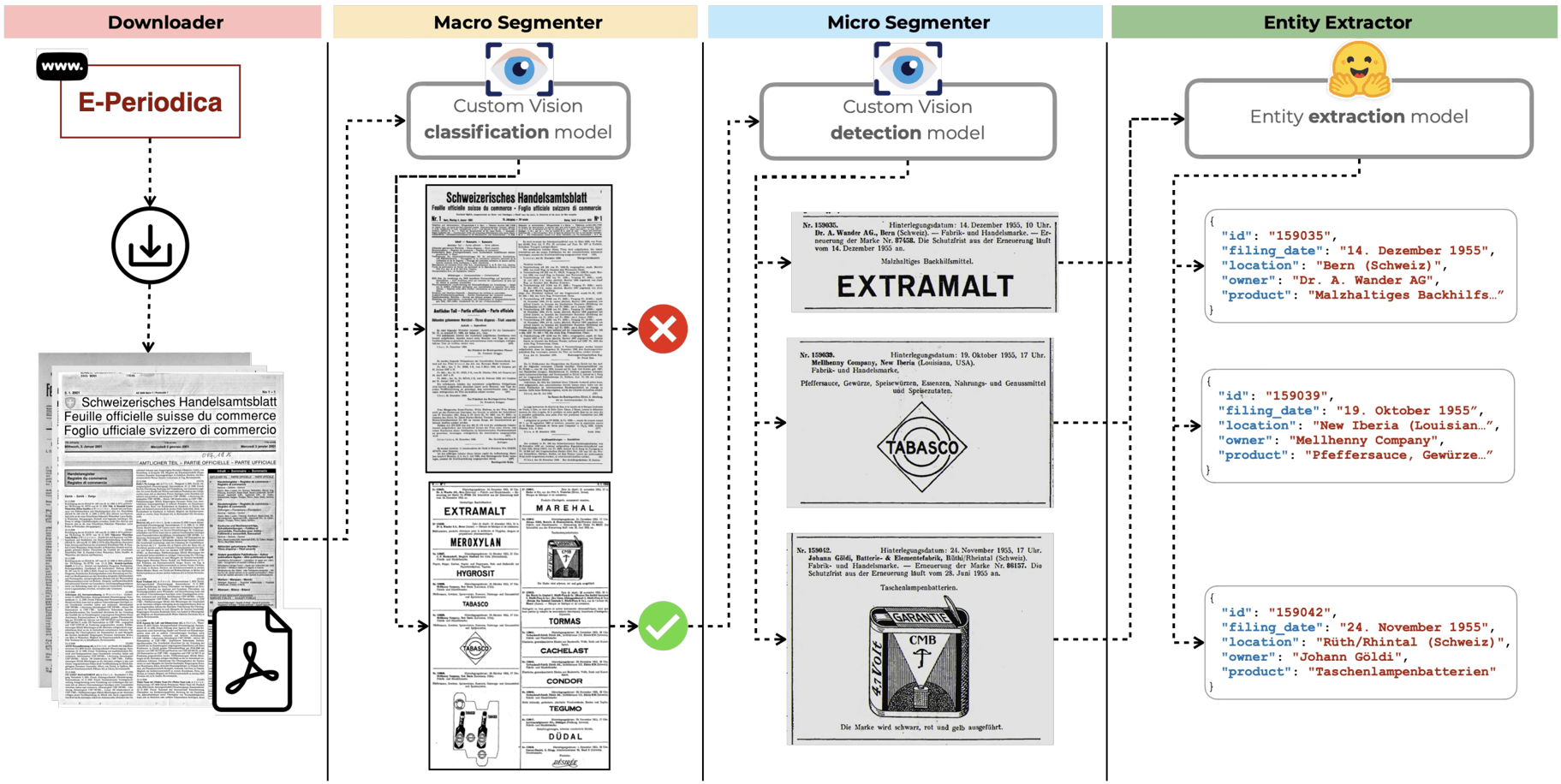
This paper presents an approach for extracting trademark registration events from the Swiss Official Gazette of Commerce (SOGC), an official daily journal published by the Swiss Confederation since January 1883. Until 2001, the data is only available as scanned documents, which constitute the target dataset of this study. Our approach is composed of a chain of three steps based on state-of-the-art deep learning techniques. We leverage image classification to identify pages containing trademarks (macro segmentation); we apply object detection to identify the portion of the page corresponding to a registration event (micro segmentation); last, we perform information extraction using a document AI technique. We obtain a dataset of ca. 500,000 trademark registration events, extracted from a corpus of 430,000 pages. Each step of our workflow has relatively high accuracy: the macro and micro segmentation steps show precision and recall greater than 95% on a manually constructed dataset. The dataset offers a unique historical perspective on trademark registrations in Switzerland that is not available from any other source. Showcasing what can be achieved with the extracted information, we provide answers to a set of preliminary economics questions.
Sphere Two: Swiss Pavilion @ Expo 2025
An interactive art-science installation for the Swiss Pavilion at Expo 2025 that turns visitors' spoken wishes into floating soap bubbles.

Mining A Century of Swiss Trademarks
Daniel Travaglia · Master of Science in Software & Data Engineering