Behavior Models
Browse all content with this tag
Synthesis of Infinite-State Abstractions and Their Use for Software Validation
In the recent years, several research efforts have been devoted to developing approaches to synthesize specifications of software behavior. Most of the proposed approaches addressed the inference of finite-state abstractions. The synthesized abstractions have been integrated in different validation scenarios, such as testing. While finite-state models can be effectively used as models of a software component’s behavior for certain specific purposes, they can hardly be used as full-fledged specifications. Because of their very limited expressive power, they cannot represent some of the component behaviors and may lead to synthesizing too coarse abstractions. In this paper, we survey a set of approaches that instead infer infinite-state abstractions, which can be used to express richer sets of behaviors of a software component in a black-box manner. For such approaches, we also discuss the few existing applications to software validation. In particular, we discuss the limitations and identify how, in principle, they can be used in different validation scenarios and how this opens new research directions.
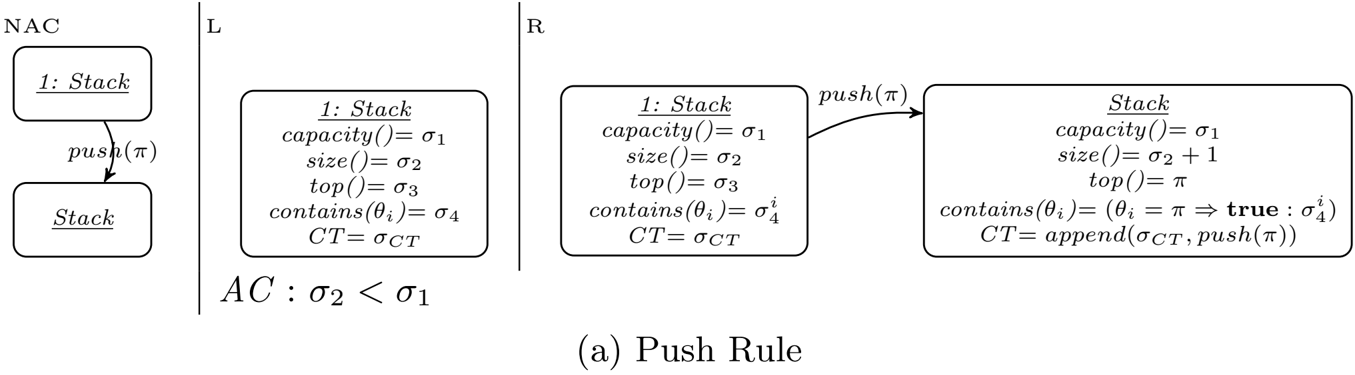
Behavioral validation of JFSL specifications through model synthesis
Contracts are a popular declarative specification technique to describe the behavior of stateful components in terms of pre/post conditions and invariants. Since each operation is specified separately in terms of an abstract implementation, it may be hard to understand and validate the resulting component behavior from contracts in terms of method interactions. In particular, properties expressed through algebraic axioms, which specify the effect of sequences of operations, require complex theorem proving techniques to be validated. In this paper, we propose an automatic small-scope based approach to synthesize incomplete behavioral abstractions for contracts expressed in the JFSL notation. The proposed abstraction technique enables the possibility to check that the contract behavior is coherent with behavioral properties expressed as axioms of an algebraic specifications. We assess the applicability of our approach by showing how the synthesis methodology can be applied to some classes of contract-based artifacts like specifications of data abstractions and requirement engineering models.
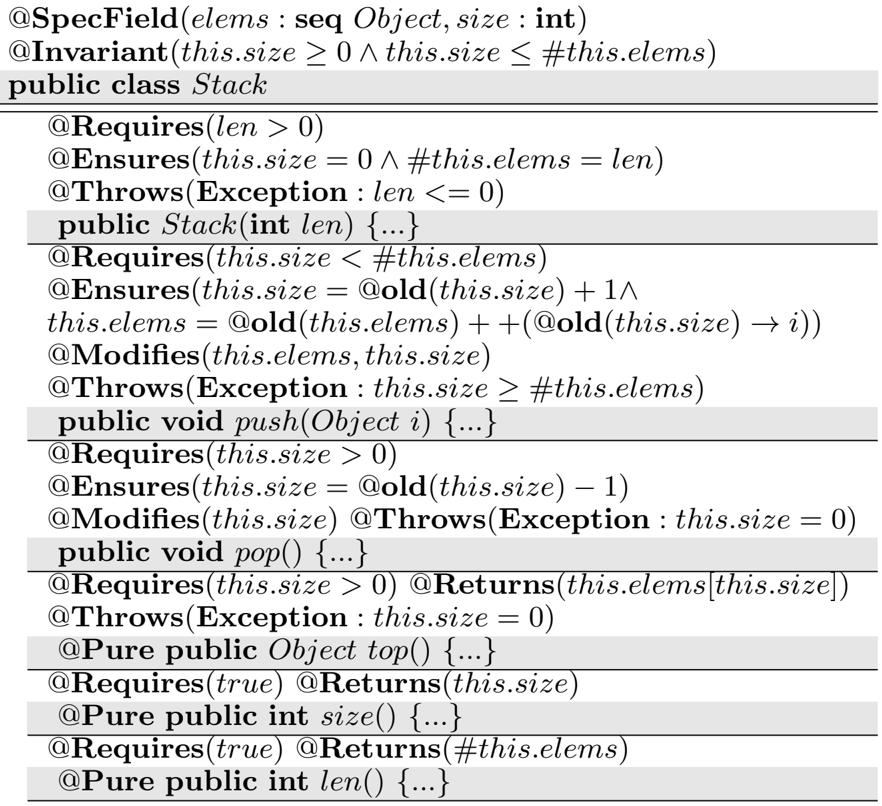
Runtime Monitoring of Component Changes with Spy@Runtime
We present Spy@Runtime, a tool to infer and work with behavior models. Spy@Runtime generates models through a dynamic black box approach and is able to keep them updated with observations coming from actual system execution. We also show how to use models describing the protocol of interaction of a software component to detect and report functional changes as soon as they are discovered. Monitoring functional properties is particularly useful in an open environment in which there is a distributed ownership of a software system. Parts of the system may be changed independently and therefore it becomes necessary to monitor the component's behavior at run time.
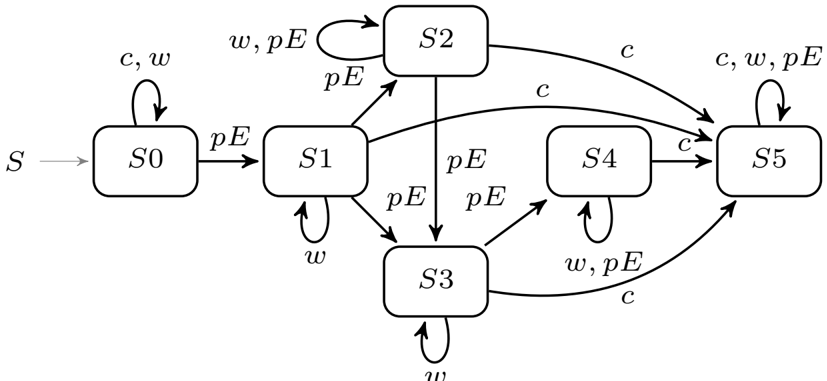
Automatic Cross Validation of Multiple Specifications: A Case Study
The problem of formal software specification has been addressed and discussed since the infancy of software engineering. However, among all the proposed solutions, none is universally accepted yet. Many different formal descriptions can in fact be given for the same software component; thus, the problem of determining the consistency relation among those descriptions becomes relevant and potentially critical. In this work, we propose a method for comparing two specific kinds of formal specifications of containers. In particular, we check the consistency of intensional behavior models with algebraic specifications. The consistency check is performed by generating a behavioral equivalence model from the intensional model, converting the algebraic axioms into temporal logic formulae, and then checking them against the model by using the NuSMV model checker. An automated software tool which encodes the problem as model checking has been implemented to check the consistency of recovered specifications of relevant Java classes.
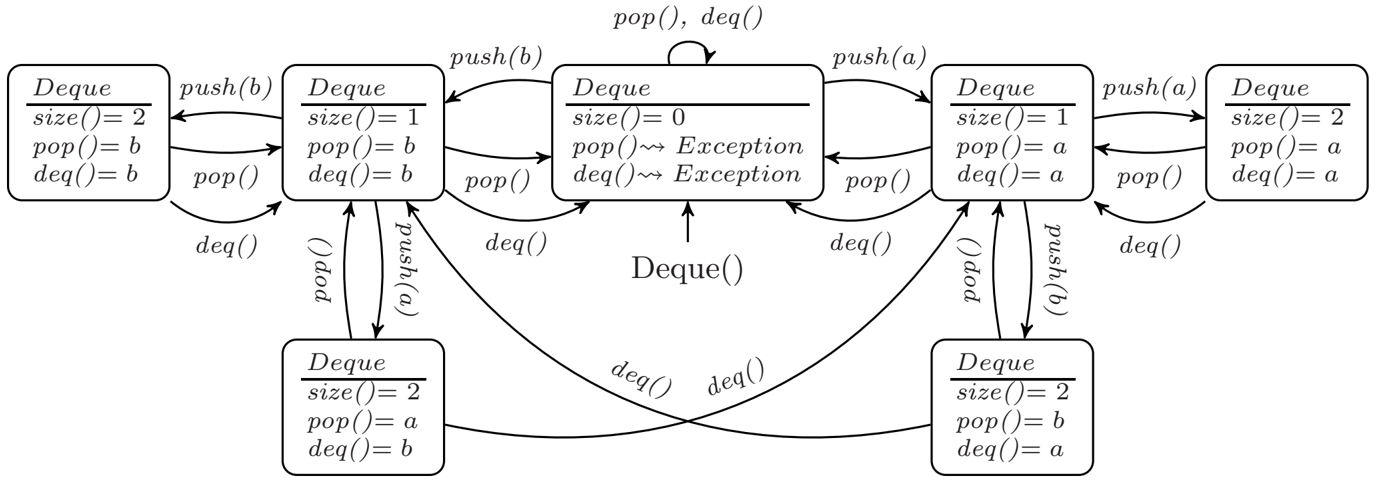
Synthesizing intensional behavior models by graph transformation
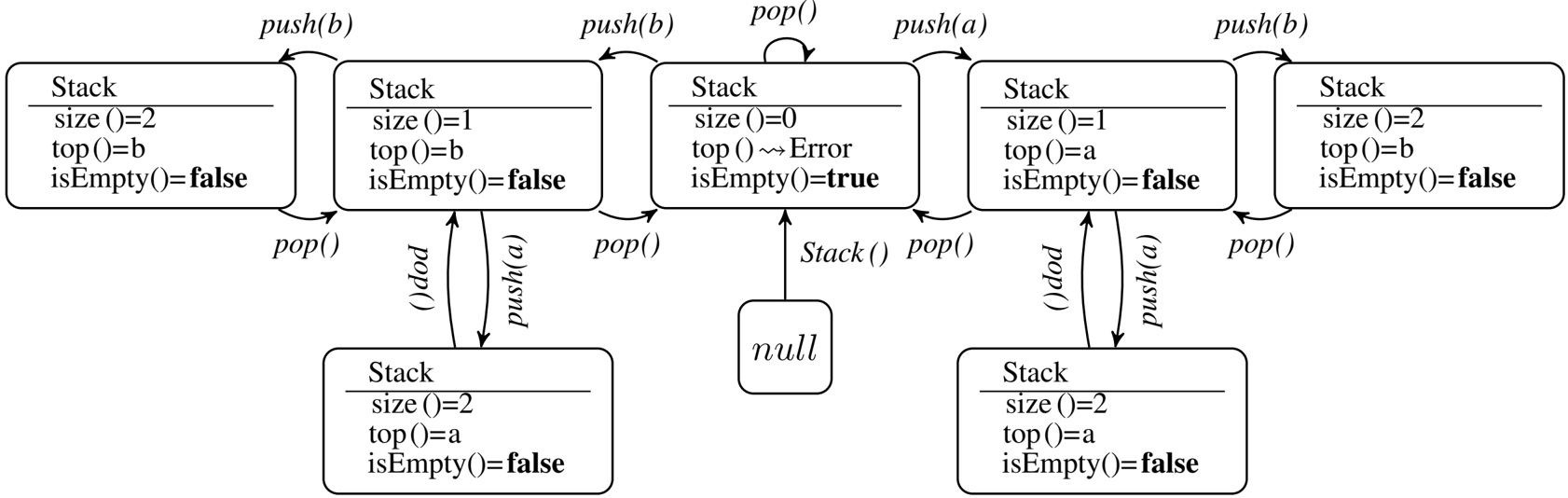
This paper describes an approach (SPY) to recover the specification of a software component from the observation of its run-time behavior. It focuses on components that behave as data abstractions. Components are assumed to be black boxes that do not allow any implementation inspection. The inferred description may help understand what the component does when no formal specification is available. SPY works in two main stages. First, it builds a deterministic finite-state machine that models the partial behavior of instances of the data abstraction. This is then generalized via graph transformation rules. The rules can generate a possibly infinite number of behavior models, which generalize the description of the data abstraction under an assumption of “regularity” with respect to the observed behavior. The rules can be viewed as a likely specification of the data abstraction. We illustrate how SPY works on relevant examples and we compare it with competing methods.
SPY
SPecification RecoverY: inferring behavior models of stateful software components, and using them at run time to detect when a component's behavior changes