Developer Productivity
Browse all content with this tag
Visualizing Interaction Data Inside & Outside the IDE to Characterize Developer Productivity
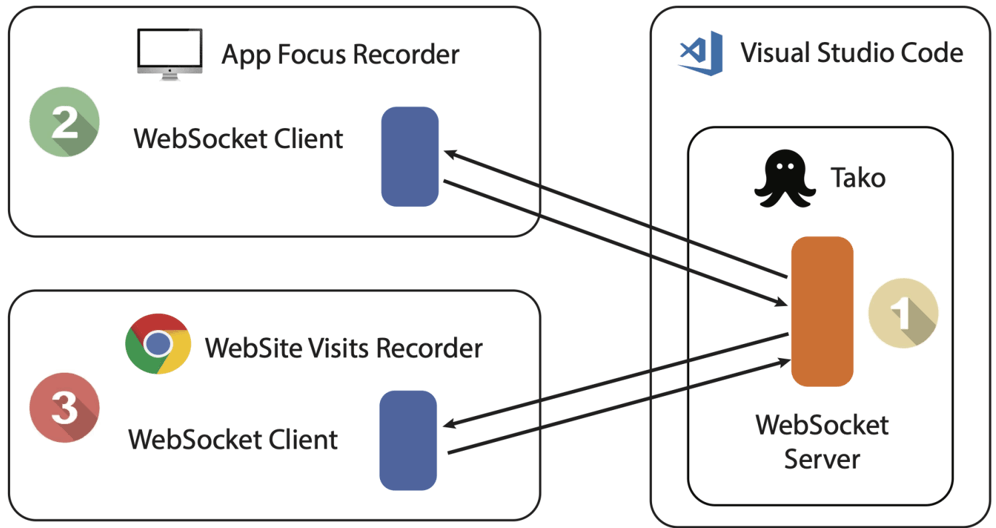
Work fragmentation is a common phenomenon in the workspace, and is detrimental to the actual work taking place. To measure and study the impact of work fragmentation in software development, several studies exploited interaction data, i.e., the data generated by the events performed by the developers in the IDE. However, the absence of information on activities performed outside the IDE could lead to a misclassification of development time. In fact, sometimes leaving the IDE is not an interruption of the task at hand, e.g., when consulting API documentation, or when discussing with colleagues in ad-hoc collaboration applications. In this paper, we propose Ferax, a data analytics platform that developers can leverage for retrospection and possibly to improve their productivity. The capabilities of Ferax are twofold: First, it extends Tako, a profiler to record IDE interaction data for Visual Studio Code, with information about which applications were used and which websites were visited. Second, to enable the understanding of productivity and interruptions on developer sessions, Ferax provides interactive visualizations that show the detailed sequence of events inside and outside the IDE, the switches the developer performs by classifying them as productive or possible interruptions, and the time distribution for application usage. As a preliminary evaluation of Ferax we have collected and analyzed real development sessions from a set of master students and two professional developers. We illustrate how a developer can leverage Ferax to characterize her usual habits, to elicit the impact of interruptions, and to better characterize sessions which were only apparently unproductive.
Characterizing and Visualizing Development Fragmentation with Interaction Data
Aldo Gabriele Di Rosa · Master of Science in Software & Data Engineering
Interaction-Aware Development Environments: Recording, Mining, and Leveraging IDE Interactions to Analyze and Support the Development Flow
Roberto Minelli · Doctor of Philosophy in Informatics
Supporting Software Developers with a Holistic Recommender System
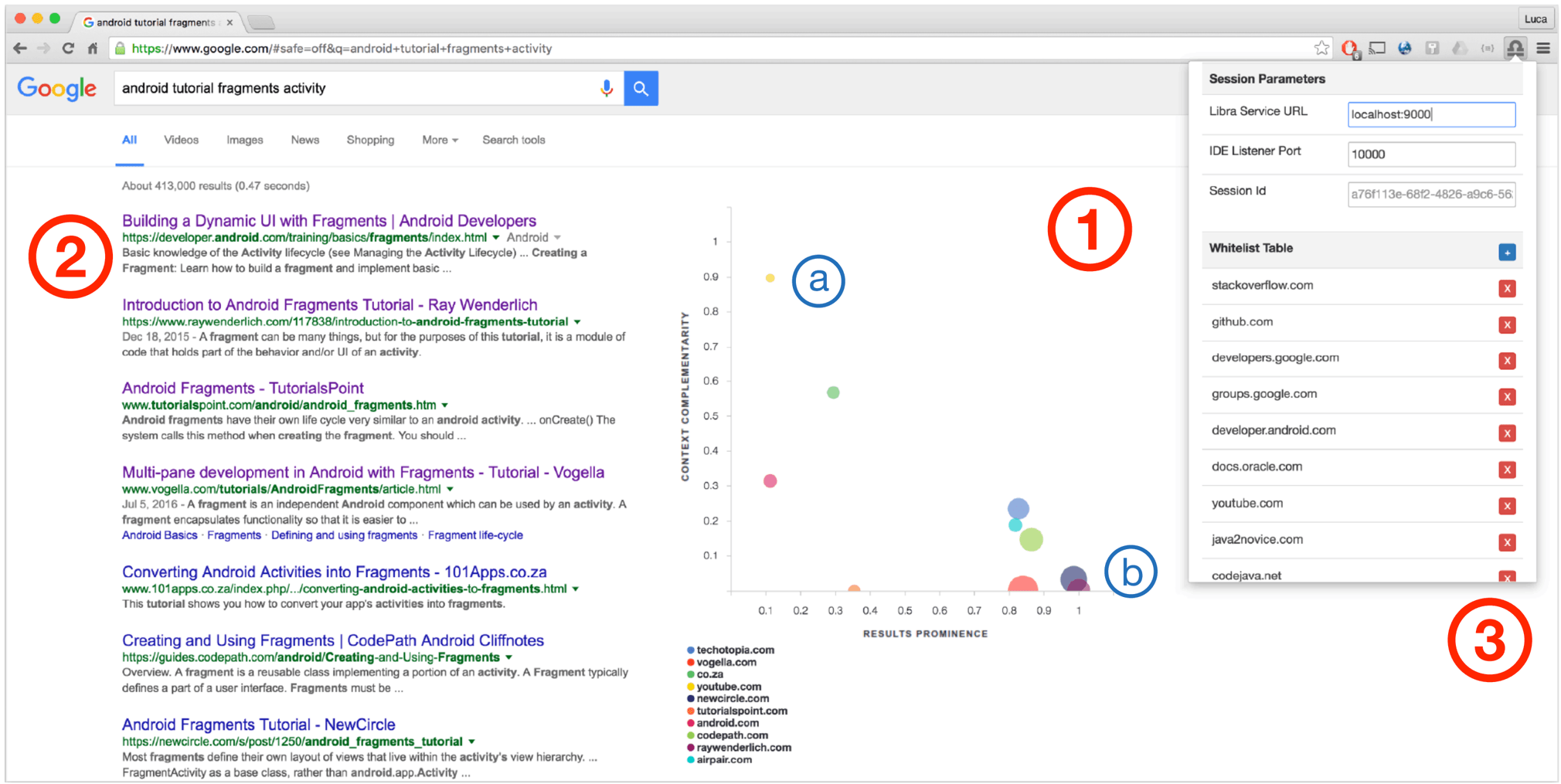
The promise of recommender systems is to provide intelligent support to developers during their programming tasks. Such support ranges from suggesting program entities to taking into account pertinent QnA pages. However, current recommender systems limit the context analysis to change history and developers' activities in the IDE, without considering what a developer has already consulted or perused, e.g., by performing searches from the Web browser. Given the faceted nature of many programming tasks, and the incompleteness of the information provided by a single artifact, several heterogeneous resources are required to obtain the broader picture needed by a developer to accomplish a task. We present Libra, a holistic recommender system. It supports the process of searching and navigating the information needed by constructing a holistic meta-information model of the resources perused by a developer, analyzing their semantic relationships, and augmenting the web browser with a dedicated interactive navigation chart. The quantitative and qualitative evaluation of Libra provides evidence that a holistic analysis of a developer's information context can indeed offer comprehensive and contextualized support to information navigation and retrieval during software development.
Taming the IDE with Fine-grained Interaction Data
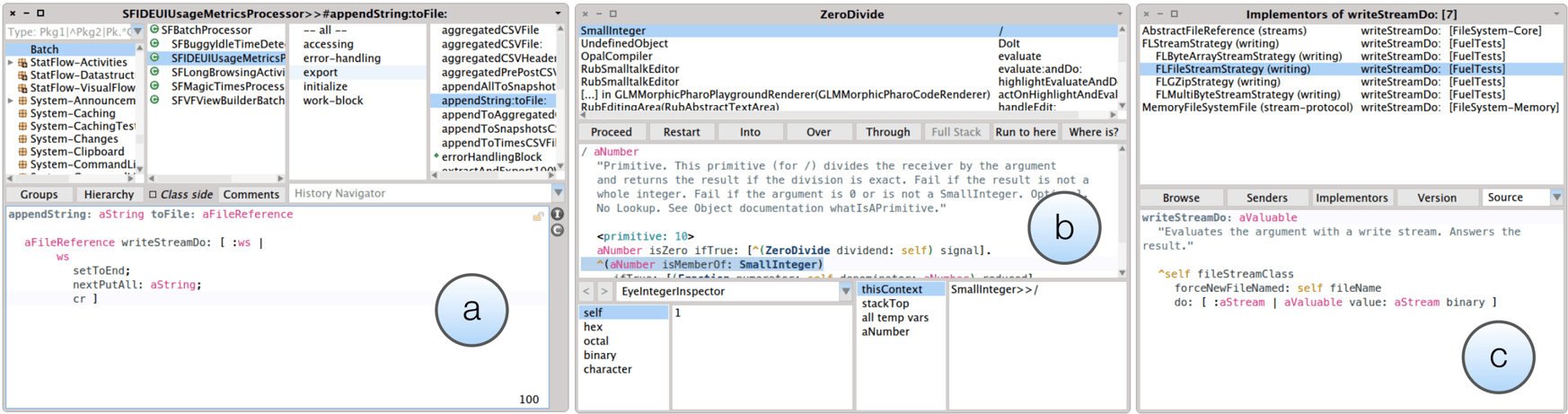
Integrated Development Environments (IDEs) lack effective support to browse complex relationships between source code elements. As a result, developers are often forced to exploit multiple user interface components at the same time, bringing the IDE into a complex, \"chaotic" state. Keeping track of these relationships demands increased source code navigation and cognitive load, leading to productivity deficits documented in observational studies. Beyond small-scale studies, the amount and nature of the chaos experienced by developers in the wild is unclear, and more importantly it is unclear how to tame it. Based on a dataset of fine-grained interaction data, we propose several metrics to characterize and quantify the "level of chaos" of an IDE. Our results suggest that developers spend, on average, more than 30% of their time in a chaotic environment, and that this may affect their productivity. To support developers, we devise and evaluate simple strategies that automatically alter the UI of the IDE. We find that even simple strategies may considerably reduce the level of chaos both in terms of effective space occupancy and time spent in a chaotic environment.
I Know What You Did Last Summer -- An Investigation of How Developers Spend Their Time
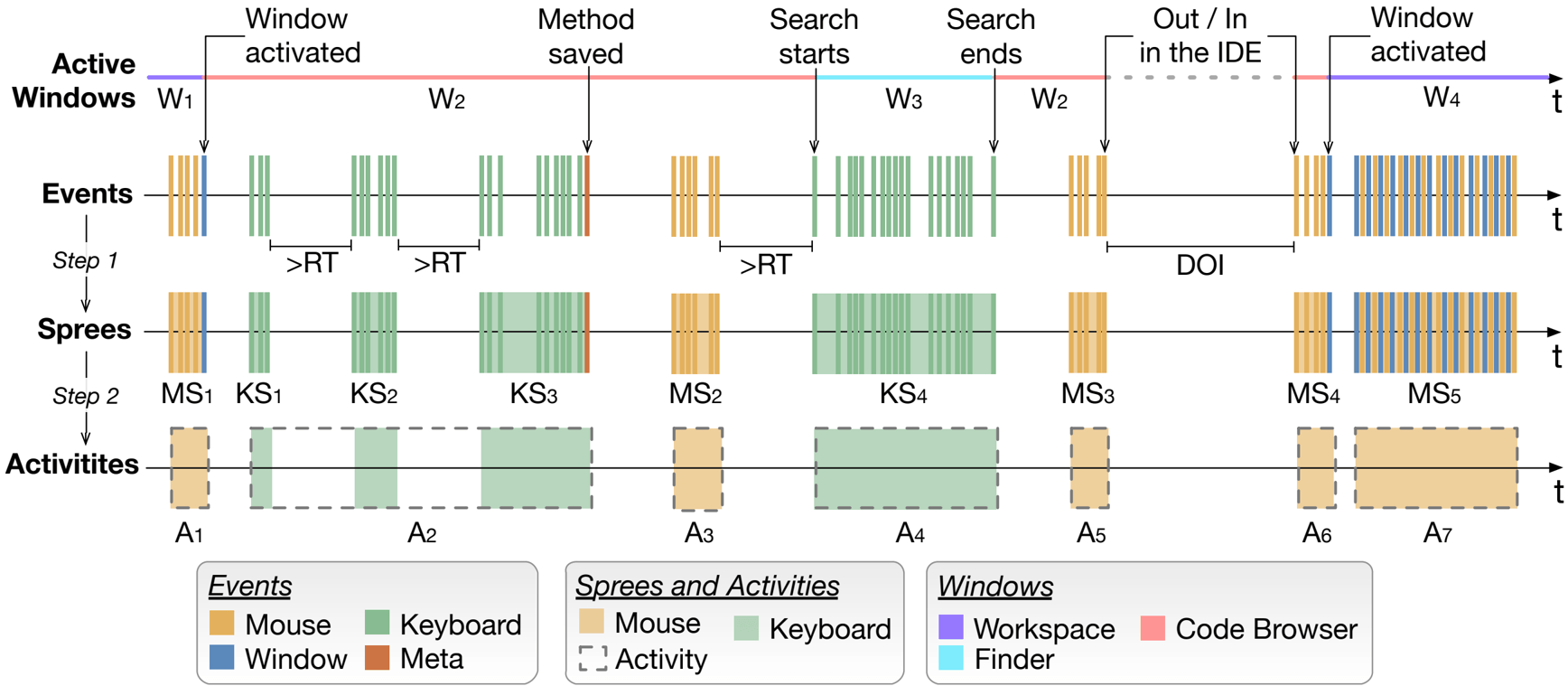
Developing software is a complex mental activity, requiring extensive technical knowledge and abstraction capabilities. The tangible part of development is the use of tools to read, inspect, edit, and manipulate source code, usually through an IDE (integrated development environment). Common claims about software development include that program comprehension takes up half of the time of a developer, or that certain UI (user interface) paradigms of IDEs offer insufficient support to developers. Such claims are often based on anecdotal evidence, throwing up the question of whether they can be corroborated on more solid grounds. We present an in-depth analysis of how developers spend their time, based on a fine-grained IDE interaction dataset consisting of ca. 740 development sessions by 18 developers, amounting to 200 hours of development time and 5 million of IDE events. We propose an inference model of development activities to precisely measure the time spent in editing, navigating and searching for artifacts, interacting with the UI of the IDE, and performing corollary activities, such as inspection and debugging. We report several interesting findings which in part confirm and reinforce some common claims, but also disconfirm other beliefs about software development.
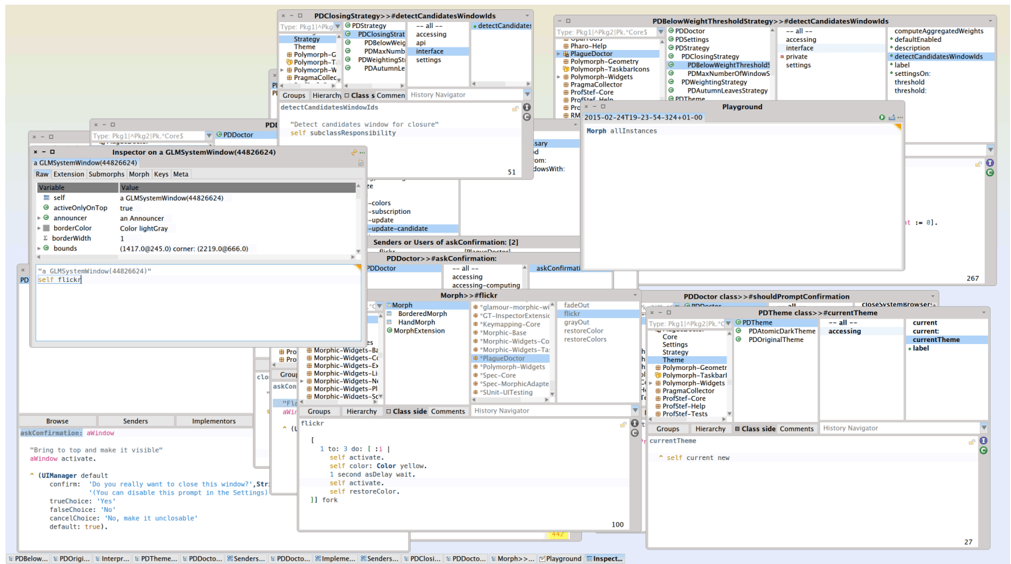
The Plague Doctor: A Promising Cure for the Window Plague
Modern Integrated Development Environments (IDEs) are often affected by the \"window plague", an overly crowded workspace with many open windows and tabs. The main cause is the lack of navigation support in IDEs, also due to the many - and not always obvious - complex relationships that exist between program entities. Researchers have shown that it is possible to mitigate the window plague by exploiting the data obtained by monitoring how developers interact with the user interface of the IDE. However, despite initial results the approach was never fully integrated in an IDE. In our previous work, we implemented DFLOW, an automatic interaction profiler that monitors all the fine-grained interactions of the developer with the IDE. Here we present a first prototype of the PLAGUE DOCTOR, a tool that seamlessly detects the windows that are less likely to be used in the future and automatically closes them. We discuss our long term vision on how to fully exploit the interaction data recorded by DFLOW to provide a more effective cure for the window plague.