ERA Track
Browse all content with this tag
The Plague Doctor: A Promising Cure for the Window Plague
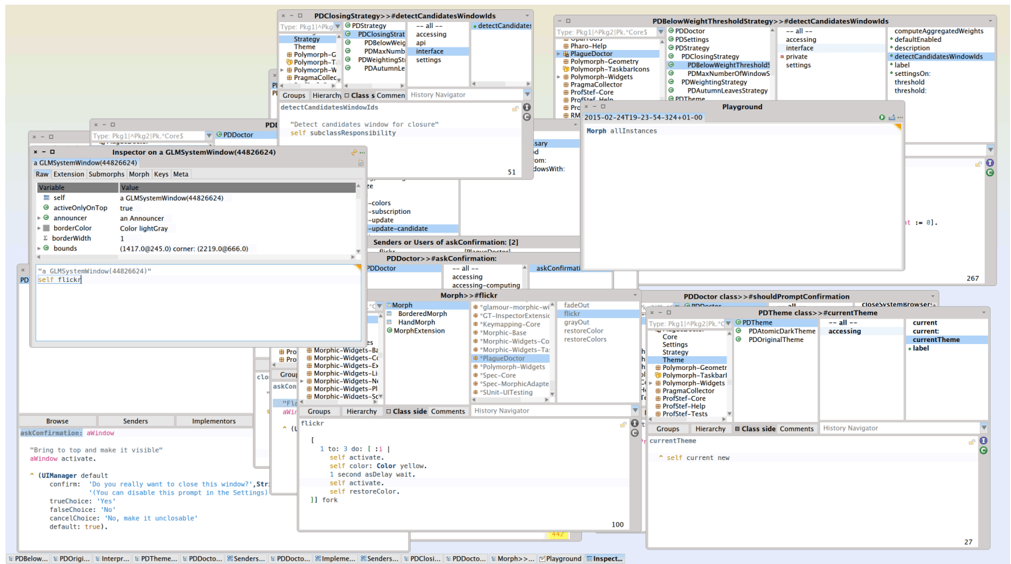
Modern Integrated Development Environments (IDEs) are often affected by the \"window plague", an overly crowded workspace with many open windows and tabs. The main cause is the lack of navigation support in IDEs, also due to the many - and not always obvious - complex relationships that exist between program entities. Researchers have shown that it is possible to mitigate the window plague by exploiting the data obtained by monitoring how developers interact with the user interface of the IDE. However, despite initial results the approach was never fully integrated in an IDE. In our previous work, we implemented DFLOW, an automatic interaction profiler that monitors all the fine-grained interactions of the developer with the IDE. Here we present a first prototype of the PLAGUE DOCTOR, a tool that seamlessly detects the windows that are less likely to be used in the future and automatically closes them. We discuss our long term vision on how to fully exploit the interaction data recorded by DFLOW to provide a more effective cure for the window plague.
Towards Visual Reflexion Models
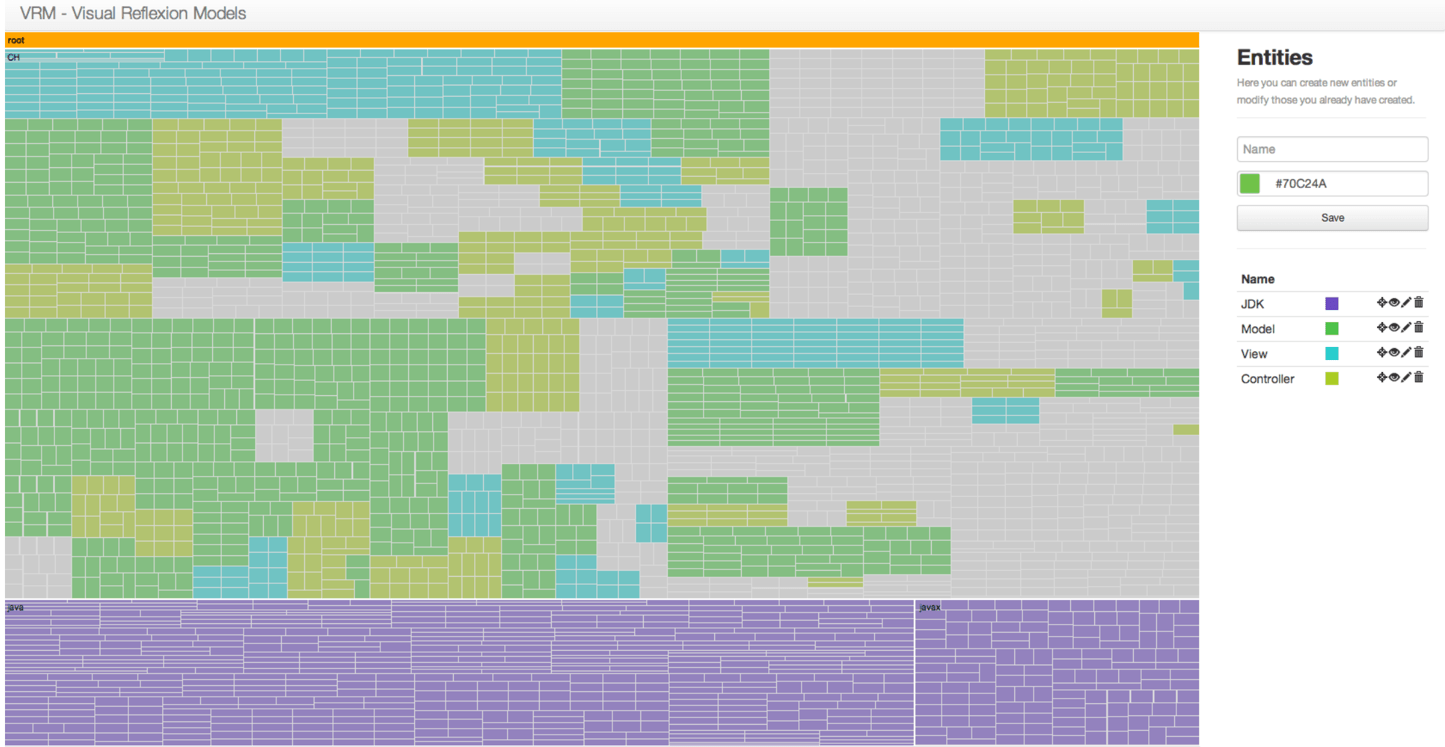
Source code and models of a software system, like architectural views, tend to evolve separately and drift apart over time. Previous research has shown that it is possible to effectively relate them through a reflexion model, defined as a \"summarization of a software system from the viewpoint of a particular high-level model". While effective, the process of constructing and analyzing reflexion models was supported by text-based tools with limited visual representation. With the original approach, it was relatively hard to understand which parts of the system were represented, and which parts of the system contributed to specific relations in the reflexion model. We present our vision on augmenting the construction and analysis of reflexion models with visual support, effectively providing the basis for visual reflexion models. We describe our approach, implemented as a web-based application, and two promising case studies involving two open-source projects.
Visual Storytelling of Development Sessions
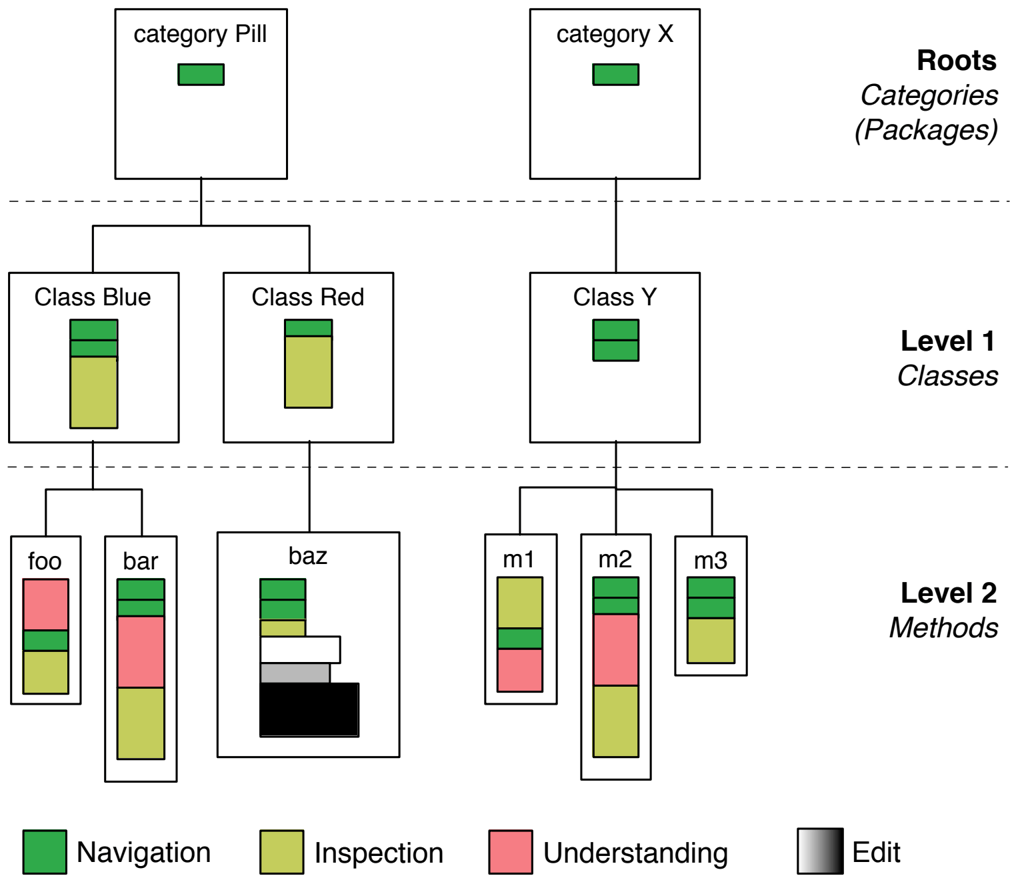
Most development activities, like program understanding, source code navigation and editing, are supported by Integrated Development Environments (IDEs). They provide different tools and user interfaces (UI) to interact with the source code, such as browsers, debuggers, and inspectors. It is uncertain how and when programmers use different UI elements of an IDE and to what extent they appropriately support development. Previously we developed DFLOW, a tool that seamlessly records and processes interaction data. Our long-term goal is to assess to what extent the UIs of IDEs support the workflow of developers and whether they can be improved. As a first step we present our approach to analyze development sessions in the form of visual storytelling. We illustrate our initial catalogue of visualizations through two development stories.
Improving Low Quality Stack Overflow Post Detection
Stack Overflow is a popular questions and answers (Q&A) website among software developers. It counts more than two millions of users who actively contribute by asking and answering thousands of questions daily. Identifying and reviewing low quality posts preserves the quality of site's contents and it is crucial to maintain a good user experience. In Stack Overflow the identification of poor quality posts is performed by selected users manually. The system also uses an automated identification system based on textual features. Low quality posts automatically enter a review queue maintained by experienced users. We present an approach to improve the automated system in use at Stack Overflow. It analyzes both the content of a post (e.g., simple textual features and complex readability metrics) and community-related aspects (e.g., popularity of a user in the community). Our approach reduces the size of the review queue effectively and removes misclassified good quality posts.
Mining Unit Tests for Code Recommendation
Developers spend a significant portion of their time understanding and learning the correct usage of the APIs of libraries they want to integrate in their projects. However, learning how to effectively use APIs is complex and time consuming. Code recommendation systems play a crucial role facilitating developers in this task by providing to them relevant examples while they code. This paper proposes a novel approach to code recommendation in which code examples are automatically obtained by mining and manipulating unit tests. In this paper we discuss the theoretical and practical implications that underpin this idea. The discussion leads to a series of fascinating research challenges that we organized in a research agenda.
Collaboration in Open-source Projects: Myth or Reality?
One of the fundamental principles of open-source projects is that they foster collaboration among developers, disregarding their geographical location or personal background. When it comes to software repositories collaboration is a rather ephemeral phenomenon which lacks a clear definition, and it must therefore be mined and modeled. This throws up the question whether what is mined actually maps to reality. In this paper we investigate collaboration by modeling it using a number of diverse approaches that we then compare to a ground truth obtained by surveying a substantial set of developers of the Pharo open-source community. Our findings indicate that the notion of collaboration must be revisited, as it is undermined by a number of factors that are often tackled in imprecise ways or not taken into account at all.
Extracting structured data from natural language documents with island parsing
The design and evolution of a software system leave traces in various kinds of artifacts. In software, produced by humans for humans, many artifacts are written in natural language by people involved in the project. Such entities contain structured information which constitute a valuable source of knowledge for analyzing and comprehending a system's design and evolution. However, the ambiguous and informal nature of narrative is a serious challenge in gathering such information, which is scattered throughout natural language text. We present an approach-based on island parsing-to recognize and enable the parsing of structured information that occur in natural language artifacts. We evaluate our approach by applying it to mailing lists pertaining to three software systems. We show that this approach allows us to extract structured data from emails with high precision and recall.