ICPC
Browse all content with this tag
The Code Time Machine
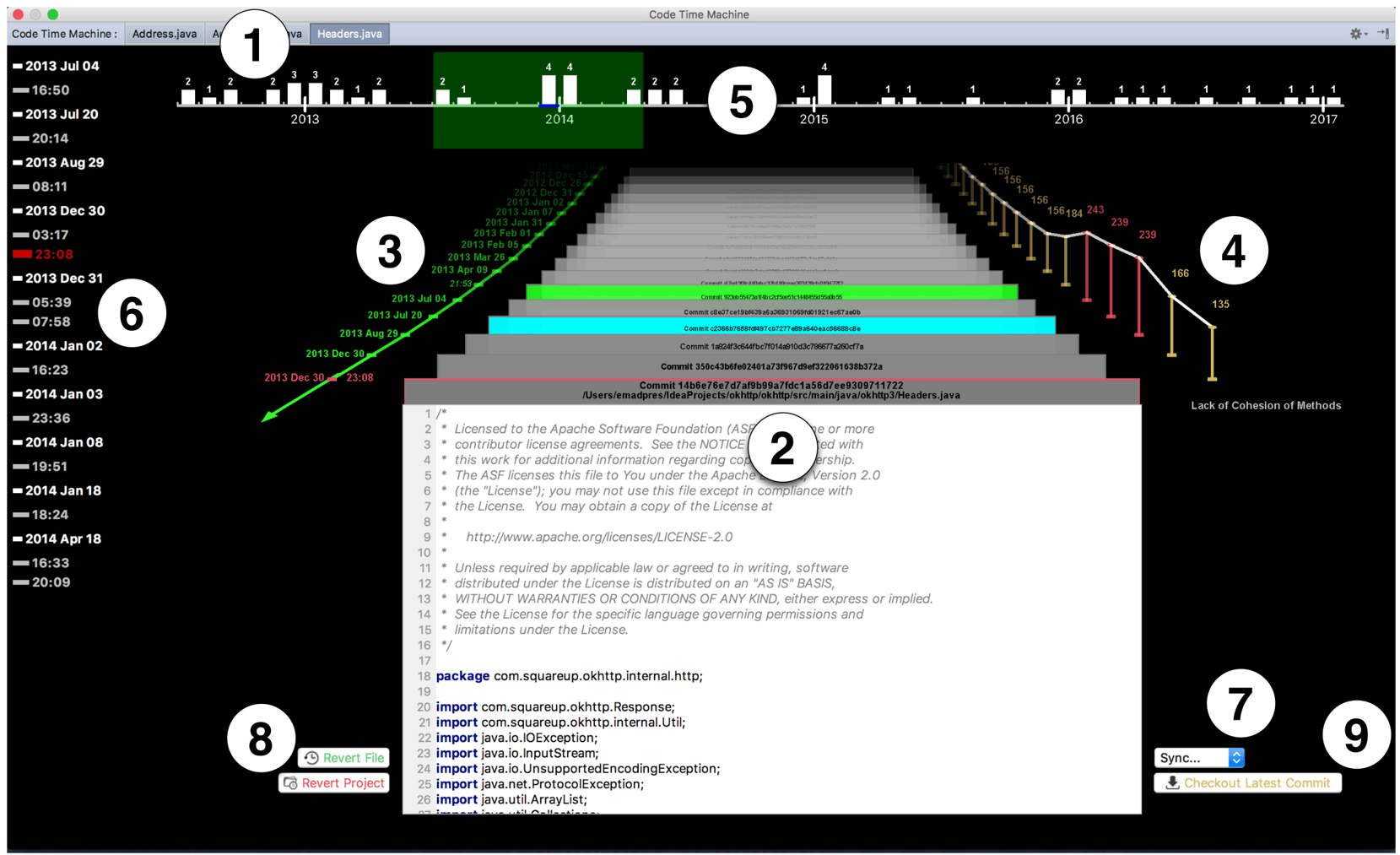
Exploring and analyzing the history of changes is an intrinsic part of software evolution comprehension. Existing tools that exploit the data residing in version control repositories provide only limited support for the intuitive navigation of code changes from a historical perspective. We present the Code Time Machine, a lightweight IDE plugin which uses visualization techniques to depict the history of any chosen file augmented with information mined from the underlying versioning system. Inspired by Apple's Time Machine, our tool allows both developers and the system itself to seamlessly move through time.
On the Uniqueness of Code Redundancies
Code redundancy widely occurs in software projects. Researchers have investigated the existence, causes, and impacts of code redundancy, showing that it can be put to good use, for example in the context of code completion. When analyzing source code redundancy, previous studies considered software projects as sequences of tokens, neglecting the role of the syntactic structures enforced by programming languages. However, differences in the redundancy of such structures may jeopardize the performance of applications leveraging code redundancy. We present a study of the redundancy of several types of code constructs in a large-scale dataset of active Java projects mined from GitHub, unveiling that redundancy is not uniform and mainly resides in specific code constructs. We further investigate the implications of the locality of redundancy by analyzing the performance of language models when applied to code completion. Our study discloses the perils of exploiting code redundancy without taking into account its strong locality in specific code constructs.
How Developers Document Pull Requests with External References
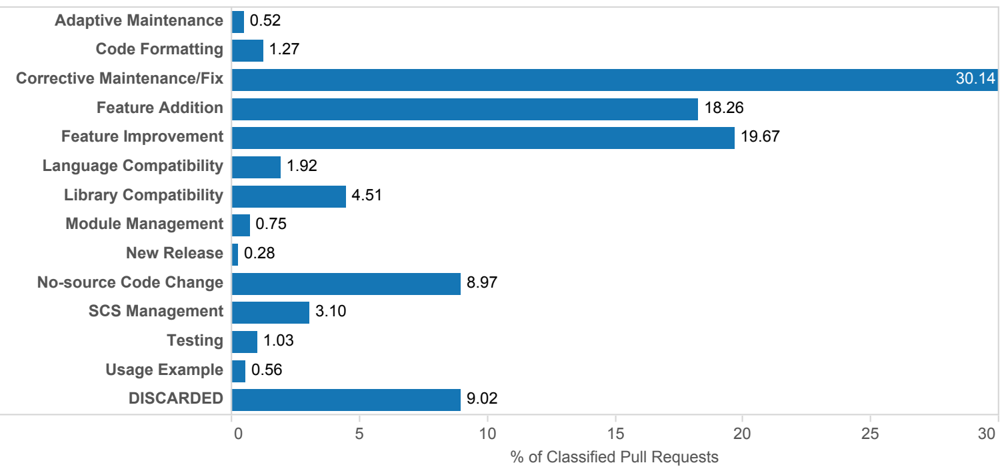
Online resources of formal and informal documentation-such as reference manuals, forum discussions and tutorials-have become an asset to software developers, as they allow them to tackle problems and to learn about new tools, libraries, and technologies. This study investigates to what extent and for which purpose developers refer to external online resources when they contribute changes to a repository by raising a pull request. Our study involved (i) a quantitative analysis of over 150k URLs occurring in pull requests posted in GitHub, (ii) a manual coding of the kinds of software evolution activities performed in commits related to a statistically significant sample of 2,130 pull requests referencing external documentation resources, (iii) a survey with 69 participants, who provided feedback on how they use online resources and how they refer to them when filing a pull request. Results of the study indicate that, on the one hand, developers find external resources useful to learn something new or to solve specific problems, and they perceive useful referring such resources to better document changes. On the other hand, both interviews and repository mining suggest that external resources are still rarely referred in document changes.
Taming the IDE with Fine-grained Interaction Data
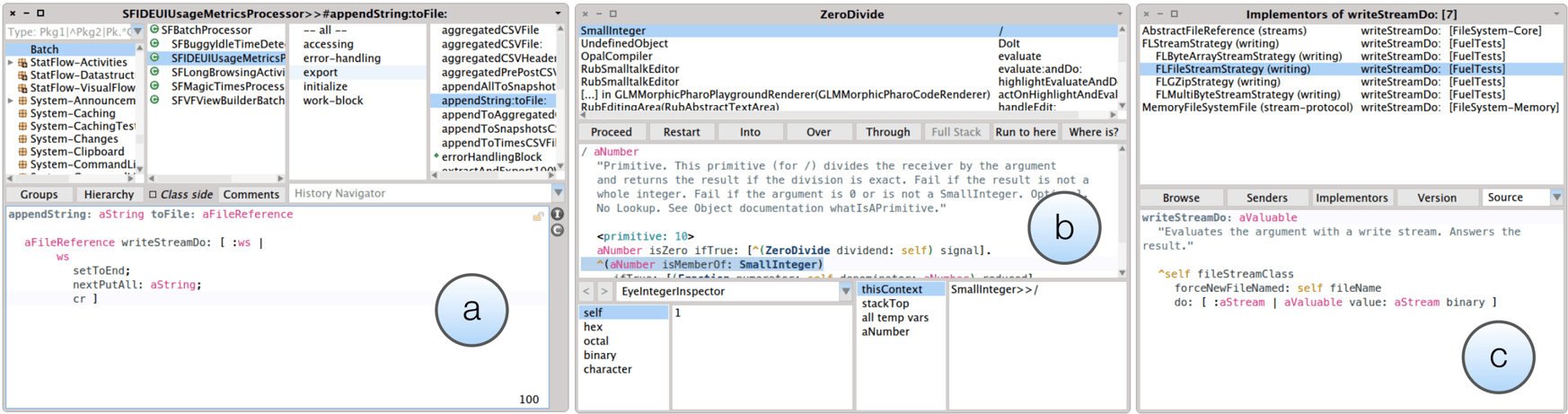
Integrated Development Environments (IDEs) lack effective support to browse complex relationships between source code elements. As a result, developers are often forced to exploit multiple user interface components at the same time, bringing the IDE into a complex, \"chaotic" state. Keeping track of these relationships demands increased source code navigation and cognitive load, leading to productivity deficits documented in observational studies. Beyond small-scale studies, the amount and nature of the chaos experienced by developers in the wild is unclear, and more importantly it is unclear how to tame it. Based on a dataset of fine-grained interaction data, we propose several metrics to characterize and quantify the "level of chaos" of an IDE. Our results suggest that developers spend, on average, more than 30% of their time in a chaotic environment, and that this may affect their productivity. To support developers, we devise and evaluate simple strategies that automatically alter the UI of the IDE. We find that even simple strategies may considerably reduce the level of chaos both in terms of effective space occupancy and time spent in a chaotic environment.
I Know What You Did Last Summer -- An Investigation of How Developers Spend Their Time
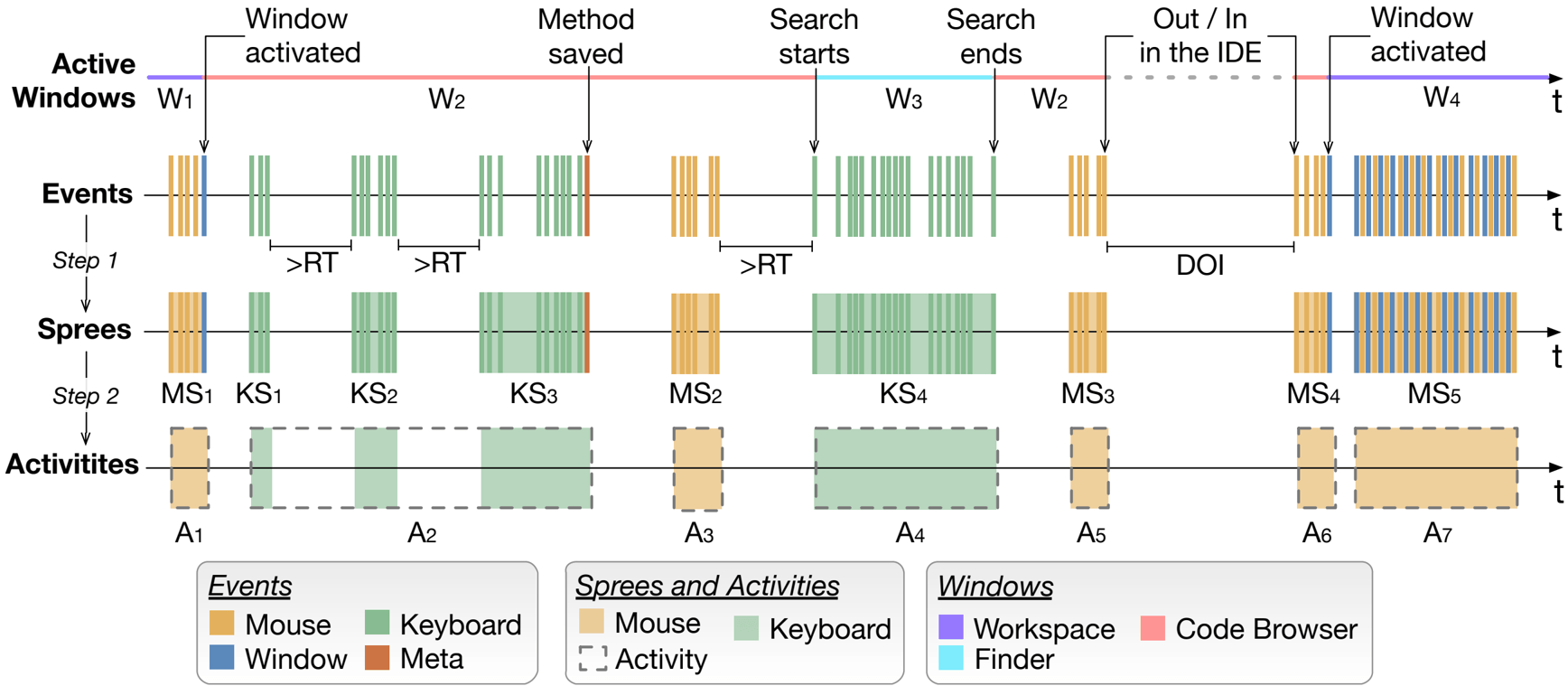
Developing software is a complex mental activity, requiring extensive technical knowledge and abstraction capabilities. The tangible part of development is the use of tools to read, inspect, edit, and manipulate source code, usually through an IDE (integrated development environment). Common claims about software development include that program comprehension takes up half of the time of a developer, or that certain UI (user interface) paradigms of IDEs offer insufficient support to developers. Such claims are often based on anecdotal evidence, throwing up the question of whether they can be corroborated on more solid grounds. We present an in-depth analysis of how developers spend their time, based on a fine-grained IDE interaction dataset consisting of ca. 740 development sessions by 18 developers, amounting to 200 hours of development time and 5 million of IDE events. We propose an inference model of development activities to precisely measure the time spent in editing, navigating and searching for artifacts, interacting with the UI of the IDE, and performing corollary activities, such as inspection and debugging. We report several interesting findings which in part confirm and reinforce some common claims, but also disconfirm other beliefs about software development.
The Plague Doctor: A Promising Cure for the Window Plague
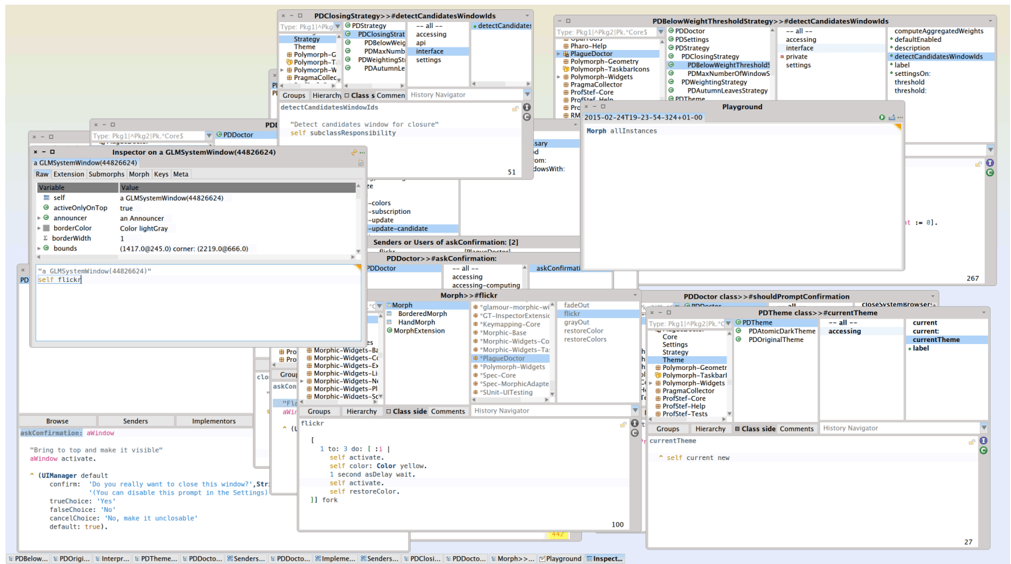
Modern Integrated Development Environments (IDEs) are often affected by the \"window plague", an overly crowded workspace with many open windows and tabs. The main cause is the lack of navigation support in IDEs, also due to the many - and not always obvious - complex relationships that exist between program entities. Researchers have shown that it is possible to mitigate the window plague by exploiting the data obtained by monitoring how developers interact with the user interface of the IDE. However, despite initial results the approach was never fully integrated in an IDE. In our previous work, we implemented DFLOW, an automatic interaction profiler that monitors all the fine-grained interactions of the developer with the IDE. Here we present a first prototype of the PLAGUE DOCTOR, a tool that seamlessly detects the windows that are less likely to be used in the future and automatically closes them. We discuss our long term vision on how to fully exploit the interaction data recorded by DFLOW to provide a more effective cure for the window plague.
Towards Visual Reflexion Models
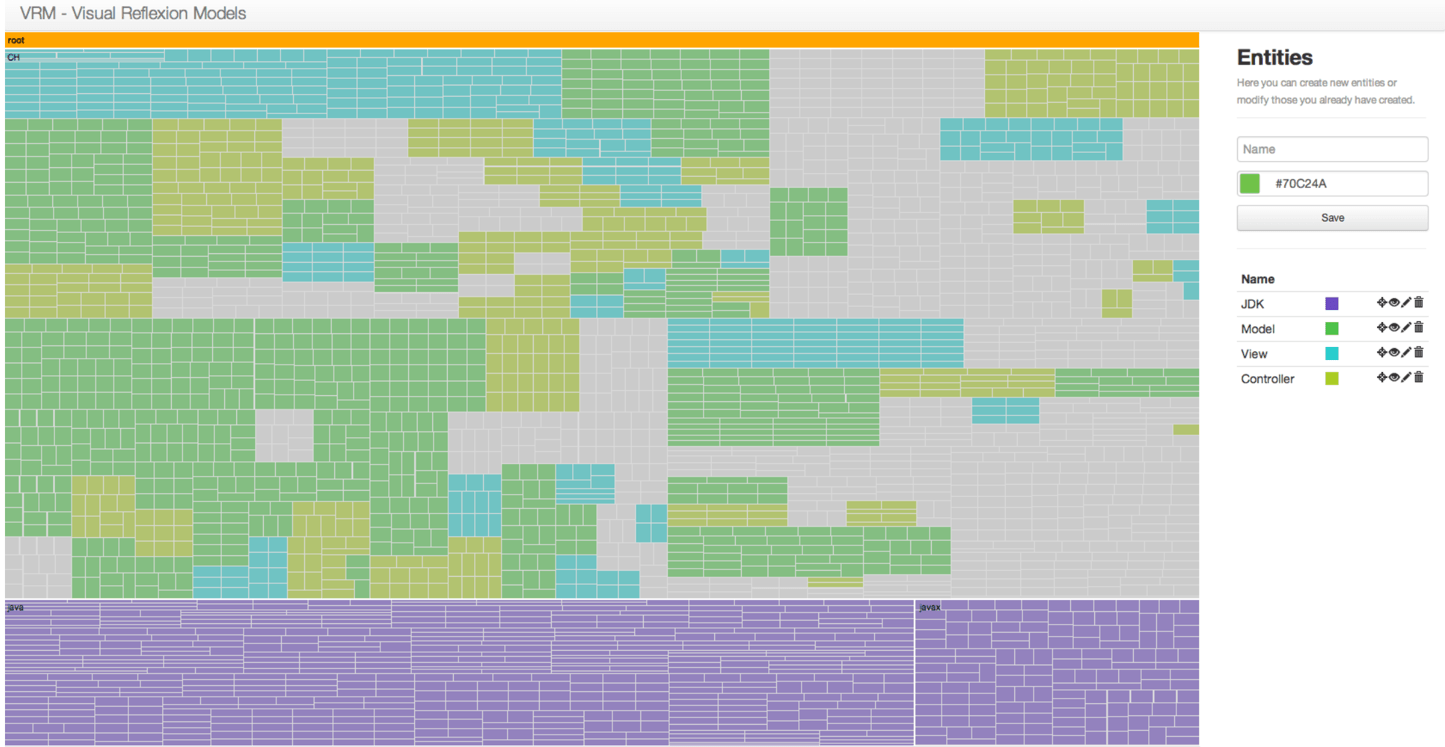
Source code and models of a software system, like architectural views, tend to evolve separately and drift apart over time. Previous research has shown that it is possible to effectively relate them through a reflexion model, defined as a \"summarization of a software system from the viewpoint of a particular high-level model". While effective, the process of constructing and analyzing reflexion models was supported by text-based tools with limited visual representation. With the original approach, it was relatively hard to understand which parts of the system were represented, and which parts of the system contributed to specific relations in the reflexion model. We present our vision on augmenting the construction and analysis of reflexion models with visual support, effectively providing the basis for visual reflexion models. We describe our approach, implemented as a web-based application, and two promising case studies involving two open-source projects.
Mining Unit Tests for Code Recommendation
Developers spend a significant portion of their time understanding and learning the correct usage of the APIs of libraries they want to integrate in their projects. However, learning how to effectively use APIs is complex and time consuming. Code recommendation systems play a crucial role facilitating developers in this task by providing to them relevant examples while they code. This paper proposes a novel approach to code recommendation in which code examples are automatically obtained by mining and manipulating unit tests. In this paper we discuss the theoretical and practical implications that underpin this idea. The discussion leads to a series of fascinating research challenges that we organized in a research agenda.