ICSE
Browse all content with this tag
Supporting Software Developers with a Holistic Recommender System
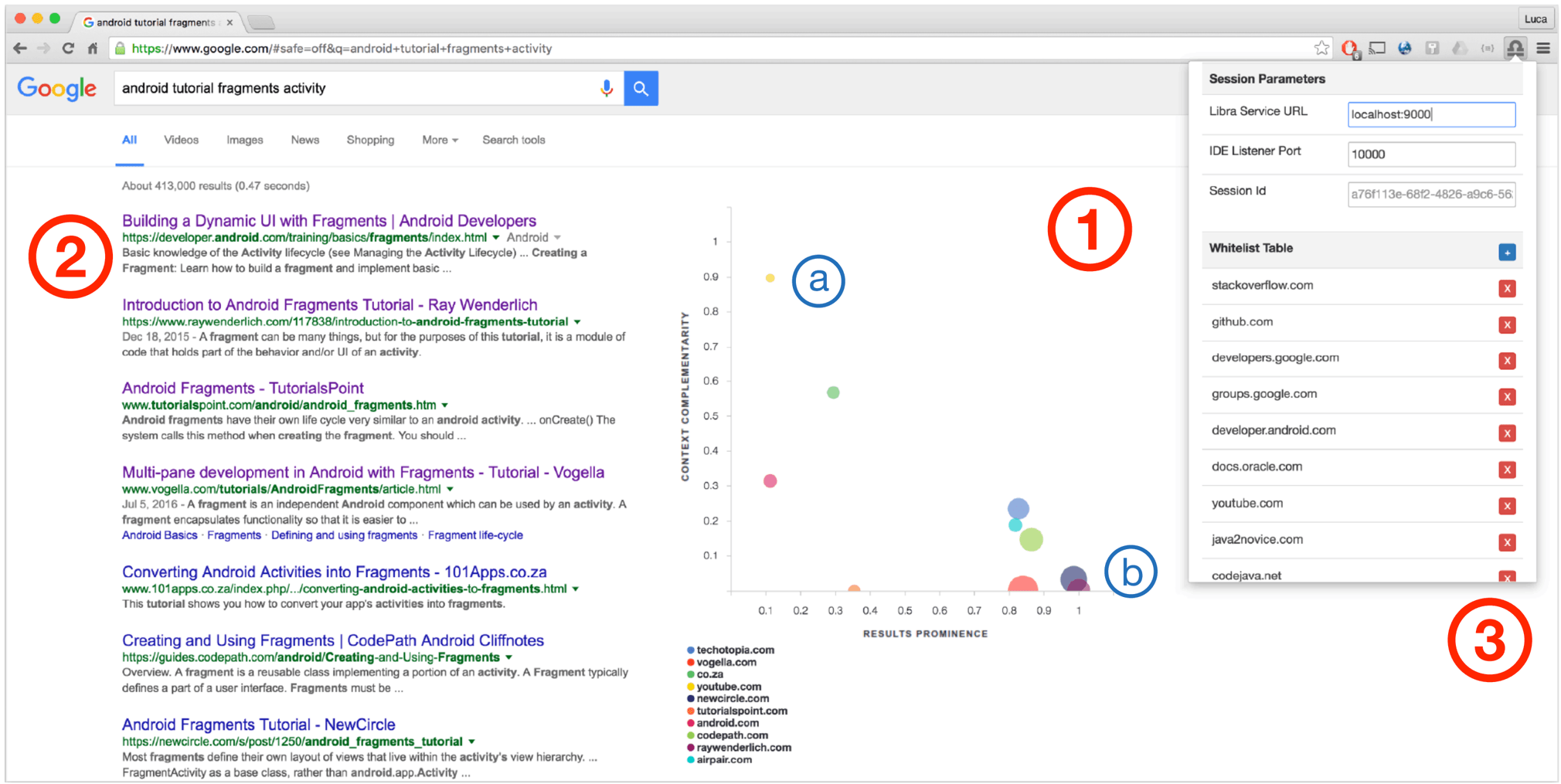
The promise of recommender systems is to provide intelligent support to developers during their programming tasks. Such support ranges from suggesting program entities to taking into account pertinent QnA pages. However, current recommender systems limit the context analysis to change history and developers' activities in the IDE, without considering what a developer has already consulted or perused, e.g., by performing searches from the Web browser. Given the faceted nature of many programming tasks, and the incompleteness of the information provided by a single artifact, several heterogeneous resources are required to obtain the broader picture needed by a developer to accomplish a task. We present Libra, a holistic recommender system. It supports the process of searching and navigating the information needed by constructing a holistic meta-information model of the resources perused by a developer, analyzing their semantic relationships, and augmenting the web browser with a dedicated interactive navigation chart. The quantitative and qualitative evaluation of Libra provides evidence that a holistic analysis of a developer's information context can indeed offer comprehensive and contextualized support to information navigation and retrieval during software development.
Too Long; Didn't Watch! Extracting Relevant Fragments from Software Development Video Tutorials
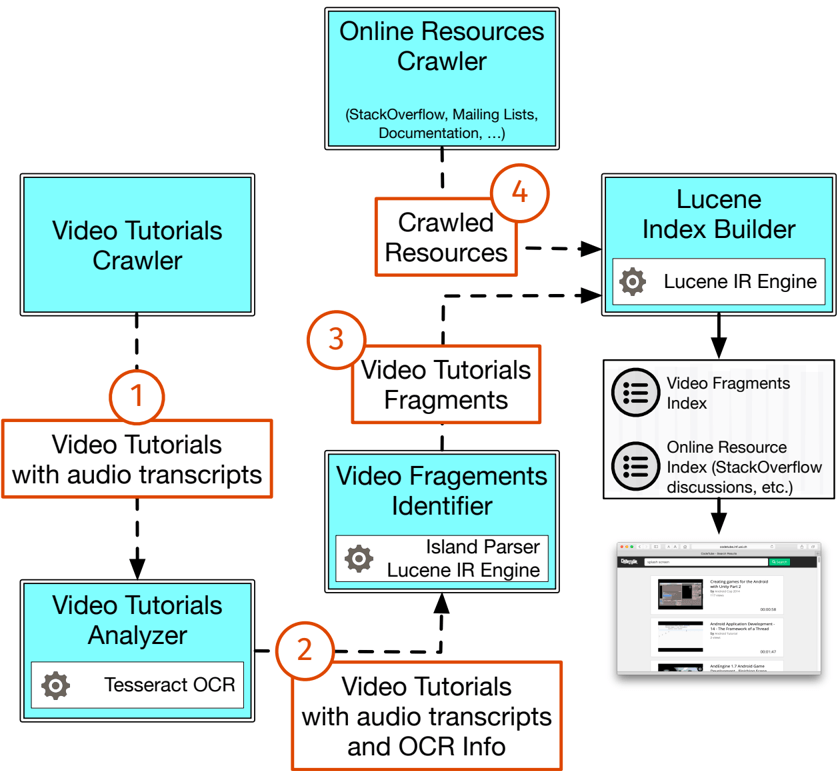
When knowledgeable colleagues are not available, developers resort to offline and online resources, e.g. tutorials, mailing lists, and Q&A websites. These, however, need to be found, read, and understood, which takes its toll in terms of time and mental energy. A more immediate and accessible resource are video tutorials found on the web, which in recent years have seen a steep increase in popularity. Nonetheless, videos are an intrinsically noisy data source, and finding the right piece of information might be even more cumbersome than using the previously mentioned resources. We present CodeTube, an approach which mines video tutorials found on the web, and enables developers to query their contents. The video tutorials are split into coherent fragments, to return only fragments related to the query. These are complemented with information from additional sources, such as Stack Overflow discussions. The results of two studies to assess CodeTube indicate that video tutorials - if appropriately processed - represent a useful, yet still under-utilized source of information for software development.
CodeTube: Extracting Relevant Fragments from Software Development Video Tutorials
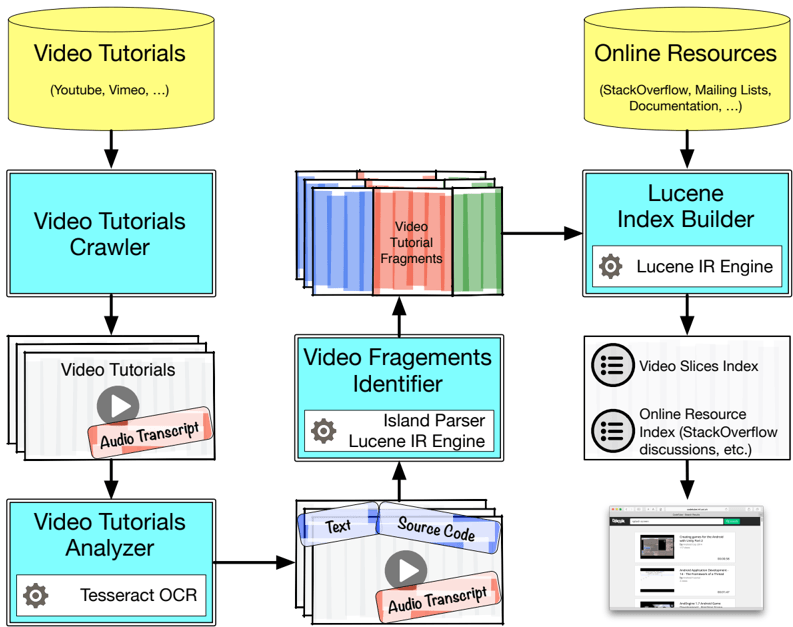
Nowadays developers heavily rely on sources of informal documentation. Examples include Q&A forums, slides, or video tutorials, the latter being particularly useful to provide introductory notions for a piece of technology. The current practice is that developers have to browse sources individually, which in the case of video tutorials is cumbersome, as they are lengthy and cannot be searched based on their contents. We present CodeTube, a Web-based recommender system that analyzes the contents of video tutorials and is able to provide, given a query, cohesive and self-contained video fragments, along with links to relevant Stack Overflow discussions. CodeTube relies on a combination of textual analysis and image processing applied on video tutorial frames and speech transcripts to split videos into cohesive fragments, index them and identify related Stack Overflow discussions.
Free Hugs: Praising Developers For Their Actions
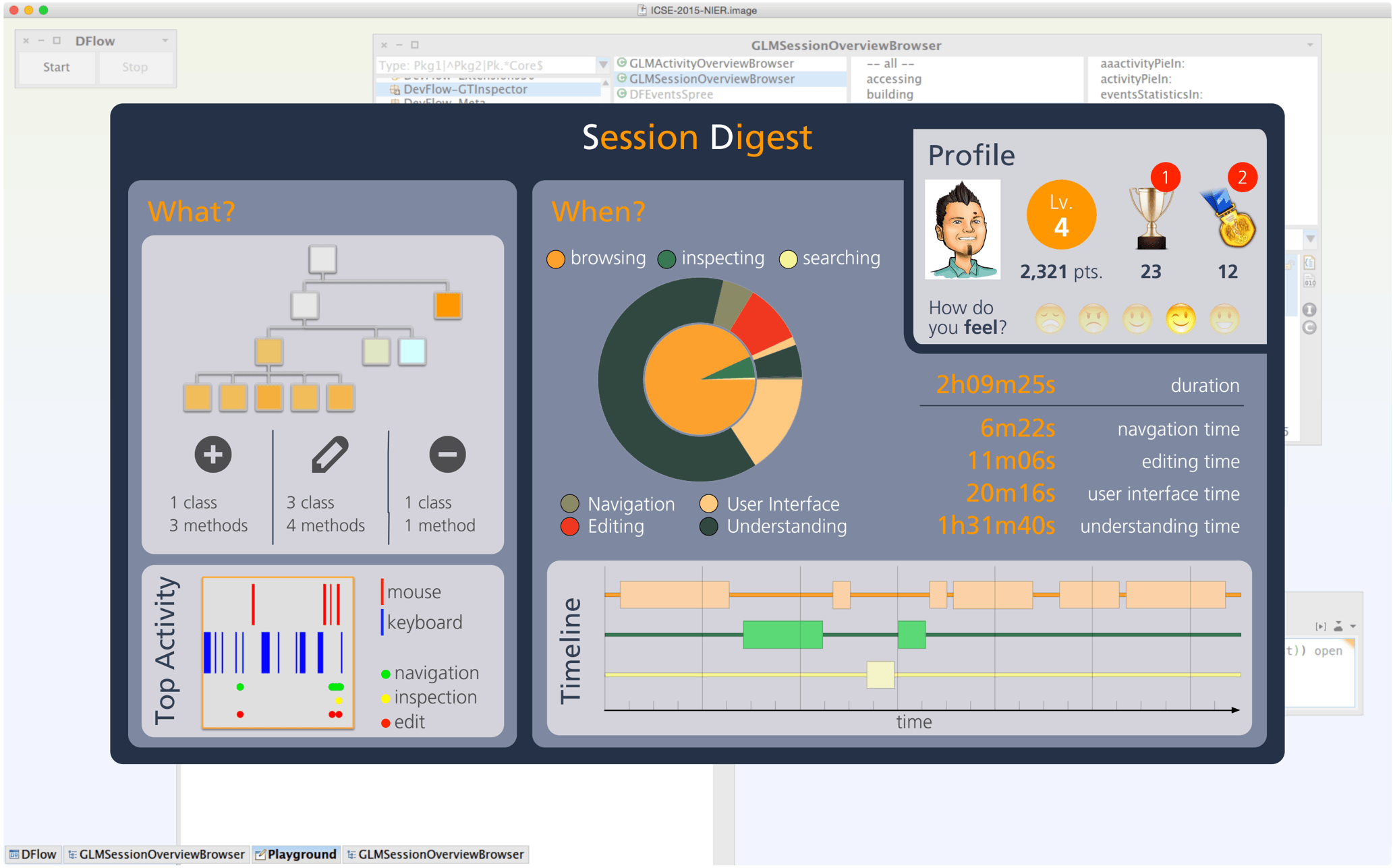
Developing software is a complex, intrinsically intellectual, and therefore ephemeral activity, also due to the intangible nature of the end product, the source code. There is a thin red line between a productive development session, where a developer actually does something useful and productive, and a session where the developer essentially produces “fried air”, pieces of code whose quality and usefulness are doubtful at best. We believe that well-thought mechanisms of gamification built on fine-grained interaction information mined from the IDE can crystallize and reward good coding behavior. We present our preliminary experience with the design and implementation of a micro-gamification layer built into an object-oriented IDE, which at the end of each development session not only helps the developer to understand what he actually produced, but also praises him in case the development session was productive. Building on this, we envision an environment where the IDE reflects on the deeds of the developers and by providing a historical view also helps to track and reward long-term growth in terms of development skills, not dissimilar from the mechanics of role-playing games.
ViDI: The Visual Design Inspector
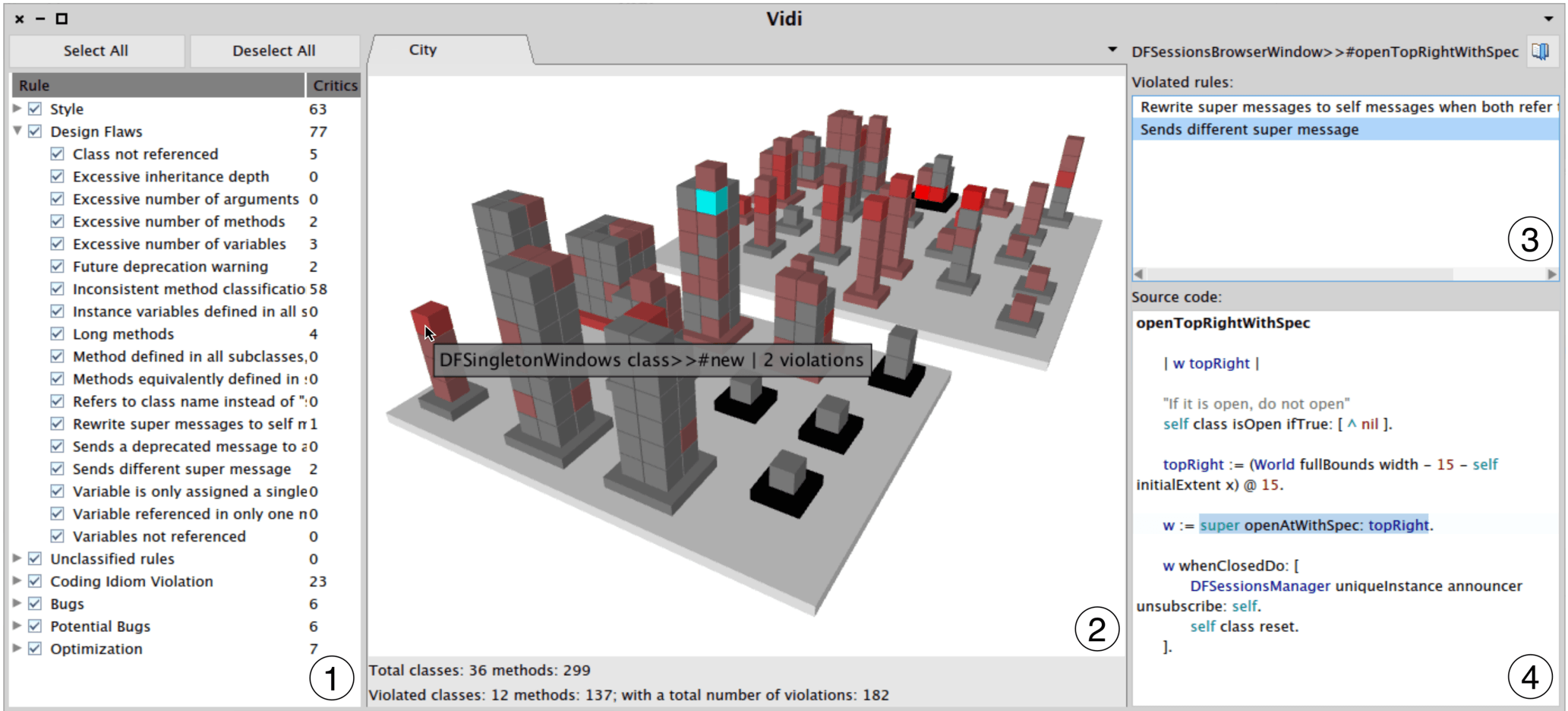
We present ViDI (Visual Design Inspector), a novel code review tool which focuses on quality concerns and design inspection as its cornerstones. It leverages visualization techniques to represent the reviewed software and augments the visualization with the results of quality analysis tools. To effectively understand the contribution of a reviewer in terms of the impact of her changes on the overall system quality, ViDI supports the recording and further inspection of reviewing sessions. ViDI is an advanced prototype which we will soon release to the Pharo open-source community.
Behavioral validation of JFSL specifications through model synthesis
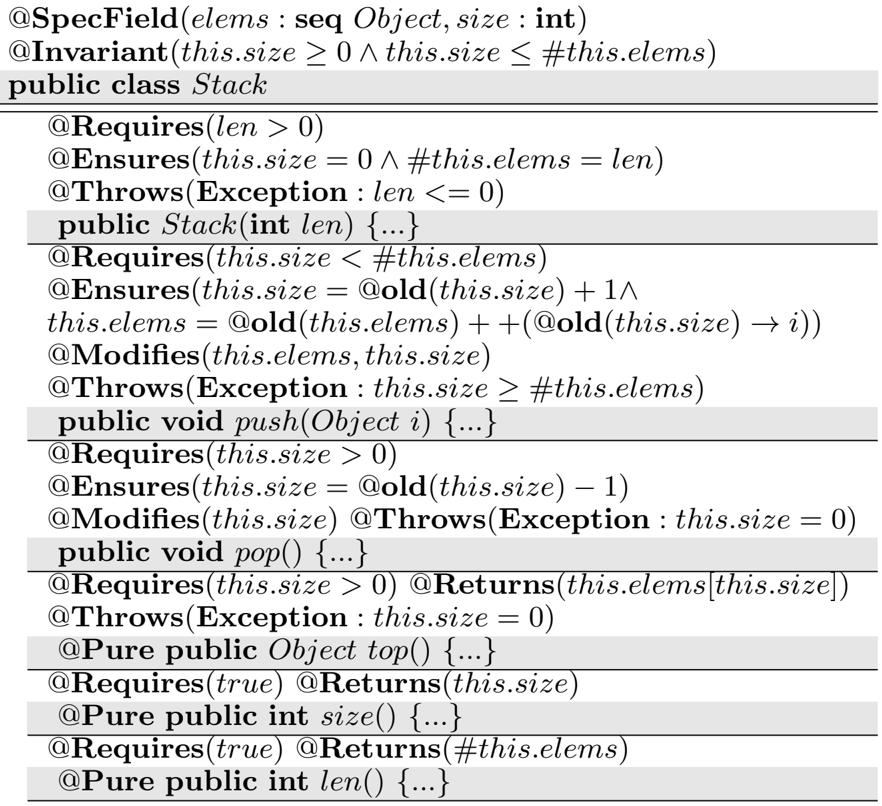
Contracts are a popular declarative specification technique to describe the behavior of stateful components in terms of pre/post conditions and invariants. Since each operation is specified separately in terms of an abstract implementation, it may be hard to understand and validate the resulting component behavior from contracts in terms of method interactions. In particular, properties expressed through algebraic axioms, which specify the effect of sequences of operations, require complex theorem proving techniques to be validated. In this paper, we propose an automatic small-scope based approach to synthesize incomplete behavioral abstractions for contracts expressed in the JFSL notation. The proposed abstraction technique enables the possibility to check that the contract behavior is coherent with behavioral properties expressed as axioms of an algebraic specifications. We assess the applicability of our approach by showing how the synthesis methodology can be applied to some classes of contract-based artifacts like specifications of data abstractions and requirement engineering models.
Runtime Monitoring of Component Changes with Spy@Runtime
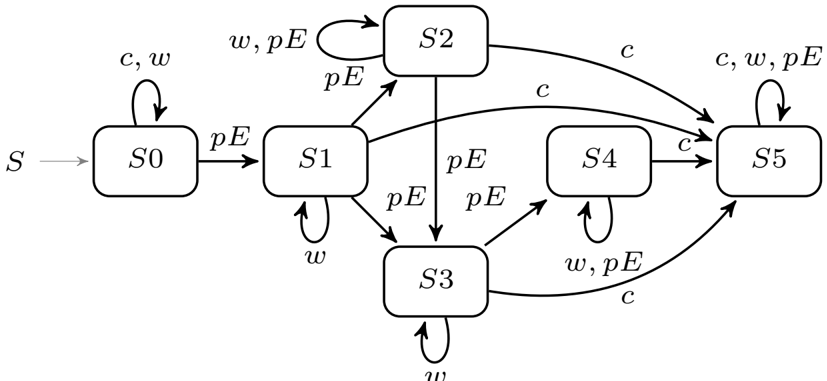
We present Spy@Runtime, a tool to infer and work with behavior models. Spy@Runtime generates models through a dynamic black box approach and is able to keep them updated with observations coming from actual system execution. We also show how to use models describing the protocol of interaction of a software component to detect and report functional changes as soon as they are discovered. Monitoring functional properties is particularly useful in an open environment in which there is a distributed ownership of a software system. Parts of the system may be changed independently and therefore it becomes necessary to monitor the component's behavior at run time.
Synthesizing intensional behavior models by graph transformation
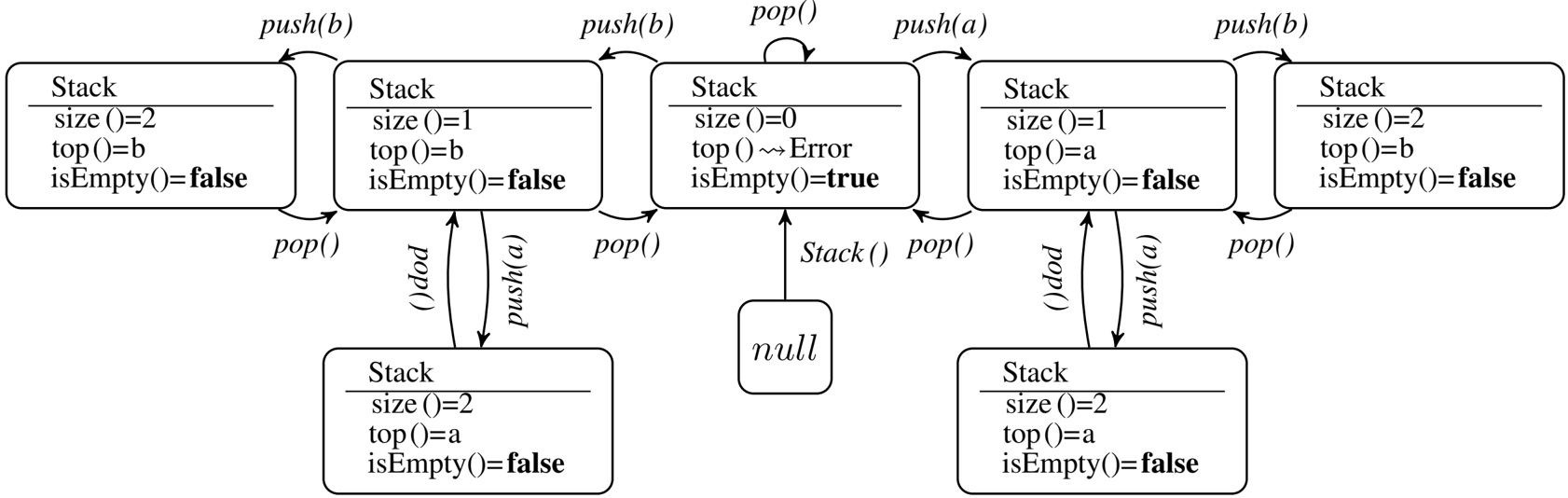
This paper describes an approach (SPY) to recover the specification of a software component from the observation of its run-time behavior. It focuses on components that behave as data abstractions. Components are assumed to be black boxes that do not allow any implementation inspection. The inferred description may help understand what the component does when no formal specification is available. SPY works in two main stages. First, it builds a deterministic finite-state machine that models the partial behavior of instances of the data abstraction. This is then generalized via graph transformation rules. The rules can generate a possibly infinite number of behavior models, which generalize the description of the data abstraction under an assumption of “regularity” with respect to the observed behavior. The rules can be viewed as a likely specification of the data abstraction. We illustrate how SPY works on relevant examples and we compare it with competing methods.