ICSME
Browse all content with this tag
UrbanIt: Visualizing Repositories Everywhere
Software evolution is supported by a variety of tools that help developers understand the structure of a software system, analyze its history and support specific classes of analyses. However, the increasingly distributed nature of software development requires basic repository analyses to be always available to developers, even when they cannot access their workstation with full-fledged applications and command-line tools. We present UrbanIt, a gesture-based tablet application for the iPad that supports the visualization of software repositories together with useful evolutionary analyses (e.g., version diff) and basic sharing features in a portable and mobile setting. UrbanIt is paired with a web application that manages synchronization of multiple repositories.

Visual Storytelling of Development Sessions
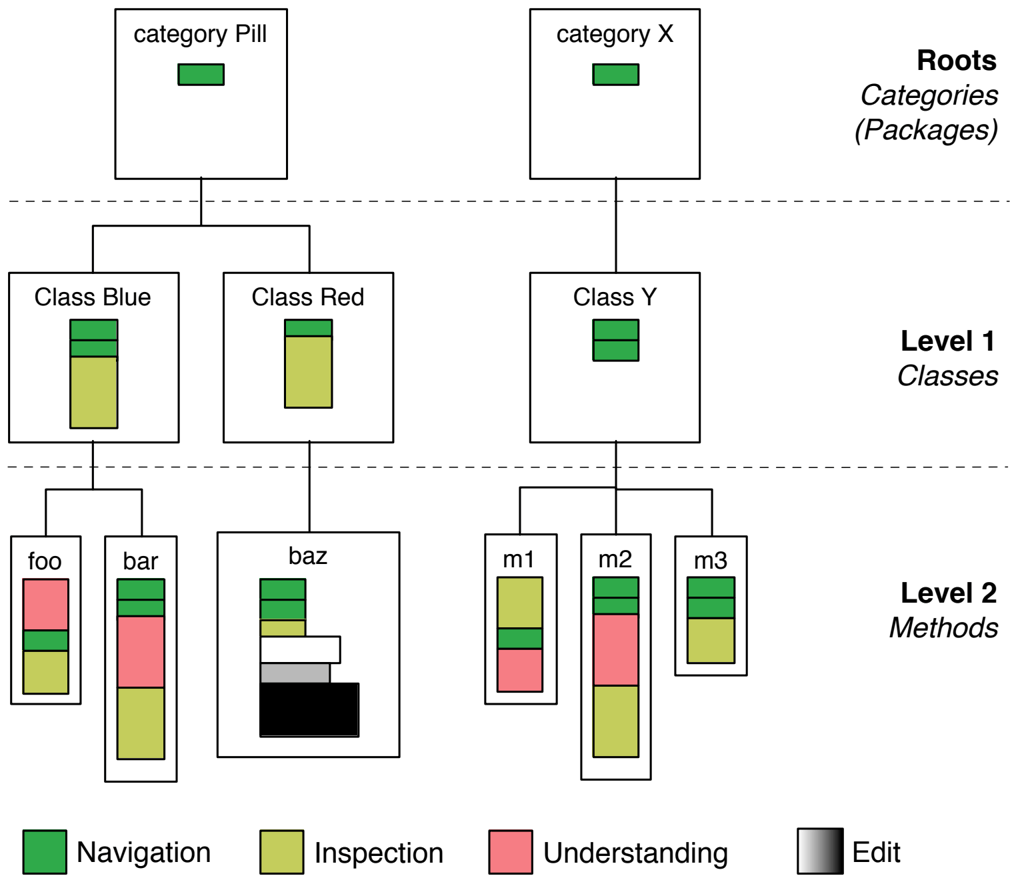
Most development activities, like program understanding, source code navigation and editing, are supported by Integrated Development Environments (IDEs). They provide different tools and user interfaces (UI) to interact with the source code, such as browsers, debuggers, and inspectors. It is uncertain how and when programmers use different UI elements of an IDE and to what extent they appropriately support development. Previously we developed DFLOW, a tool that seamlessly records and processes interaction data. Our long-term goal is to assess to what extent the UIs of IDEs support the workflow of developers and whether they can be improved. As a first step we present our approach to analyze development sessions in the form of visual storytelling. We illustrate our initial catalogue of visualizations through two development stories.
Improving Low Quality Stack Overflow Post Detection
Stack Overflow is a popular questions and answers (Q&A) website among software developers. It counts more than two millions of users who actively contribute by asking and answering thousands of questions daily. Identifying and reviewing low quality posts preserves the quality of site's contents and it is crucial to maintain a good user experience. In Stack Overflow the identification of poor quality posts is performed by selected users manually. The system also uses an automated identification system based on textual features. Low quality posts automatically enter a review queue maintained by experienced users. We present an approach to improve the automated system in use at Stack Overflow. It analyzes both the content of a post (e.g., simple textual features and complex readability metrics) and community-related aspects (e.g., popularity of a user in the community). Our approach reduces the size of the review queue effectively and removes misclassified good quality posts.