Information Extraction
Browse all content with this tag
Reconstructing Narrative Complexity in Fallout 4
Andrey Kan · Bachelor of Science in Informatics
Mining a Century of Swiss Trademark Data
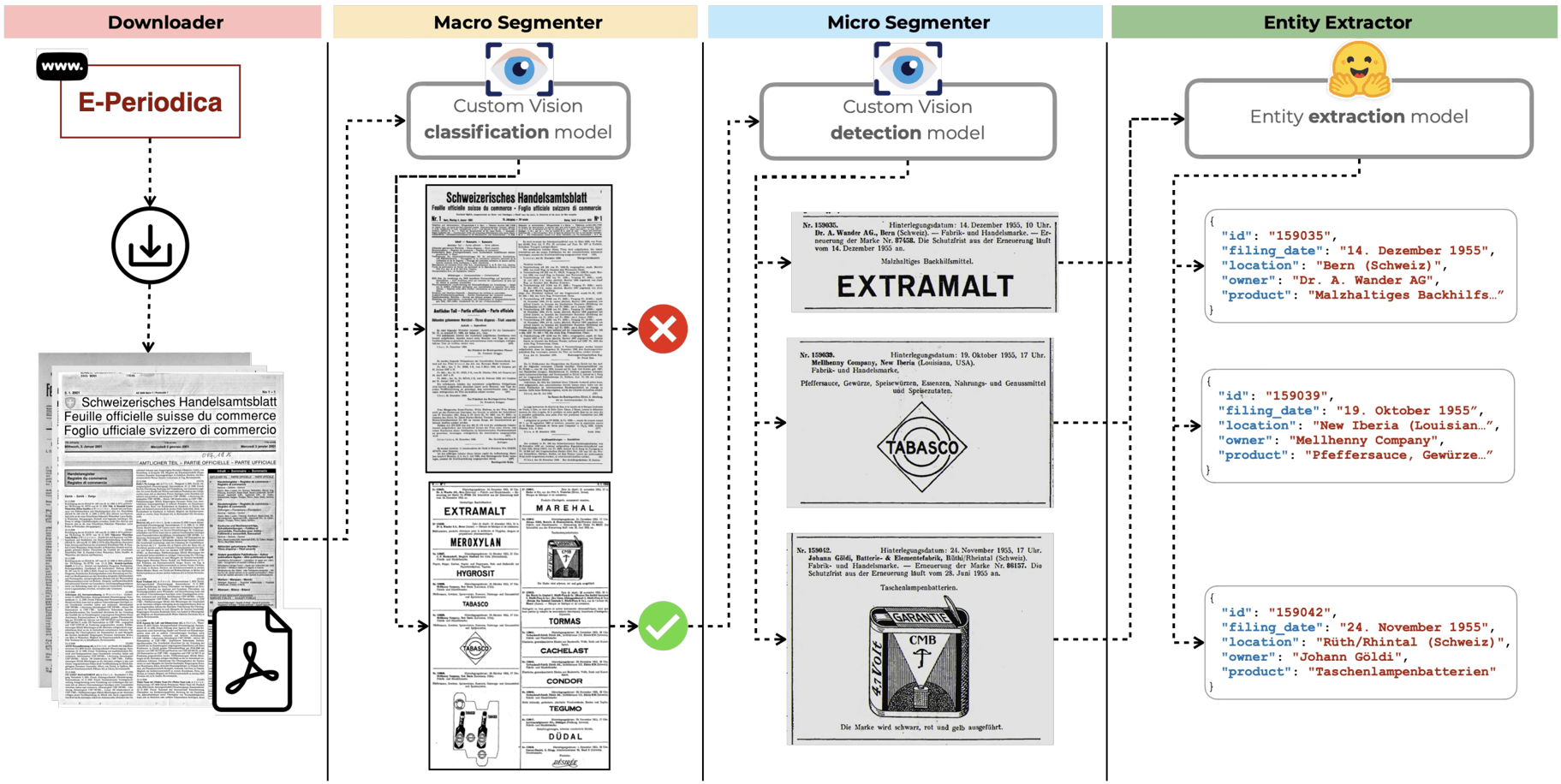
This paper presents an approach for extracting trademark registration events from the Swiss Official Gazette of Commerce (SOGC), an official daily journal published by the Swiss Confederation since January 1883. Until 2001, the data is only available as scanned documents, which constitute the target dataset of this study. Our approach is composed of a chain of three steps based on state-of-the-art deep learning techniques. We leverage image classification to identify pages containing trademarks (macro segmentation); we apply object detection to identify the portion of the page corresponding to a registration event (micro segmentation); last, we perform information extraction using a document AI technique. We obtain a dataset of ca. 500,000 trademark registration events, extracted from a corpus of 430,000 pages. Each step of our workflow has relatively high accuracy: the macro and micro segmentation steps show precision and recall greater than 95% on a manually constructed dataset. The dataset offers a unique historical perspective on trademark registrations in Switzerland that is not available from any other source. Showcasing what can be achieved with the extracted information, we provide answers to a set of preliminary economics questions.
Modeling and Analyzing Time-Dependent Network of Firms
Federico Lombardo · Master of Science in Software & Data Engineering
Mining A Century of Swiss Trademarks
Daniel Travaglia · Master of Science in Software & Data Engineering
REFLEX Data Pipeline & REFLEXplorer
The software backbone of the REFLEX project: a document-AI and NLP pipeline turning 140 years of scanned Swiss commercial registry into structured, geocoded data, and a web platform to explore it
Holistic Recommender Systems for Software Engineering
Luca Ponzanelli · Doctor of Philosophy in Informatics
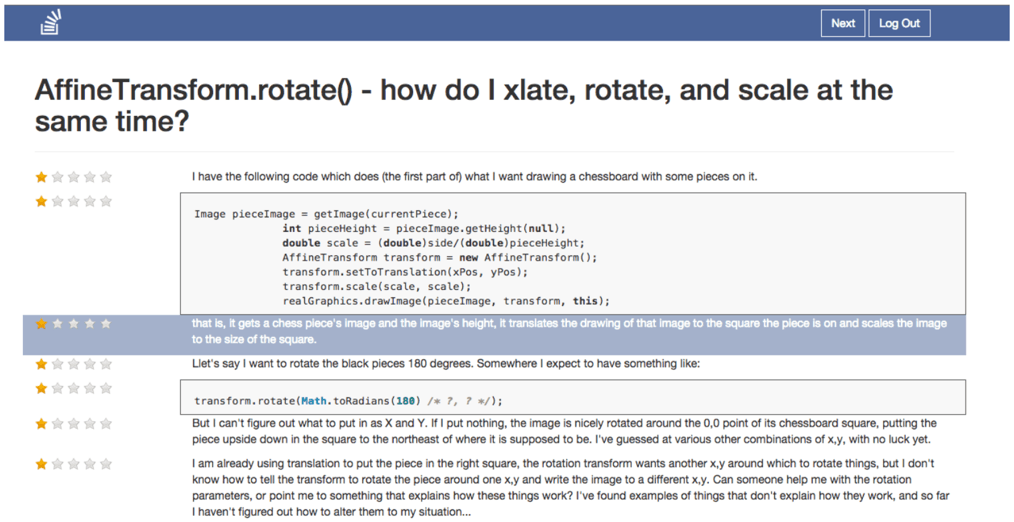
StORMeD: Stack Overflow Ready Made Data
Stack Overflow is the de facto Question and Answer (Q&A) website for developers, and it has been used in many approaches by software engineering researchers to mine useful data. However, the contents of a Stack Overflow discussion are inherently heterogeneous, mixing natural language, source code, stack traces and configuration files in XML or JSON format. We constructed a full island grammar capable of modeling the set of 700,000 Stack Overflow discussions talking about Java, building a heterogeneous abstract syntax tree (H-AST) of each post (question, answer or comment) in a discussion. The resulting dataset models every Stack Overflow discussion, providing a full H-AST for each type of structured fragment (i.e., JSON, XML, Java, Stack traces), and complementing this information with a set of basic meta-information like term frequency to enable natural language analyses. Our dataset allows the end-user to perform combined analyses of the Stack Overflow by visiting the H-AST of a discussion.
Summarizing Complex Development Artifacts by Mining Heterogeneous Data
Summarization is hailed as a promising approach to reduce the amount of information that must be taken in by the person who wants to understand development artifacts, such as pieces of code, bug reports, emails, etc. However, existing approaches treat artifacts as pure textual entities, disregarding the heterogeneous and partially structured nature of most artifacts, which contain intertwined pieces of distinct type, such as source code, diffs, stack traces, human language, etc. We present a novel approach to augment existing summarization techniques (such as LexRank) to deal with the heterogeneous and multidimensional nature of complex artifacts. Our preliminary results on heterogeneous artifacts suggest our approach outperforms the current text-based approaches.