NIER Track
Browse all content with this tag
Free Hugs: Praising Developers For Their Actions
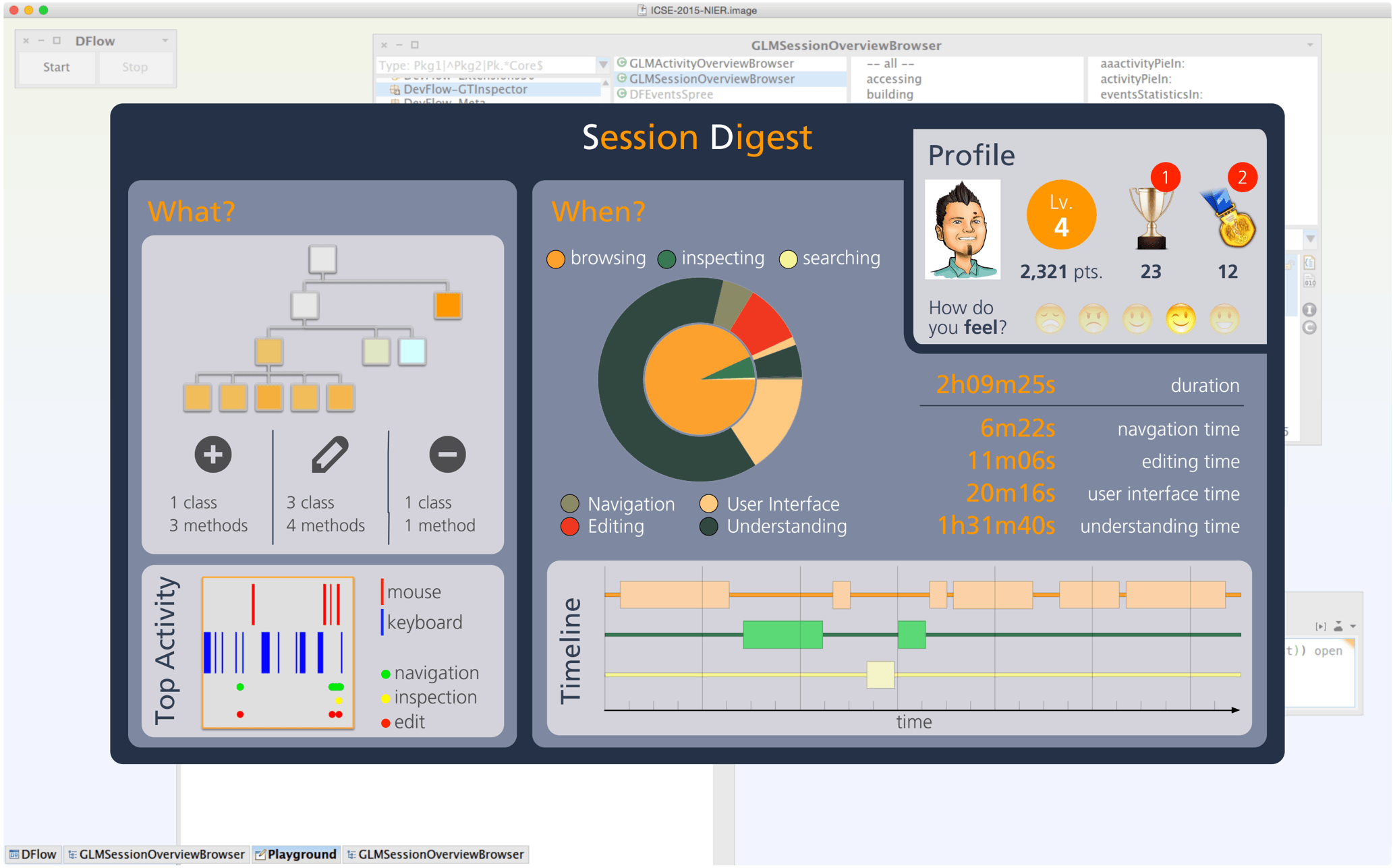
Developing software is a complex, intrinsically intellectual, and therefore ephemeral activity, also due to the intangible nature of the end product, the source code. There is a thin red line between a productive development session, where a developer actually does something useful and productive, and a session where the developer essentially produces “fried air”, pieces of code whose quality and usefulness are doubtful at best. We believe that well-thought mechanisms of gamification built on fine-grained interaction information mined from the IDE can crystallize and reward good coding behavior. We present our preliminary experience with the design and implementation of a micro-gamification layer built into an object-oriented IDE, which at the end of each development session not only helps the developer to understand what he actually produced, but also praises him in case the development session was productive. Building on this, we envision an environment where the IDE reflects on the deeds of the developers and by providing a historical view also helps to track and reward long-term growth in terms of development skills, not dissimilar from the mechanics of role-playing games.
Summarizing Complex Development Artifacts by Mining Heterogeneous Data
Summarization is hailed as a promising approach to reduce the amount of information that must be taken in by the person who wants to understand development artifacts, such as pieces of code, bug reports, emails, etc. However, existing approaches treat artifacts as pure textual entities, disregarding the heterogeneous and partially structured nature of most artifacts, which contain intertwined pieces of distinct type, such as source code, diffs, stack traces, human language, etc. We present a novel approach to augment existing summarization techniques (such as LexRank) to deal with the heterogeneous and multidimensional nature of complex artifacts. Our preliminary results on heterogeneous artifacts suggest our approach outperforms the current text-based approaches.