NLP
Browse all content with this tag
Reconstructing Narrative Complexity in Fallout 4
Andrey Kan · Bachelor of Science in Informatics
What Makes a Level Hard in Super Mario Maker 2?
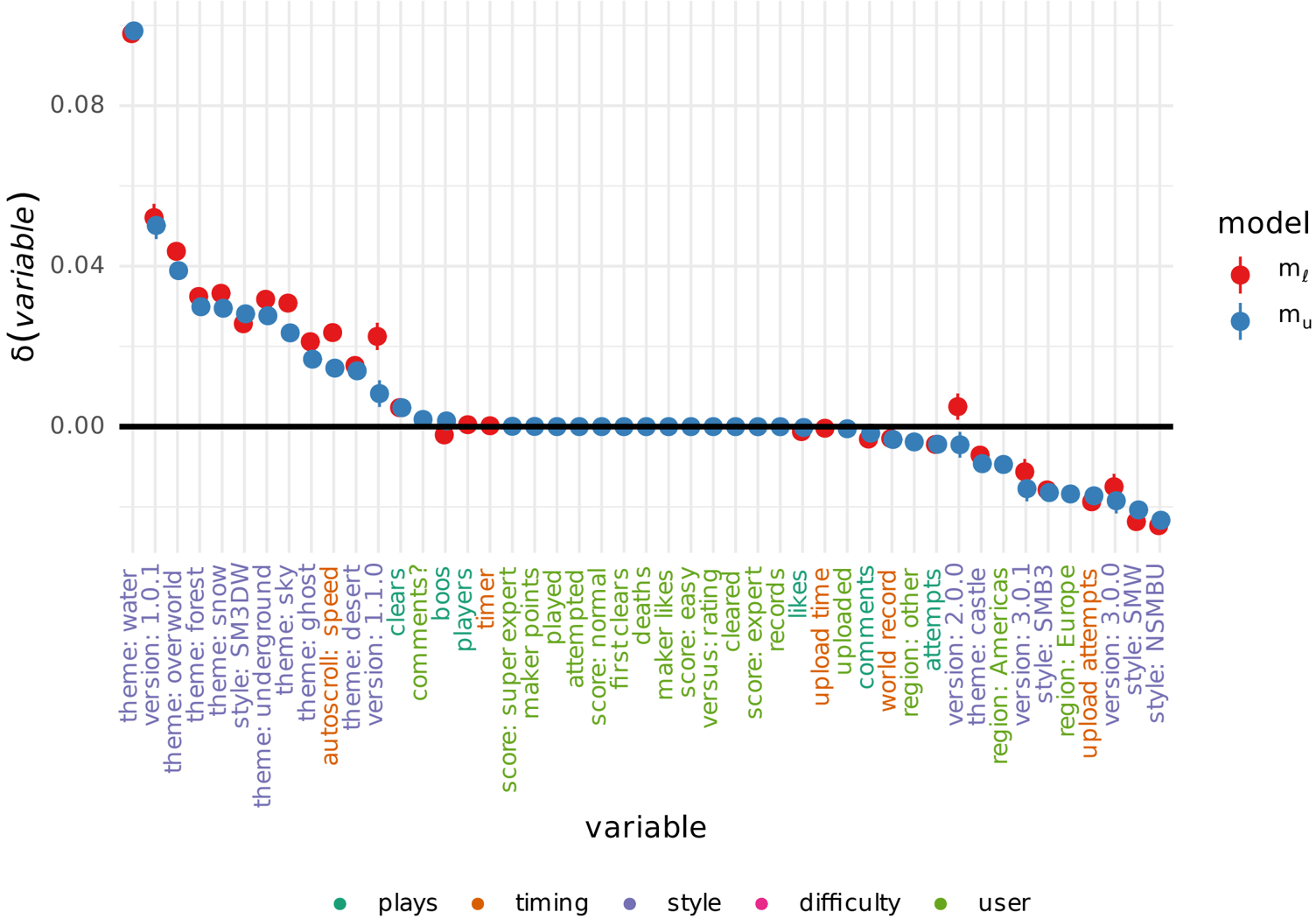
Games like Super Mario Maker 2 (SMM2) lower the barrier for casual users to become level designers. In this paper, we set out to analyze a vast amount of data about SMM2 user-written levels, in order to understand what factors affect a level's difficulty as experienced by other users. To this end, we perform two kinds of analyses: one based on regression models and one using natural language processing techniques. The main results shed light on which level characteristics (e.g., its style, popularity, timing) and which topics and sentiments have a consistent association with easier or harder levels. While none of our findings are startling, they help distill some key differences between easy and hard SMM2 levels, which, in turn, can pave the way for a better understanding of end-user level design.
REFLEX Data Pipeline & REFLEXplorer
The software backbone of the REFLEX project: a document-AI and NLP pipeline turning 140 years of scanned Swiss commercial registry into structured, geocoded data, and a web platform to explore it
Automatic Classification of Development Artifact Contents
Alexander Fischer · Master of Science in Software & Data Engineering
Investigating the Use of Code Analysis and NLP to Promote a Consistent Usage of Identifiers
Meaningless identifiers as well as inconsistent use of identifiers in the source code might hinder code readability and result in increased software maintenance efforts. Over the past years, effort has been devoted to promoting a consistent usage of identifiers across different parts of a system through approaches exploiting static code analysis and Natural Language Processing (NLP). These techniques have been evaluated in small-scale studies, but it is unclear how they compare to each other and how they complement each other. Furthermore, a full-fledged larger empirical evaluation is still missing.,,We aim at bridging this gap. We asked developers of five projects to assess the meaningfulness of the recommendations generated by three techniques, two already existing in the literature (one exploiting static analysis, one using NLP) and a novel one we propose. With a total of 922 rename refactorings evaluated, this is, to the best of our knowledge, the largest empirical study conducted to assess and compare rename refactoring tools promoting a consistent use of identifiers. Our study sheds light on the current state-of-the-art in rename refactoring recommenders, and indicates directions for future work.
Assessing Software Documents by Comprehension Effort
Talal El Afchal · Master of Science in Informatics
Summarizing Complex Development Artifacts by Mining Heterogeneous Data
Summarization is hailed as a promising approach to reduce the amount of information that must be taken in by the person who wants to understand development artifacts, such as pieces of code, bug reports, emails, etc. However, existing approaches treat artifacts as pure textual entities, disregarding the heterogeneous and partially structured nature of most artifacts, which contain intertwined pieces of distinct type, such as source code, diffs, stack traces, human language, etc. We present a novel approach to augment existing summarization techniques (such as LexRank) to deal with the heterogeneous and multidimensional nature of complex artifacts. Our preliminary results on heterogeneous artifacts suggest our approach outperforms the current text-based approaches.