Recommender Systems
Browse all content with this tag
Assessing Software Documents by Comprehension Effort
Talal El Afchal · Master of Science in Informatics
Supporting Software Developers with a Holistic Recommender System
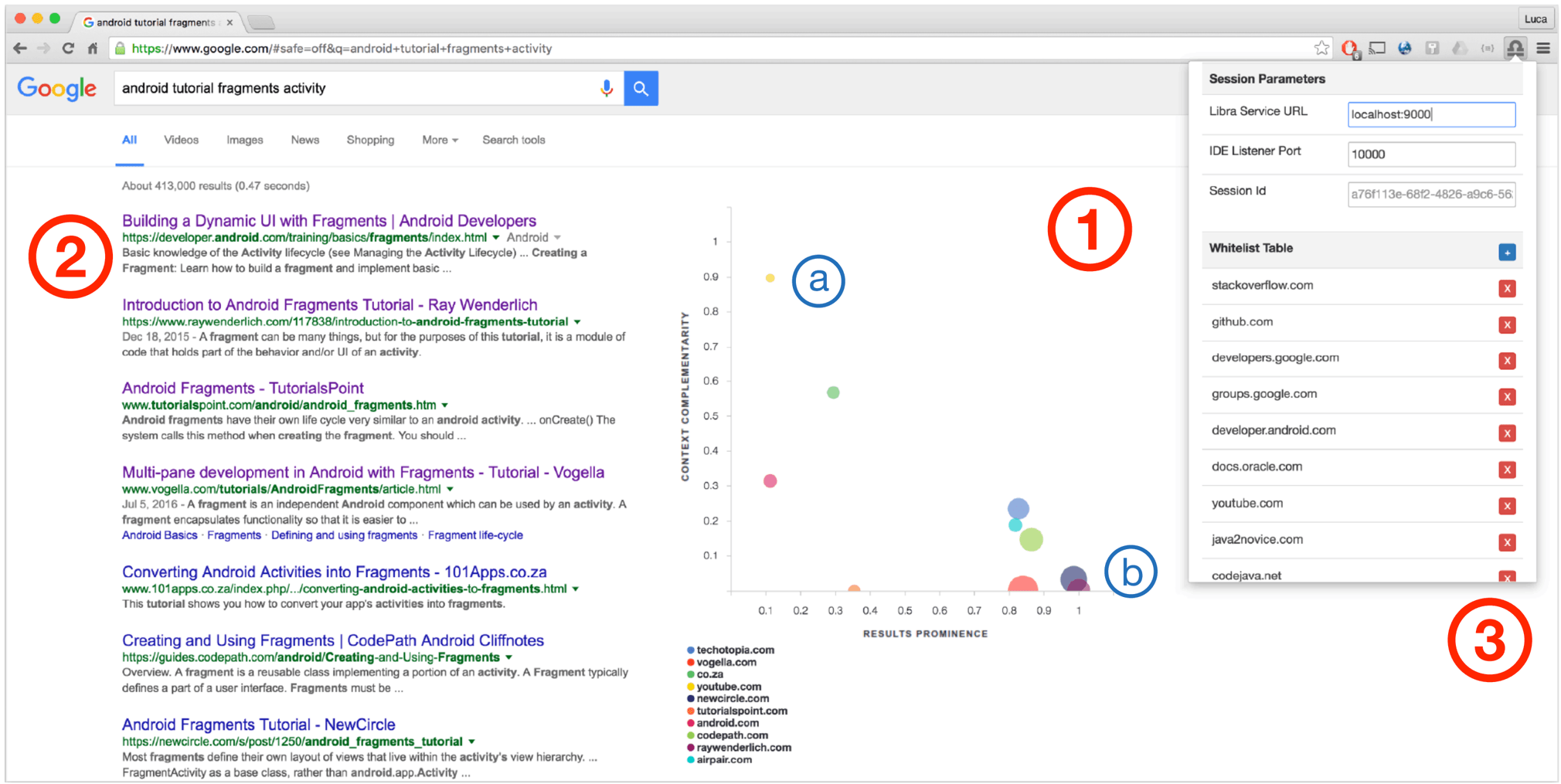
The promise of recommender systems is to provide intelligent support to developers during their programming tasks. Such support ranges from suggesting program entities to taking into account pertinent QnA pages. However, current recommender systems limit the context analysis to change history and developers' activities in the IDE, without considering what a developer has already consulted or perused, e.g., by performing searches from the Web browser. Given the faceted nature of many programming tasks, and the incompleteness of the information provided by a single artifact, several heterogeneous resources are required to obtain the broader picture needed by a developer to accomplish a task. We present Libra, a holistic recommender system. It supports the process of searching and navigating the information needed by constructing a holistic meta-information model of the resources perused by a developer, analyzing their semantic relationships, and augmenting the web browser with a dedicated interactive navigation chart. The quantitative and qualitative evaluation of Libra provides evidence that a holistic analysis of a developer's information context can indeed offer comprehensive and contextualized support to information navigation and retrieval during software development.
Holistic Recommender Systems for Software Engineering
Luca Ponzanelli · Doctor of Philosophy in Informatics
Too Long; Didn't Watch! Extracting Relevant Fragments from Software Development Video Tutorials
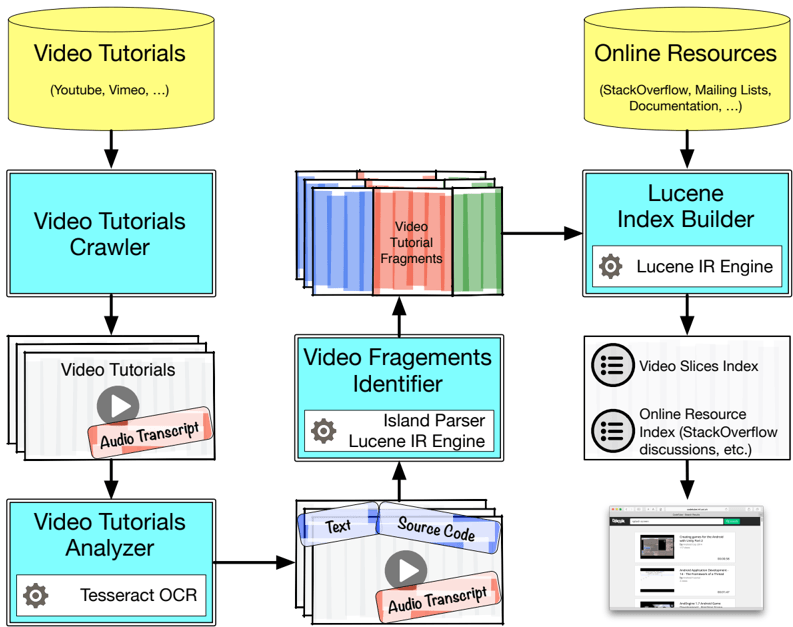
When knowledgeable colleagues are not available, developers resort to offline and online resources, e.g. tutorials, mailing lists, and Q&A websites. These, however, need to be found, read, and understood, which takes its toll in terms of time and mental energy. A more immediate and accessible resource are video tutorials found on the web, which in recent years have seen a steep increase in popularity. Nonetheless, videos are an intrinsically noisy data source, and finding the right piece of information might be even more cumbersome than using the previously mentioned resources. We present CodeTube, an approach which mines video tutorials found on the web, and enables developers to query their contents. The video tutorials are split into coherent fragments, to return only fragments related to the query. These are complemented with information from additional sources, such as Stack Overflow discussions. The results of two studies to assess CodeTube indicate that video tutorials - if appropriately processed - represent a useful, yet still under-utilized source of information for software development.
CodeTube: Extracting Relevant Fragments from Software Development Video Tutorials
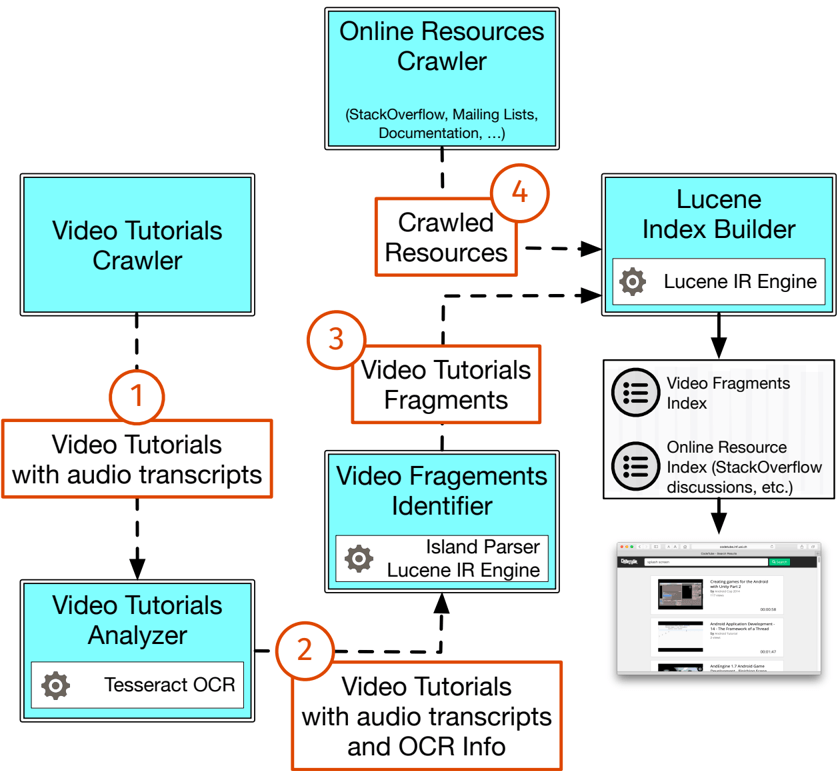
Nowadays developers heavily rely on sources of informal documentation. Examples include Q&A forums, slides, or video tutorials, the latter being particularly useful to provide introductory notions for a piece of technology. The current practice is that developers have to browse sources individually, which in the case of video tutorials is cumbersome, as they are lengthy and cannot be searched based on their contents. We present CodeTube, a Web-based recommender system that analyzes the contents of video tutorials and is able to provide, given a query, cohesive and self-contained video fragments, along with links to relevant Stack Overflow discussions. CodeTube relies on a combination of textual analysis and image processing applied on video tutorial frames and speech transcripts to split videos into cohesive fragments, index them and identify related Stack Overflow discussions.
Mining Unit Tests for Code Recommendation
Developers spend a significant portion of their time understanding and learning the correct usage of the APIs of libraries they want to integrate in their projects. However, learning how to effectively use APIs is complex and time consuming. Code recommendation systems play a crucial role facilitating developers in this task by providing to them relevant examples while they code. This paper proposes a novel approach to code recommendation in which code examples are automatically obtained by mining and manipulating unit tests. In this paper we discuss the theoretical and practical implications that underpin this idea. The discussion leads to a series of fascinating research challenges that we organized in a research agenda.