Testing & Analysis
Browse all content with this tag
Behavioral validation of JFSL specifications through model synthesis
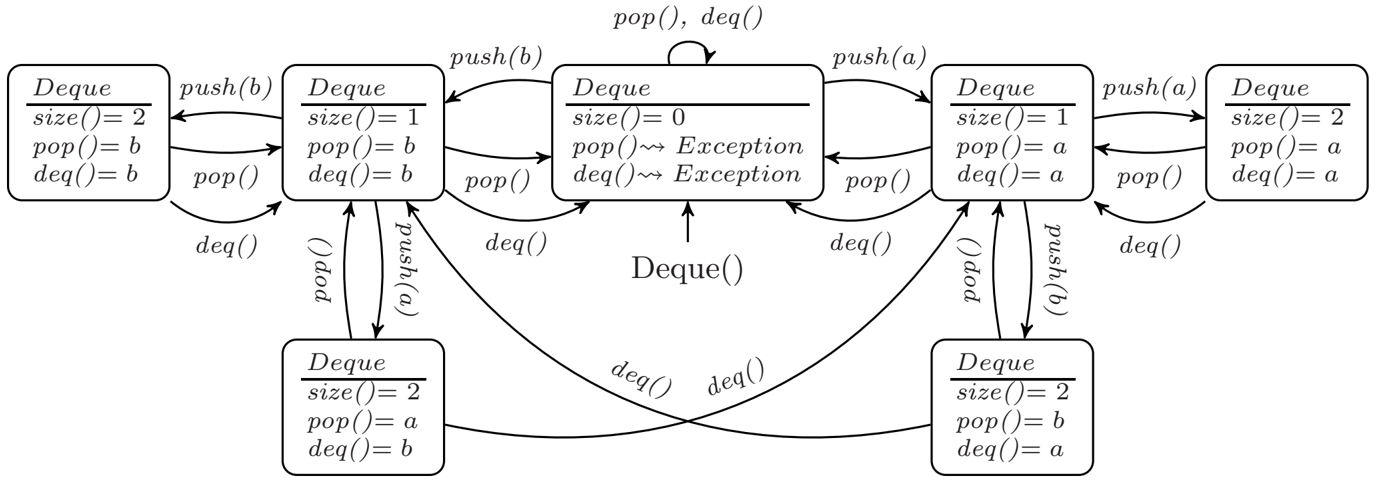
Contracts are a popular declarative specification technique to describe the behavior of stateful components in terms of pre/post conditions and invariants. Since each operation is specified separately in terms of an abstract implementation, it may be hard to understand and validate the resulting component behavior from contracts in terms of method interactions. In particular, properties expressed through algebraic axioms, which specify the effect of sequences of operations, require complex theorem proving techniques to be validated. In this paper, we propose an automatic small-scope based approach to synthesize incomplete behavioral abstractions for contracts expressed in the JFSL notation. The proposed abstraction technique enables the possibility to check that the contract behavior is coherent with behavioral properties expressed as axioms of an algebraic specifications. We assess the applicability of our approach by showing how the synthesis methodology can be applied to some classes of contract-based artifacts like specifications of data abstractions and requirement engineering models.
Dynamic Synthesis of Program Invariants using Genetic Programming
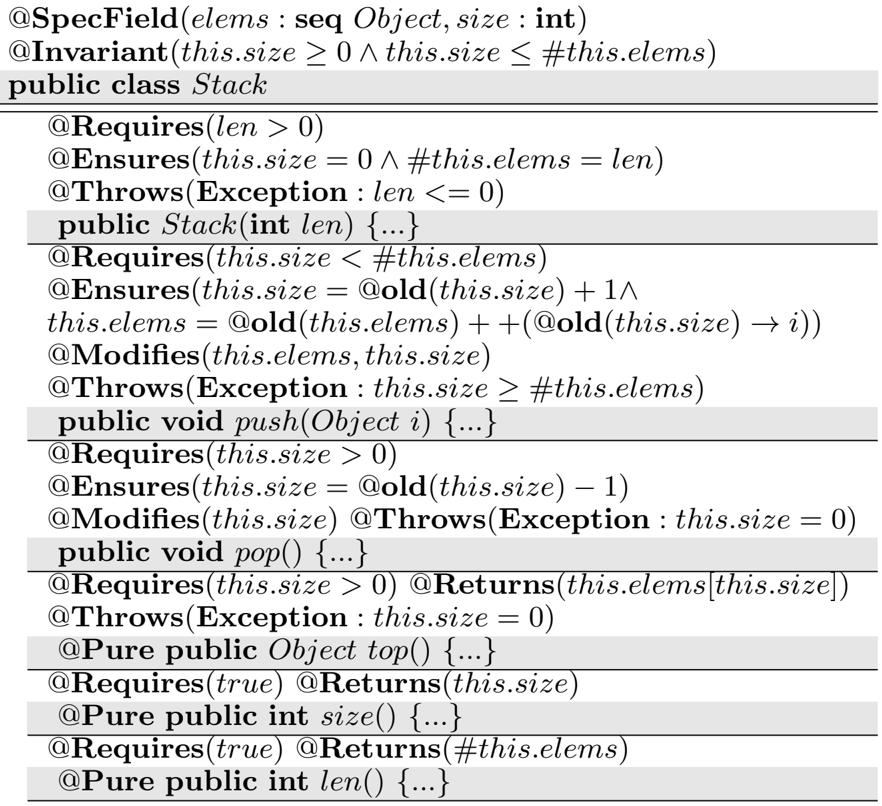
Symbolic program manipulation plays a key role in program comprehension and verification. Logic formulae are used to represent the program' s state and transformation rules describe the effect of statement executions on the program's state. A well-known problem arises in the case of loops, since the number of iterations is generally unknown. The effect of a loop is therefore abstracted into a loop invariant, whose derivation cannot in general be automated and requires human ingenuity. In this paper, we present a preliminary approach that in tegrates genetic programming into the synthesis of invariant formula that describes the behavior of a loop. We present a specific representation of formulae that works well with loops manipulating arrays. The technique has been validated with a set of relevant examples with increasing complexity. The preliminary results are promising and show the feasibility of our approach.
Automatic Cross Validation of Multiple Specifications: A Case Study
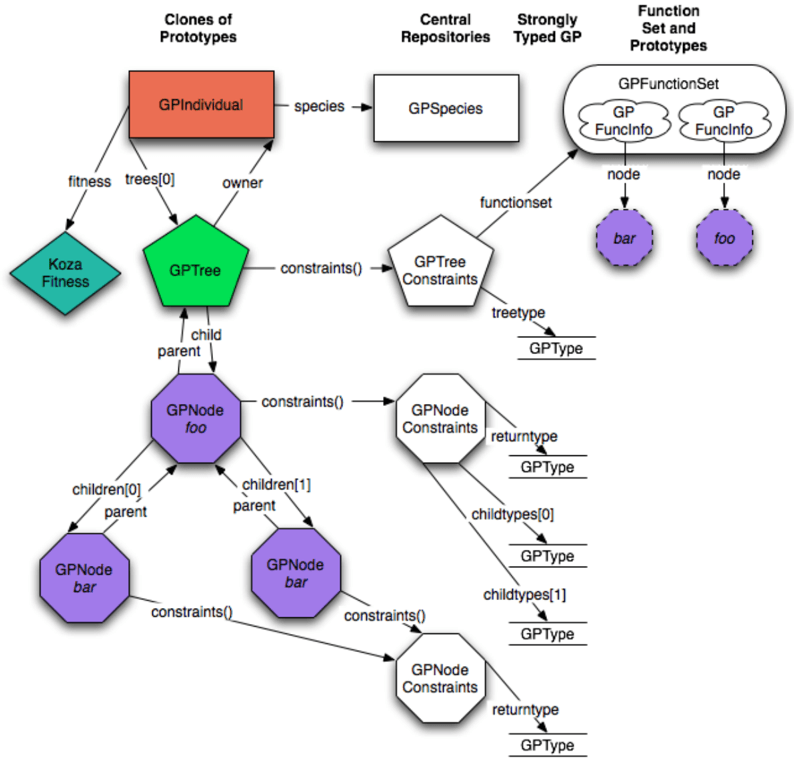
The problem of formal software specification has been addressed and discussed since the infancy of software engineering. However, among all the proposed solutions, none is universally accepted yet. Many different formal descriptions can in fact be given for the same software component; thus, the problem of determining the consistency relation among those descriptions becomes relevant and potentially critical. In this work, we propose a method for comparing two specific kinds of formal specifications of containers. In particular, we check the consistency of intensional behavior models with algebraic specifications. The consistency check is performed by generating a behavioral equivalence model from the intensional model, converting the algebraic axioms into temporal logic formulae, and then checking them against the model by using the NuSMV model checker. An automated software tool which encodes the problem as model checking has been implemented to check the consistency of recovered specifications of relevant Java classes.