Tool Demo Track
Browse all content with this tag
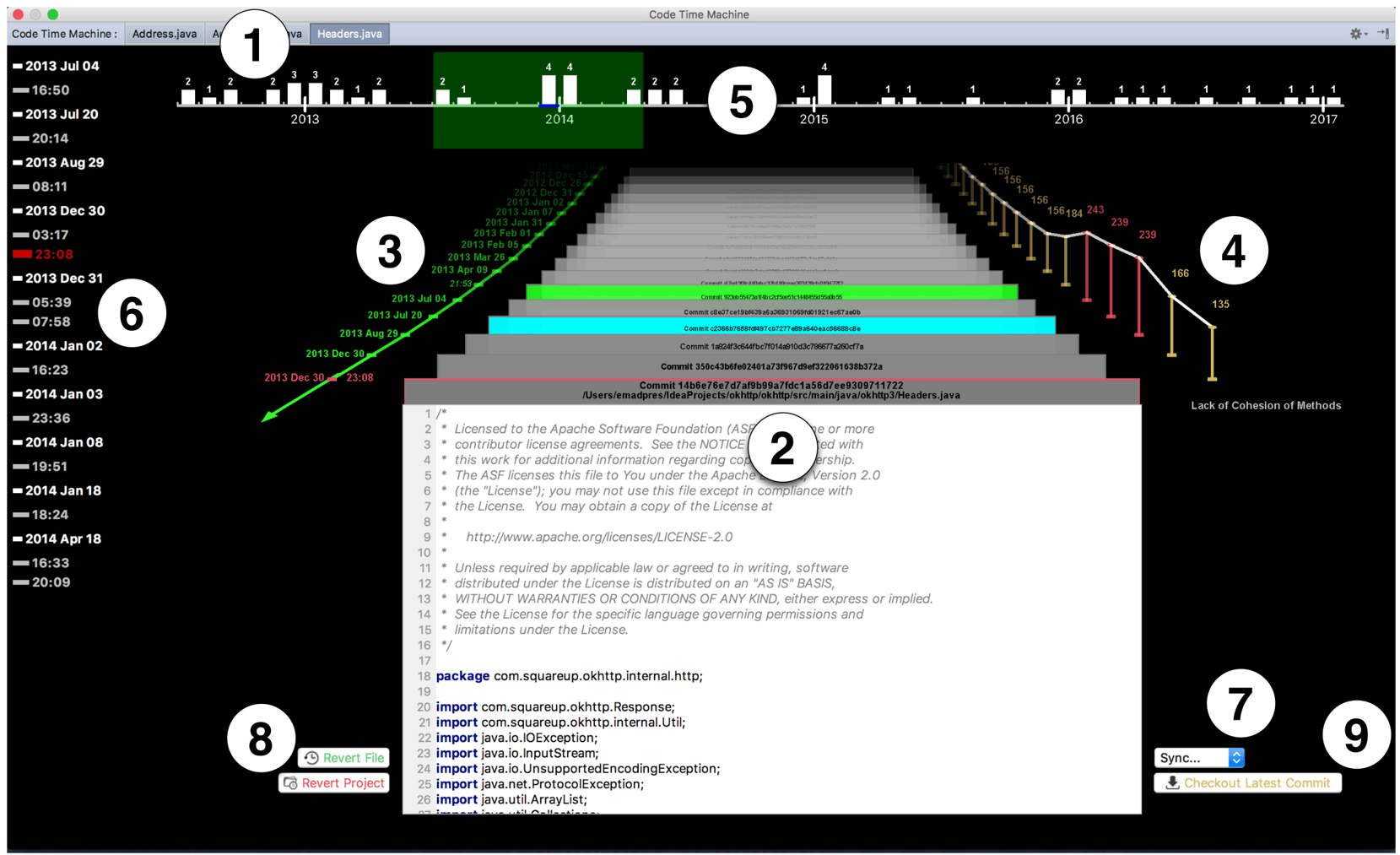
The Code Time Machine
Exploring and analyzing the history of changes is an intrinsic part of software evolution comprehension. Existing tools that exploit the data residing in version control repositories provide only limited support for the intuitive navigation of code changes from a historical perspective. We present the Code Time Machine, a lightweight IDE plugin which uses visualization techniques to depict the history of any chosen file augmented with information mined from the underlying versioning system. Inspired by Apple's Time Machine, our tool allows both developers and the system itself to seamlessly move through time.
CodeTube: Extracting Relevant Fragments from Software Development Video Tutorials
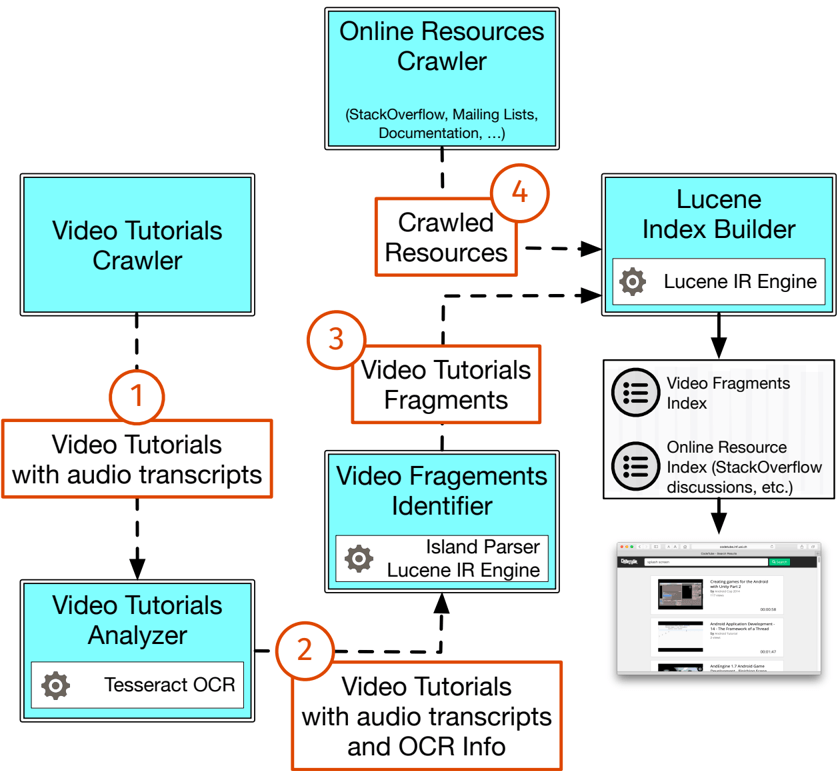
Nowadays developers heavily rely on sources of informal documentation. Examples include Q&A forums, slides, or video tutorials, the latter being particularly useful to provide introductory notions for a piece of technology. The current practice is that developers have to browse sources individually, which in the case of video tutorials is cumbersome, as they are lengthy and cannot be searched based on their contents. We present CodeTube, a Web-based recommender system that analyzes the contents of video tutorials and is able to provide, given a query, cohesive and self-contained video fragments, along with links to relevant Stack Overflow discussions. CodeTube relies on a combination of textual analysis and image processing applied on video tutorial frames and speech transcripts to split videos into cohesive fragments, index them and identify related Stack Overflow discussions.
UrbanIt: Visualizing Repositories Everywhere
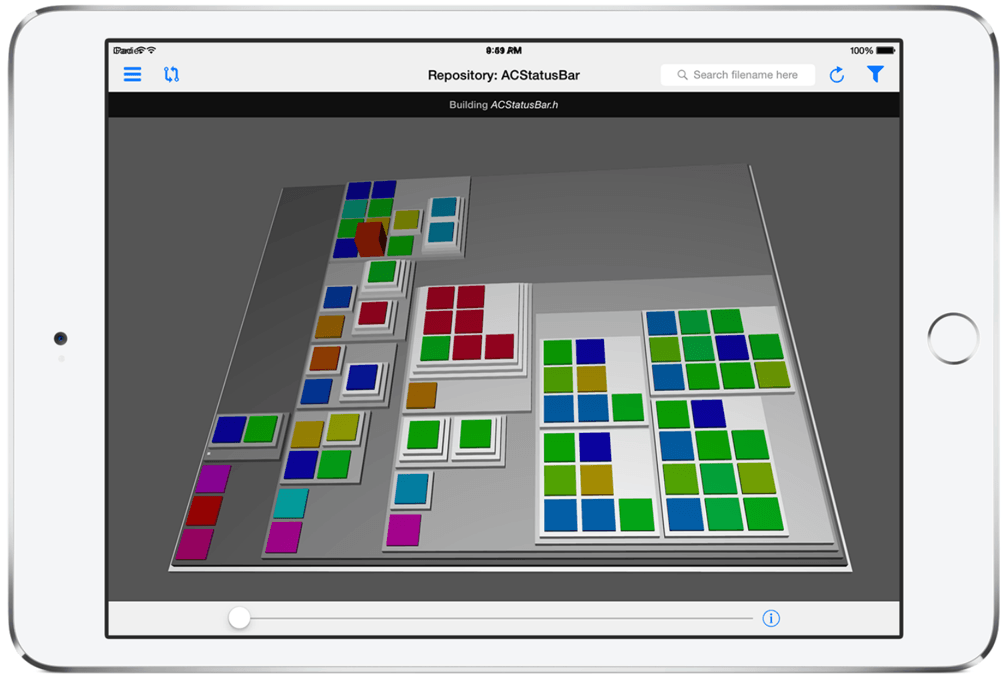
Software evolution is supported by a variety of tools that help developers understand the structure of a software system, analyze its history and support specific classes of analyses. However, the increasingly distributed nature of software development requires basic repository analyses to be always available to developers, even when they cannot access their workstation with full-fledged applications and command-line tools. We present UrbanIt, a gesture-based tablet application for the iPad that supports the visualization of software repositories together with useful evolutionary analyses (e.g., version diff) and basic sharing features in a portable and mobile setting. UrbanIt is paired with a web application that manages synchronization of multiple repositories.
ViDI: The Visual Design Inspector
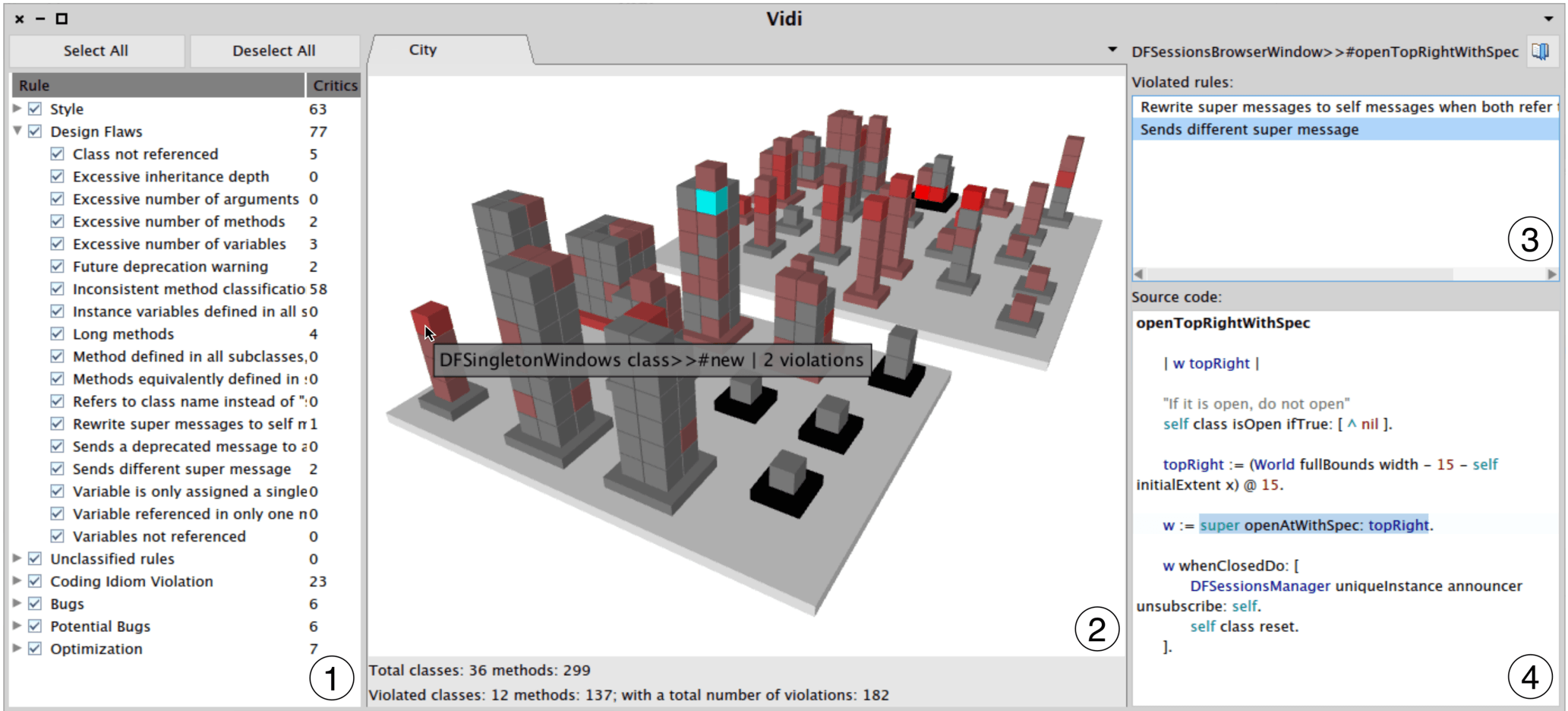
We present ViDI (Visual Design Inspector), a novel code review tool which focuses on quality concerns and design inspection as its cornerstones. It leverages visualization techniques to represent the reviewed software and augments the visualization with the results of quality analysis tools. To effectively understand the contribution of a reviewer in terms of the impact of her changes on the overall system quality, ViDI supports the recording and further inspection of reviewing sessions. ViDI is an advanced prototype which we will soon release to the Pharo open-source community.
Runtime Monitoring of Component Changes with Spy@Runtime
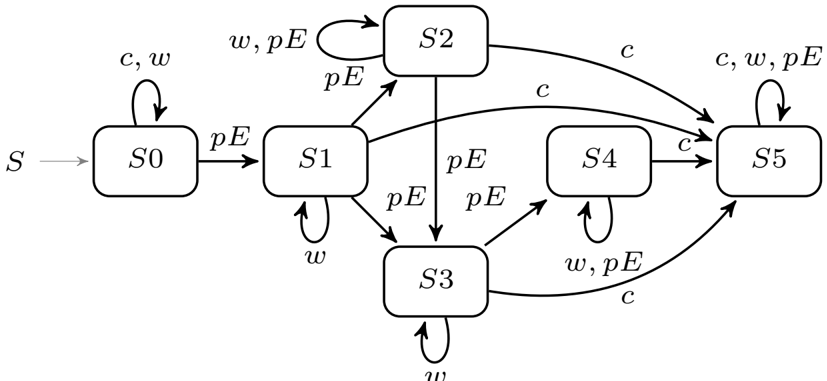
We present Spy@Runtime, a tool to infer and work with behavior models. Spy@Runtime generates models through a dynamic black box approach and is able to keep them updated with observations coming from actual system execution. We also show how to use models describing the protocol of interaction of a software component to detect and report functional changes as soon as they are discovered. Monitoring functional properties is particularly useful in an open environment in which there is a distributed ownership of a software system. Parts of the system may be changed independently and therefore it becomes necessary to monitor the component's behavior at run time.