
Alberto Bacchelli

Collaborations with Alberto Bacchelli
University of Zurich, Switzerland
Co-Authored Publications
Mining structured data in natural language artifacts with island parsing
Software repositories typically store data composed of structured and unstructured parts. Researchers mine this data to empirically validate research ideas and to support practitioners' activities. Structured data (e.g., source code) has a formal syntax and is straightforward to analyze; unstructured data (e.g., documentation) is a mix of natural language, noise, and snippets of structured data, and it is harder to analyze. Especially the structured content (e.g., code snippets) in unstructured data contains valuable information. Researchers have proposed several approaches to recognize, extract, and analyze structured data embedded in natural language. We analyze these approaches and investigate their drawbacks. Subsequently, we present two novel methods, based on scannerless generalized LR (SGLR) and Parsing Expression Grammars (PEGs), to address these drawbacks and to mine structured fragments within unstructured data. We validate and compare these approaches on development emails and Stack Overflow posts with Java code fragments. Both approaches achieve high precision and recall values, but the PEG-based one achieves better computational performances and simplicity in engineering.
Quantitatively Exploring Non-code Software Artifacts
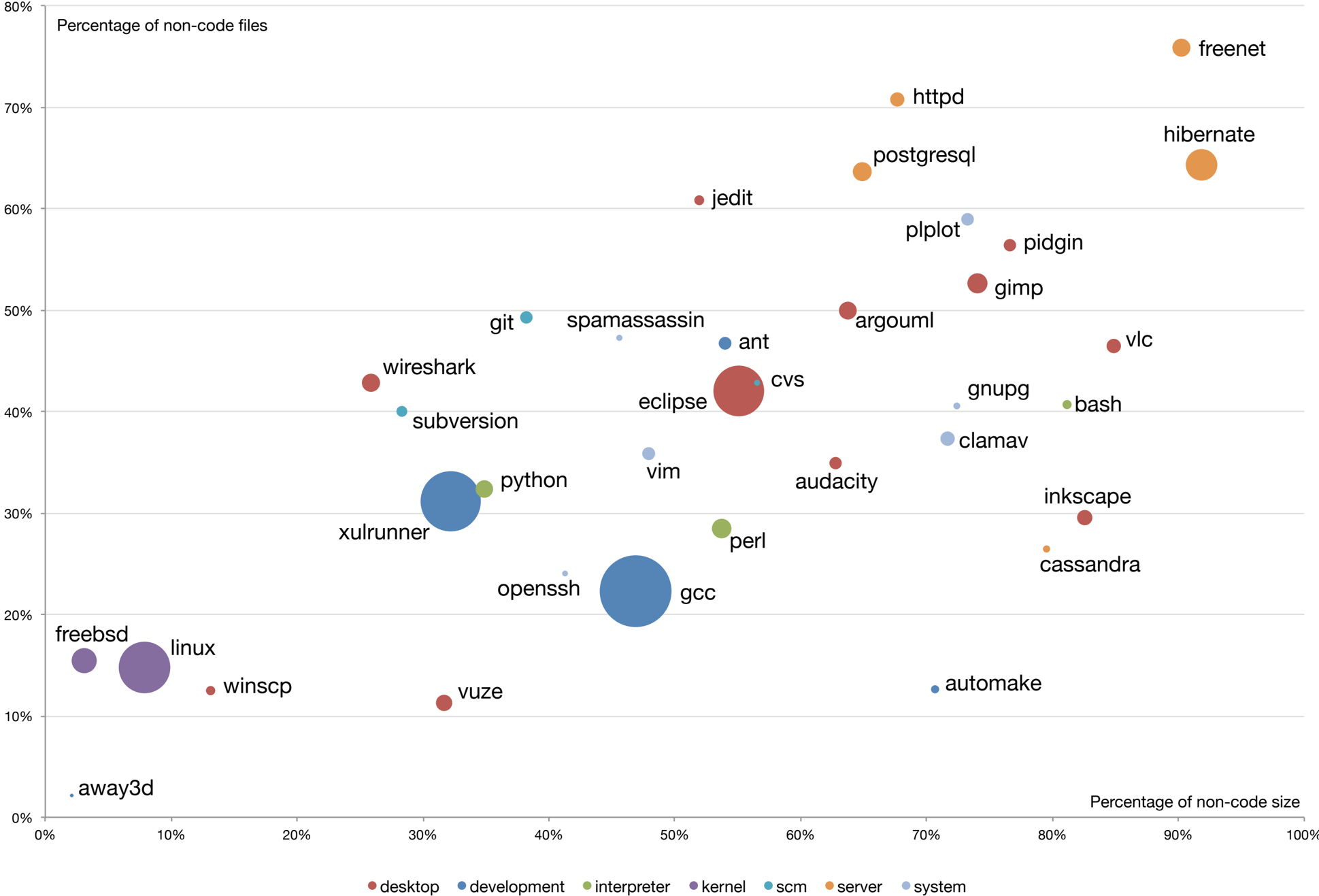
Most software engineering research focuses its analyses on source code, because correct, well designed, and efficient program code is the desired end output of software development. Nevertheless, source code is not the only constituent of software systems: Programs also comprise other types of artifacts, such as documentation, build system and configuration files, and graphics. These non-code artifacts only recently got the attention of researchers and are not yet investigated as a whole, but separately and with very specific aims. By taking a quantitative perspective, we look into non-code software artifacts to measure their role in software systems. We analyze 35 mature open-source software systems and we address exploratory questions such as: How many non-code software artifacts do software systems contain? How do they relate to source code? How much effort is put into producing and maintaining them? Our results show that a significant portion of systems is made of non-code artifacts, and that programmers spend a relevant part of their effort on non-code artifacts during the development process. Our analysis opens questions for future investigations.
Understanding and Classifying the Quality of Technical Forum Questions
Technical questions and answers (Q&A) services have become a valuable resource for developers. A prominent example of technical Q&A website is StackOverflow (SO), which relies on a growing community of more than two millions of users who actively contribute by asking questions and providing answers. To maintain the value of this resource, poor quality questions - among the more than 6,000 asked daily - have to be filtered out. Currently, poor quality questions are manually identified and reviewed by selected users in SO, this costs considerable time and effort. Automating the process would save time and unload the review queue, improving the efficiency of SO as a resource for developers. We present an approach to automate the classification of questions according to their quality. We present an empirical study that investigates how to model and predict the quality of a question by considering as features both the contents of a post (e.g., from simple textual features to more complex readability metrics) and community-related aspects (e.g., popularity of a user in the community). Our findings show that there is indeed the possibility of at least a partial automation of the costly SO review process.
Improving Low Quality Stack Overflow Post Detection
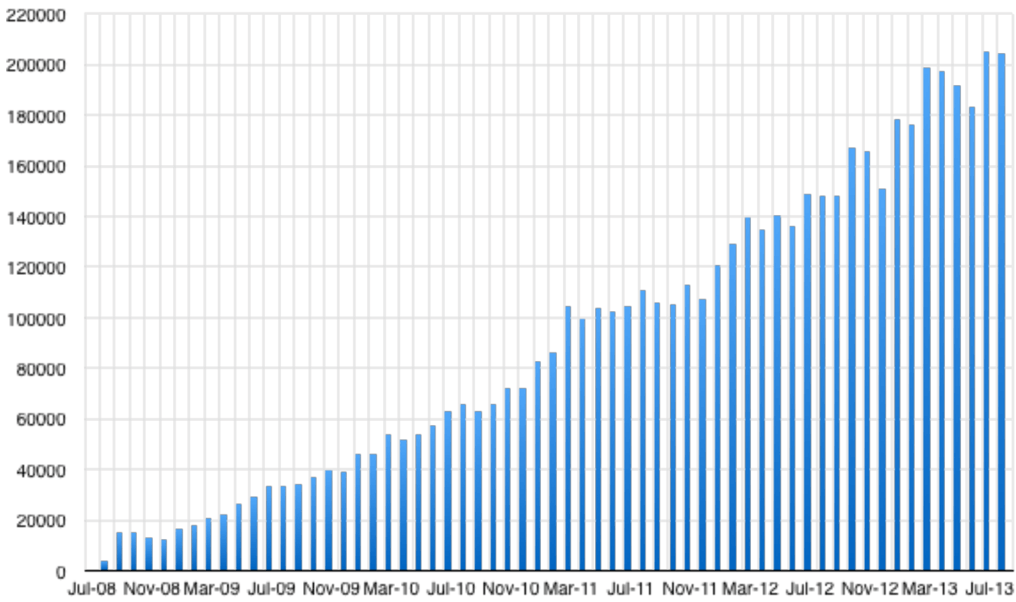
Stack Overflow is a popular questions and answers (Q&A) website among software developers. It counts more than two millions of users who actively contribute by asking and answering thousands of questions daily. Identifying and reviewing low quality posts preserves the quality of site's contents and it is crucial to maintain a good user experience. In Stack Overflow the identification of poor quality posts is performed by selected users manually. The system also uses an automated identification system based on textual features. Low quality posts automatically enter a review queue maintained by experienced users. We present an approach to improve the automated system in use at Stack Overflow. It analyzes both the content of a post (e.g., simple textual features and complex readability metrics) and community-related aspects (e.g., popularity of a user in the community). Our approach reduces the size of the review queue effectively and removes misclassified good quality posts.
Extracting structured data from natural language documents with island parsing
The design and evolution of a software system leave traces in various kinds of artifacts. In software, produced by humans for humans, many artifacts are written in natural language by people involved in the project. Such entities contain structured information which constitute a valuable source of knowledge for analyzing and comprehending a system's design and evolution. However, the ambiguous and informal nature of narrative is a serious challenge in gathering such information, which is scattered throughout natural language text. We present an approach-based on island parsing-to recognize and enable the parsing of structured information that occur in natural language artifacts. We evaluate our approach by applying it to mailing lists pertaining to three software systems. We show that this approach allows us to extract structured data from emails with high precision and recall.