

Projects
SMScom: Self-Managing Situated Computing
Methods and tools for the design, validation, and operation of dependable self-managing situated software.

Teaching and Training Activities
Software Engineering
Software engineering is the discipline of engineering large software systems, that is developing software systems that are available in multiple versions and whose design, development and maintenance involve multiple people. Modern software engineering requires to manage methods, tools and techniques to develop systems on time and on schedule. The course provides the fundamental skills to engineer large software systems, manage a software process, elicit, specify and analyze software requirements, architect and design dependable and maintainable software, validate and verify software systems.
Software
SPY
SPecification RecoverY: inferring behavior models of stateful software components, and using them at run time to detect when a component's behavior changes
Co-Authored Publications
Mining Unit Tests for Code Recommendation
Developers spend a significant portion of their time understanding and learning the correct usage of the APIs of libraries they want to integrate in their projects. However, learning how to effectively use APIs is complex and time consuming. Code recommendation systems play a crucial role facilitating developers in this task by providing to them relevant examples while they code. This paper proposes a novel approach to code recommendation in which code examples are automatically obtained by mining and manipulating unit tests. In this paper we discuss the theoretical and practical implications that underpin this idea. The discussion leads to a series of fascinating research challenges that we organized in a research agenda.
Synthesis of Infinite-State Abstractions and Their Use for Software Validation
In the recent years, several research efforts have been devoted to developing approaches to synthesize specifications of software behavior. Most of the proposed approaches addressed the inference of finite-state abstractions. The synthesized abstractions have been integrated in different validation scenarios, such as testing. While finite-state models can be effectively used as models of a software component’s behavior for certain specific purposes, they can hardly be used as full-fledged specifications. Because of their very limited expressive power, they cannot represent some of the component behaviors and may lead to synthesizing too coarse abstractions. In this paper, we survey a set of approaches that instead infer infinite-state abstractions, which can be used to express richer sets of behaviors of a software component in a black-box manner. For such approaches, we also discuss the few existing applications to software validation. In particular, we discuss the limitations and identify how, in principle, they can be used in different validation scenarios and how this opens new research directions.
Behavioral validation of JFSL specifications through model synthesis
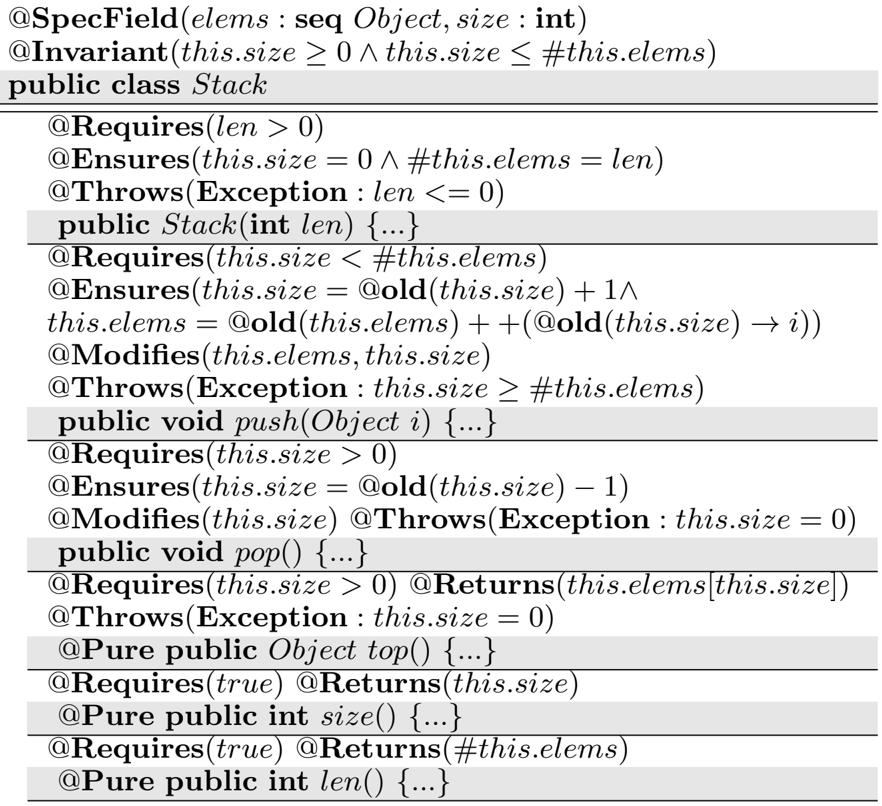
Contracts are a popular declarative specification technique to describe the behavior of stateful components in terms of pre/post conditions and invariants. Since each operation is specified separately in terms of an abstract implementation, it may be hard to understand and validate the resulting component behavior from contracts in terms of method interactions. In particular, properties expressed through algebraic axioms, which specify the effect of sequences of operations, require complex theorem proving techniques to be validated. In this paper, we propose an automatic small-scope based approach to synthesize incomplete behavioral abstractions for contracts expressed in the JFSL notation. The proposed abstraction technique enables the possibility to check that the contract behavior is coherent with behavioral properties expressed as axioms of an algebraic specifications. We assess the applicability of our approach by showing how the synthesis methodology can be applied to some classes of contract-based artifacts like specifications of data abstractions and requirement engineering models.
Runtime Monitoring of Component Changes with Spy@Runtime
We present Spy@Runtime, a tool to infer and work with behavior models. Spy@Runtime generates models through a dynamic black box approach and is able to keep them updated with observations coming from actual system execution. We also show how to use models describing the protocol of interaction of a software component to detect and report functional changes as soon as they are discovered. Monitoring functional properties is particularly useful in an open environment in which there is a distributed ownership of a software system. Parts of the system may be changed independently and therefore it becomes necessary to monitor the component's behavior at run time.
Runtime Monitoring of Functional Component Changes with Behavior Models
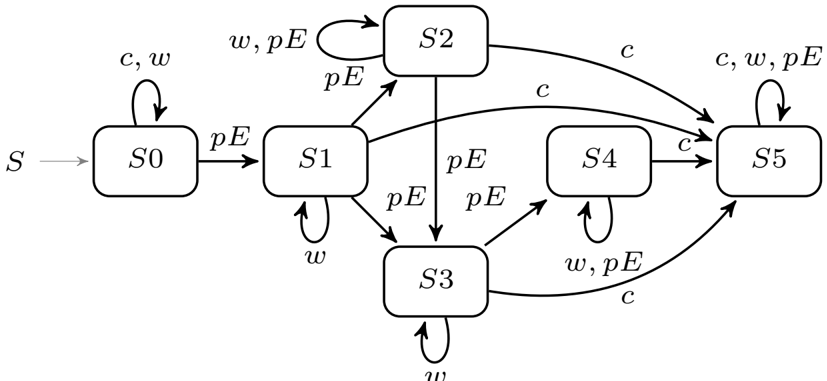
We consider the problem of run-time discovery and continuous monitoring of new components that live in an open environment. We focus on extracting a formal model—which may not be available upfront—by observing the behavior of the running component. We show how the model built at run time can be enriched through new observations (dynamic model update). We also use the inferred model to perform run-time verification. That is, we try to identify if any changes are made to the component that modify its original behavior, contradict the previous observations, and invalidate the inferred model.
Dynamic Synthesis of Program Invariants using Genetic Programming
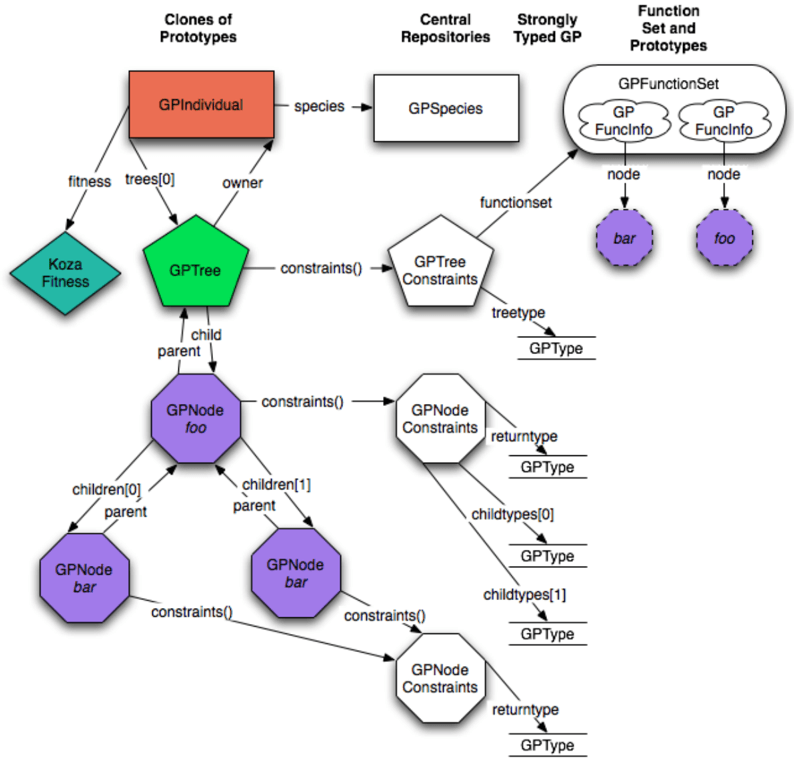
Symbolic program manipulation plays a key role in program comprehension and verification. Logic formulae are used to represent the program' s state and transformation rules describe the effect of statement executions on the program's state. A well-known problem arises in the case of loops, since the number of iterations is generally unknown. The effect of a loop is therefore abstracted into a loop invariant, whose derivation cannot in general be automated and requires human ingenuity. In this paper, we present a preliminary approach that in tegrates genetic programming into the synthesis of invariant formula that describes the behavior of a loop. We present a specific representation of formulae that works well with loops manipulating arrays. The technique has been validated with a set of relevant examples with increasing complexity. The preliminary results are promising and show the feasibility of our approach.
Behavior model based component search: an initial assessment
We focus on the problem of searching components based on semantic queries on their provided interface. Although semantics-based search has long been advocated as a key enabler in the context of component-based software development and, more recently, service-oriented computing, no practical and scalable approach has been proposed yet. This paper presents a promising model-based search technique for interface behaviors based on operational specifications, called behavioral equivalence models (Bems). Semantic queries are expressed equationally, following an algebraic specification style. The search engine tries to match specifications against queries. This can be done quite efficiently by encoding Bems into relational models and queries into relational logic formulae, whose satisfiability is checked with the SAT-based constraint solver KodKod. We can report on an initial very promising assessment of the proposed technique, which has been applied to searching components in Java libraries providing container functionalities.
Automatic Cross Validation of Multiple Specifications: A Case Study
The problem of formal software specification has been addressed and discussed since the infancy of software engineering. However, among all the proposed solutions, none is universally accepted yet. Many different formal descriptions can in fact be given for the same software component; thus, the problem of determining the consistency relation among those descriptions becomes relevant and potentially critical. In this work, we propose a method for comparing two specific kinds of formal specifications of containers. In particular, we check the consistency of intensional behavior models with algebraic specifications. The consistency check is performed by generating a behavioral equivalence model from the intensional model, converting the algebraic axioms into temporal logic formulae, and then checking them against the model by using the NuSMV model checker. An automated software tool which encodes the problem as model checking has been implemented to check the consistency of recovered specifications of relevant Java classes.
Synthesizing intensional behavior models by graph transformation
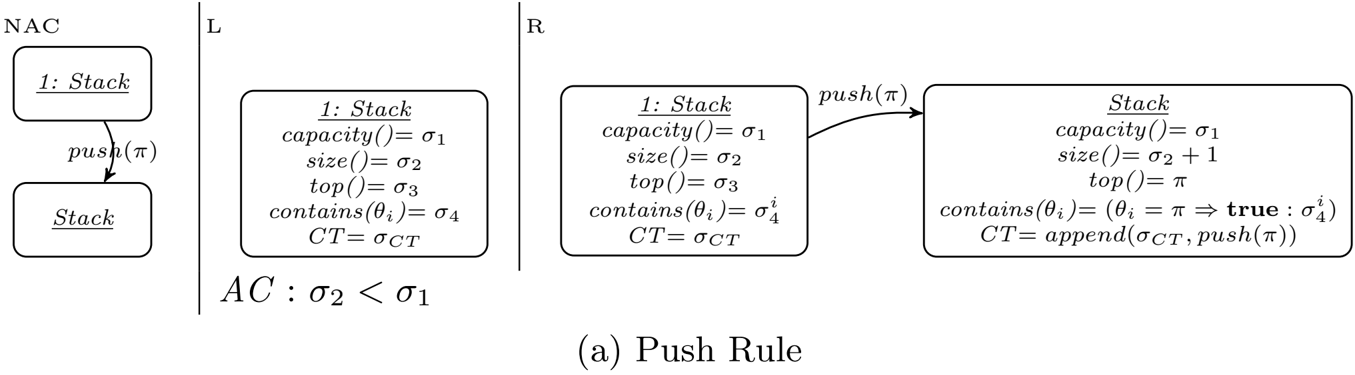
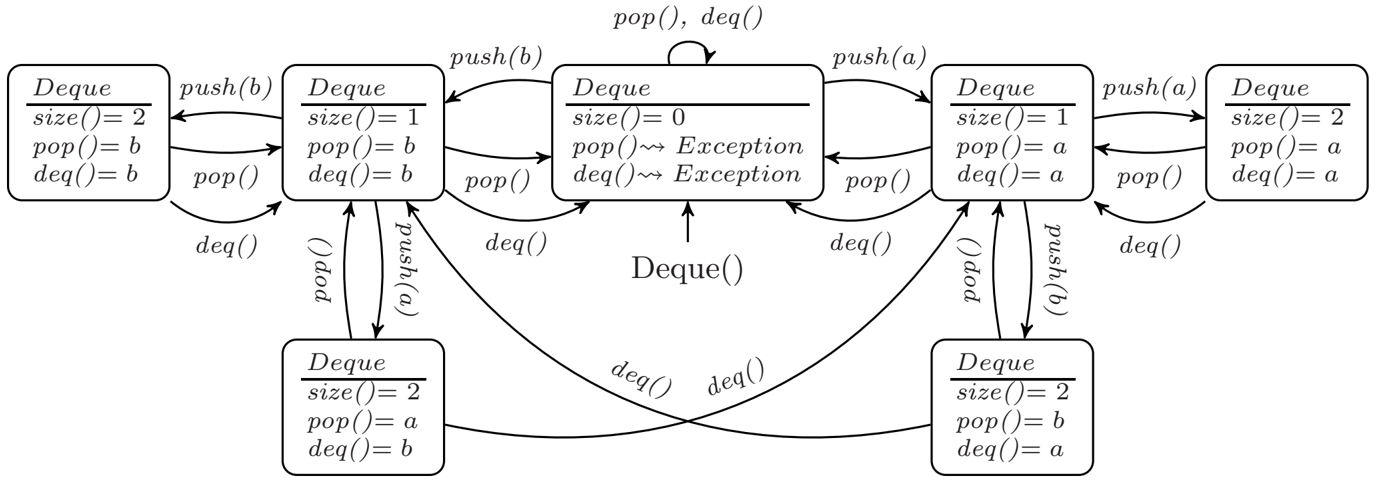
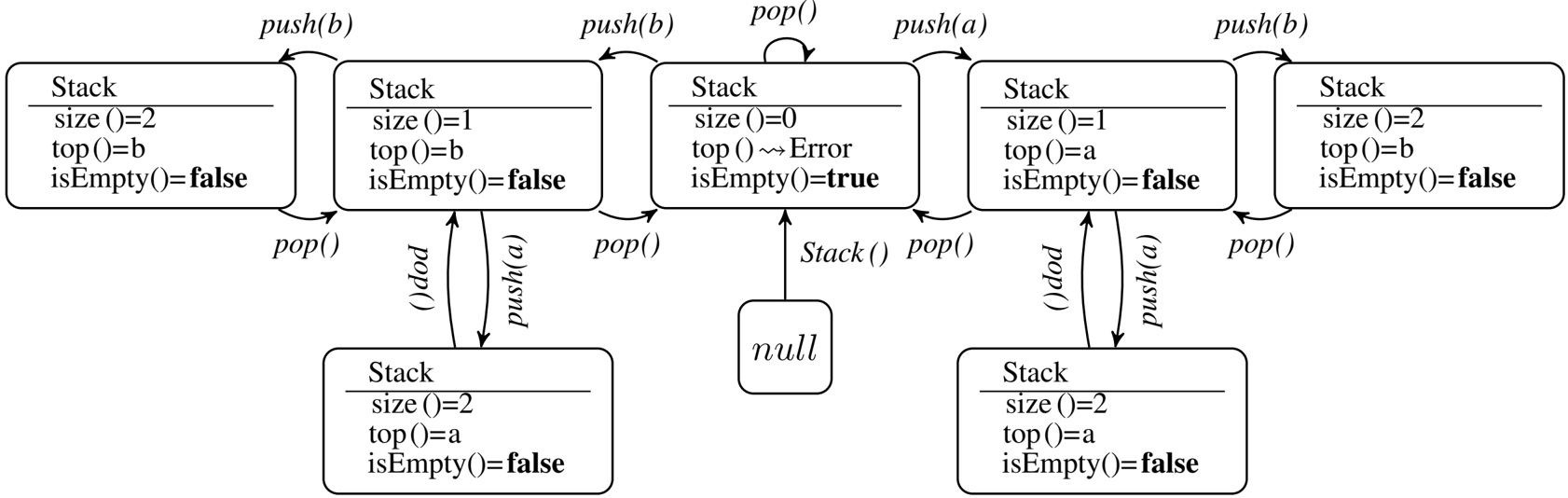
This paper describes an approach (SPY) to recover the specification of a software component from the observation of its run-time behavior. It focuses on components that behave as data abstractions. Components are assumed to be black boxes that do not allow any implementation inspection. The inferred description may help understand what the component does when no formal specification is available. SPY works in two main stages. First, it builds a deterministic finite-state machine that models the partial behavior of instances of the data abstraction. This is then generalized via graph transformation rules. The rules can generate a possibly infinite number of behavior models, which generalize the description of the data abstraction under an assumption of “regularity” with respect to the observed behavior. The rules can be viewed as a likely specification of the data abstraction. We illustrate how SPY works on relevant examples and we compare it with competing methods.
Using graph transformation systems to specify and verify data abstractions
This paper proposes an approach for the specification of the behavior of software components that implement data abstractions. By generalizing the approach of behavior models using graph transformation, we provide a concise specification for data abstractions that describes the relationship between the internal state, represented in a canonical form, and the observers of the component. Graph transformation also supports the generation of behavior models that are amenable to verification. To this end, we provide a translation approach into an LTL model on which we can express useful properties that can be model-checked with a SAT solver.
Efficient recovery of algebraic specifications for stateful components
Specification recovery is a necessary step of many reverse engineering and reuse efforts. This paper deals with recovering the semantic part of a component's interface. It focuses on stateful components that provide data abstractions. Recovery is achieved by following a black-box strategy, i.e. by observing the component's dynamic behavior. Among the published approaches, Heureka recovers algebraic specifications from Java classes. Another approach (Adabu) recovers behavioral models. The work we describe here adapts the latter, which provides an approximate semantic description for the class, to significantly optimize the former. The resulting approach, called Adiheu, is described in the paper with a preliminary assessment.