
Co-Authored Publications
Synthesizing intensional behavior models by graph transformation
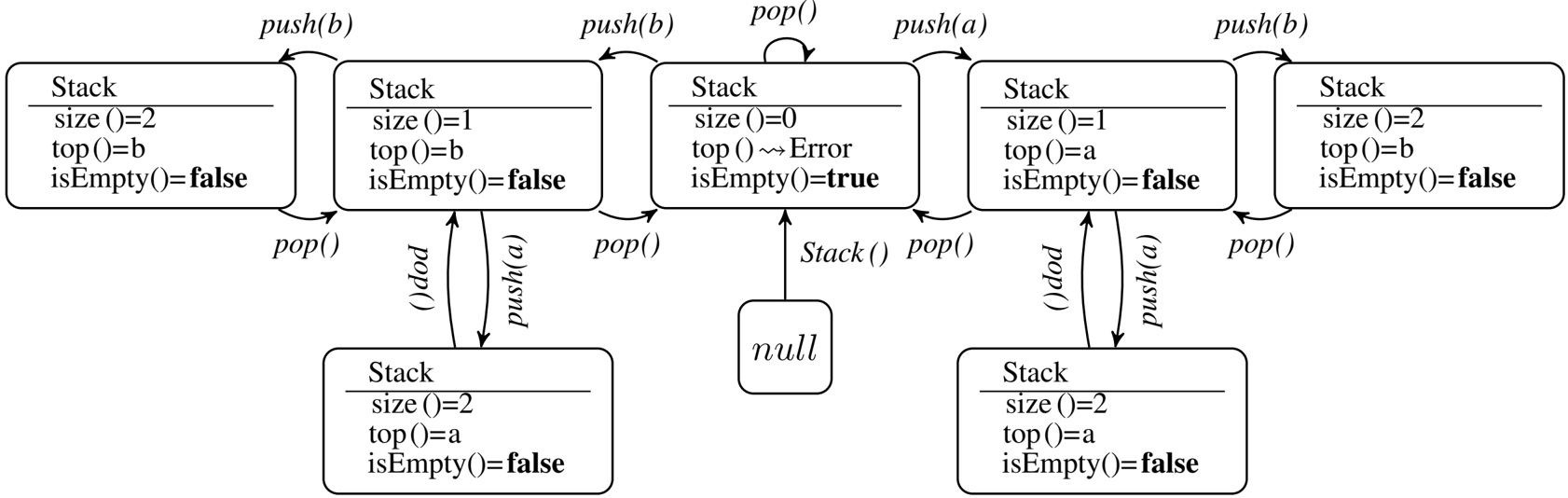
This paper describes an approach (SPY) to recover the specification of a software component from the observation of its run-time behavior. It focuses on components that behave as data abstractions. Components are assumed to be black boxes that do not allow any implementation inspection. The inferred description may help understand what the component does when no formal specification is available. SPY works in two main stages. First, it builds a deterministic finite-state machine that models the partial behavior of instances of the data abstraction. This is then generalized via graph transformation rules. The rules can generate a possibly infinite number of behavior models, which generalize the description of the data abstraction under an assumption of “regularity” with respect to the observed behavior. The rules can be viewed as a likely specification of the data abstraction. We illustrate how SPY works on relevant examples and we compare it with competing methods.
Using graph transformation systems to specify and verify data abstractions
This paper proposes an approach for the specification of the behavior of software components that implement data abstractions. By generalizing the approach of behavior models using graph transformation, we provide a concise specification for data abstractions that describes the relationship between the internal state, represented in a canonical form, and the observers of the component. Graph transformation also supports the generation of behavior models that are amenable to verification. To this end, we provide a translation approach into an LTL model on which we can express useful properties that can be model-checked with a SAT solver.
Efficient recovery of algebraic specifications for stateful components
Specification recovery is a necessary step of many reverse engineering and reuse efforts. This paper deals with recovering the semantic part of a component's interface. It focuses on stateful components that provide data abstractions. Recovery is achieved by following a black-box strategy, i.e. by observing the component's dynamic behavior. Among the published approaches, Heureka recovers algebraic specifications from Java classes. Another approach (Adabu) recovers behavioral models. The work we describe here adapts the latter, which provides an approximate semantic description for the class, to significantly optimize the former. The resulting approach, called Adiheu, is described in the paper with a preliminary assessment.