Project Description (from SNSF website)
In the nineteenth century, Switzerland was not a poor country by global standards but was relatively under-developed, with a mostly closed, agricultural economy. In the last century, the economy has been transformed. Agricultural output has been replaced by high-tech industry. Smaller companies with simple financing structures have been replaced by complex corporate entities with overlapping ownership and sophisticated financial obligations. Intense international competition has repeatedly forced Switzerland’s export-oriented economy to constantly adapt and reinvent itself. Were these successes an accident? Following in a long transdisciplinary research tradition, this project analyzes the institutional foundations for the Swiss economic success story. We explore how shifts in taxation, regulation, and ownership structure have propelled the evolution in industrialization, financialization, and globalization. To pursue these substantive goals, we will produce a new historical dataset describing 140 years of Swiss business activity.
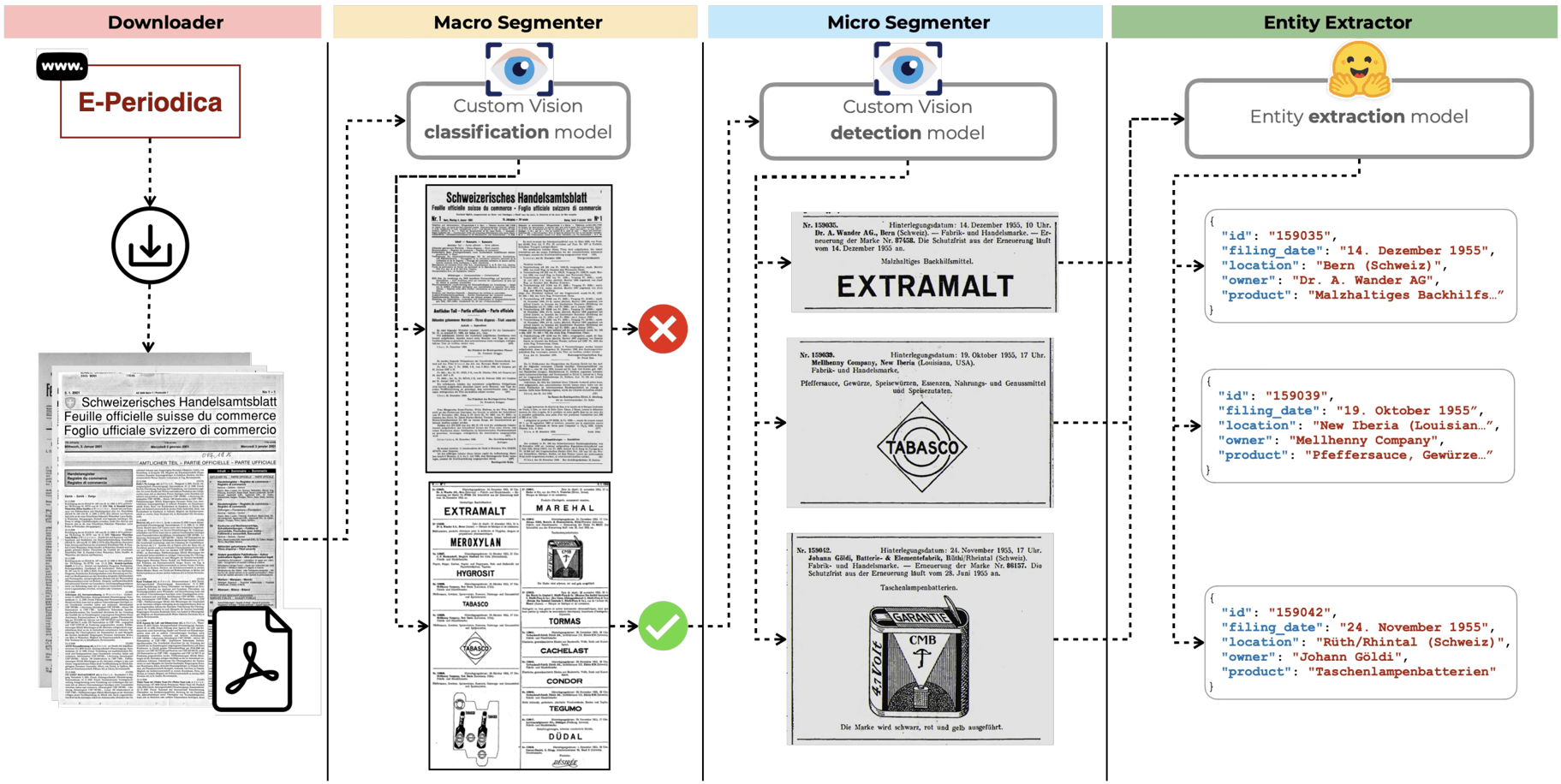
We start with the Swiss Commercial Registry↗, a venerable daily publication recording granular business events — foundings, relocations, incorporations, acquisitions, bankruptcies, etc. — since 1883. We have access to a newly digitized archive of the registry since its inception, comprising 600GB of scanned documents. We will process these scanned PDFs to extract relevant business events and their important features. The difficulty is that the data points of interest currently reside in the unstructured text of the registry items. Thus, the major lift of this project is converting the registry texts to structured variables amenable to analysis.
Using tools from computational linguistics and information extraction, we will build histories of specific firms (corporate entities) and people (human entities) by matching them across events over time. Addresses will be used to geolocalize firms, and we will apply machine learning to names to infer gender, nationality, and other demographic characteristics. Further, we will build detailed records on corporate form, bankruptcies, and product trademarks. This dataset of Swiss economic history will be the first of its kind, potentially forming the basis of hundreds of academic projects across multiple disciplines. Alongside the statistical data, we build a searchable data platform usable by qualitative researchers, policymakers, journalists, and the wider public. Our data and tools will be useful for policymakers and businesses in Switzerland and beyond.
Our data collection is motivated by substantive questions in which economics, law, and political science share a common interest. First, we analyze variation in the tax systems across municipalities and over time to understand how these local taxes influenced firm location decisions and firm outcomes. Second, we use the differences across cantons in commercial laws and regulations to see what legal rules led to more or less industrialization and financialization. Third, we explore structures of ownership in Swiss firms across sectors and over time — including the public-private aspect, family relationships, cultural factors, and politics. We are an interdisciplinary consortium of computer scientists, economists, lawyers, and political scientists, well-positioned for delivering on this project. We all have experience in developing and analyzing large-scale social datasets. We have substantial expertise, in particular, in the analysis of natural language data. We have analyzed the political economy of business in a variety of settings, not just in Switzerland but in the European Union, Africa, and the United States. We have established contacts with research groups and government agencies working on synergistic projects.