Publications
An Annotation-based API for Supporting Runtime Code Annotation Reading
Code annotations are the core of the main APIs and frameworks for enterprise development, and are widely used on several applications. However, despite these APIs and frameworks made advanced uses of annotations, the language API for annotation reading is far from their needs. In particular, annotation reading is still a relatively complex task, that can consume a lot of development time and that can couple the framework internal structure to its annotations. This paper proposes an annotation-based API to retrieve metadata from code annotations and populate an instance with meta-information ready to be used by the framework. The proposed API is based on best practices and approaches for metadata definition documented on patterns, and has been implemented by a framework named Esfinge Metadata. We evaluated the approach by refactoring an existing framework to use it through Esfinge Metadata. The original and the refactored versions are compared using several code assessment techniques, such as software metrics, and bad smells detection, followed by a qualitative analysis based on source code inspection. As a result, the case study revealed that the usage of the proposed API can reduce the coupling between the metadata reading code and the annotations.
The Code Time Machine
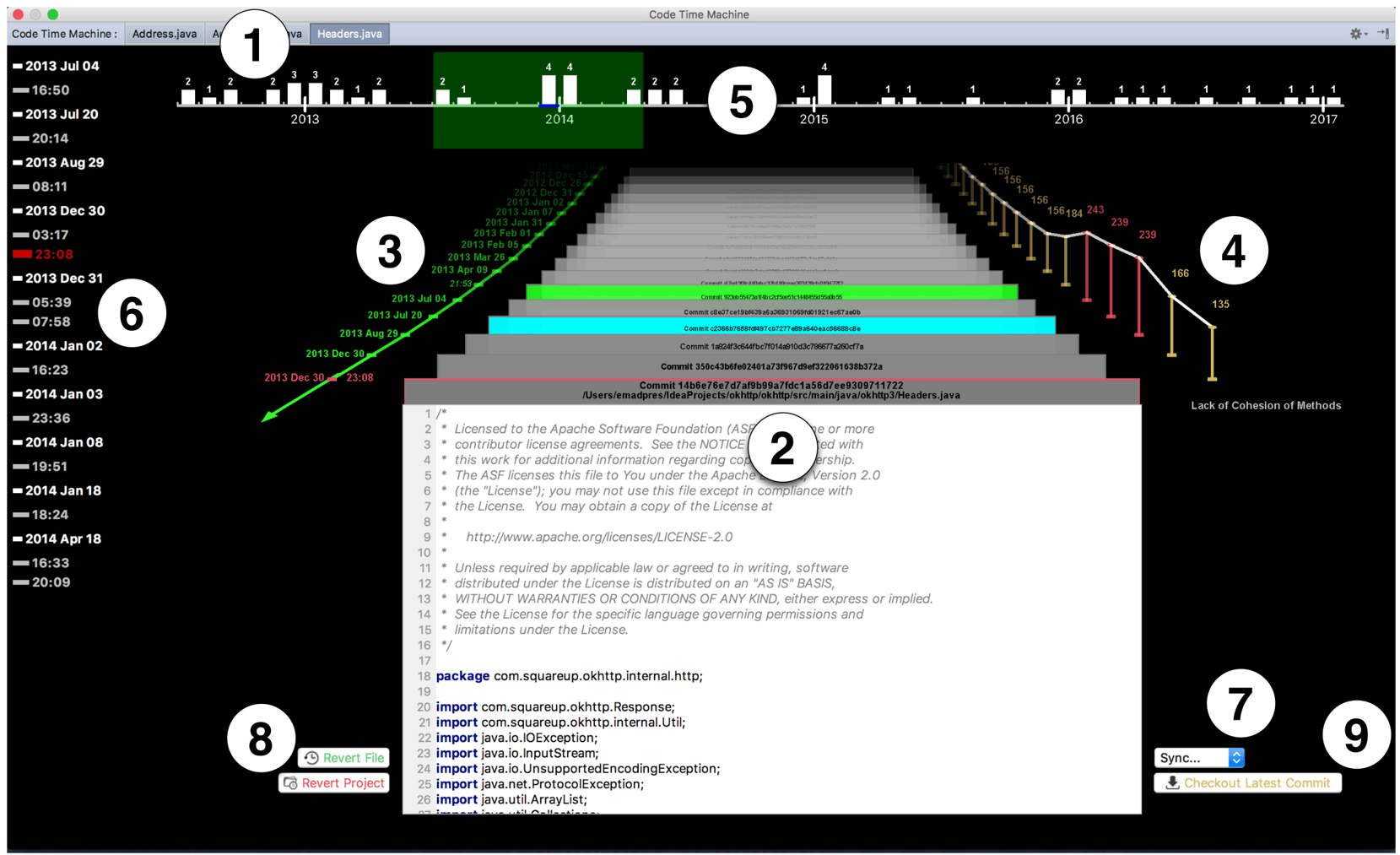
Exploring and analyzing the history of changes is an intrinsic part of software evolution comprehension. Existing tools that exploit the data residing in version control repositories provide only limited support for the intuitive navigation of code changes from a historical perspective. We present the Code Time Machine, a lightweight IDE plugin which uses visualization techniques to depict the history of any chosen file augmented with information mined from the underlying versioning system. Inspired by Apple's Time Machine, our tool allows both developers and the system itself to seamlessly move through time.
On the Uniqueness of Code Redundancies
Code redundancy widely occurs in software projects. Researchers have investigated the existence, causes, and impacts of code redundancy, showing that it can be put to good use, for example in the context of code completion. When analyzing source code redundancy, previous studies considered software projects as sequences of tokens, neglecting the role of the syntactic structures enforced by programming languages. However, differences in the redundancy of such structures may jeopardize the performance of applications leveraging code redundancy. We present a study of the redundancy of several types of code constructs in a large-scale dataset of active Java projects mined from GitHub, unveiling that redundancy is not uniform and mainly resides in specific code constructs. We further investigate the implications of the locality of redundancy by analyzing the performance of language models when applied to code completion. Our study discloses the perils of exploiting code redundancy without taking into account its strong locality in specific code constructs.
How Developers Document Pull Requests with External References
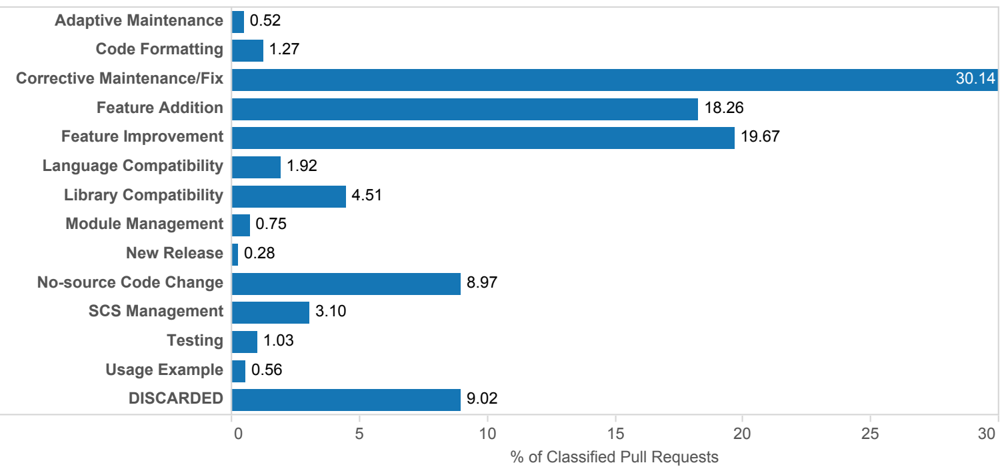
Online resources of formal and informal documentation-such as reference manuals, forum discussions and tutorials-have become an asset to software developers, as they allow them to tackle problems and to learn about new tools, libraries, and technologies. This study investigates to what extent and for which purpose developers refer to external online resources when they contribute changes to a repository by raising a pull request. Our study involved (i) a quantitative analysis of over 150k URLs occurring in pull requests posted in GitHub, (ii) a manual coding of the kinds of software evolution activities performed in commits related to a statistically significant sample of 2,130 pull requests referencing external documentation resources, (iii) a survey with 69 participants, who provided feedback on how they use online resources and how they refer to them when filing a pull request. Results of the study indicate that, on the one hand, developers find external resources useful to learn something new or to solve specific problems, and they perceive useful referring such resources to better document changes. On the other hand, both interviews and repository mining suggest that external resources are still rarely referred in document changes.
Supporting Software Developers with a Holistic Recommender System
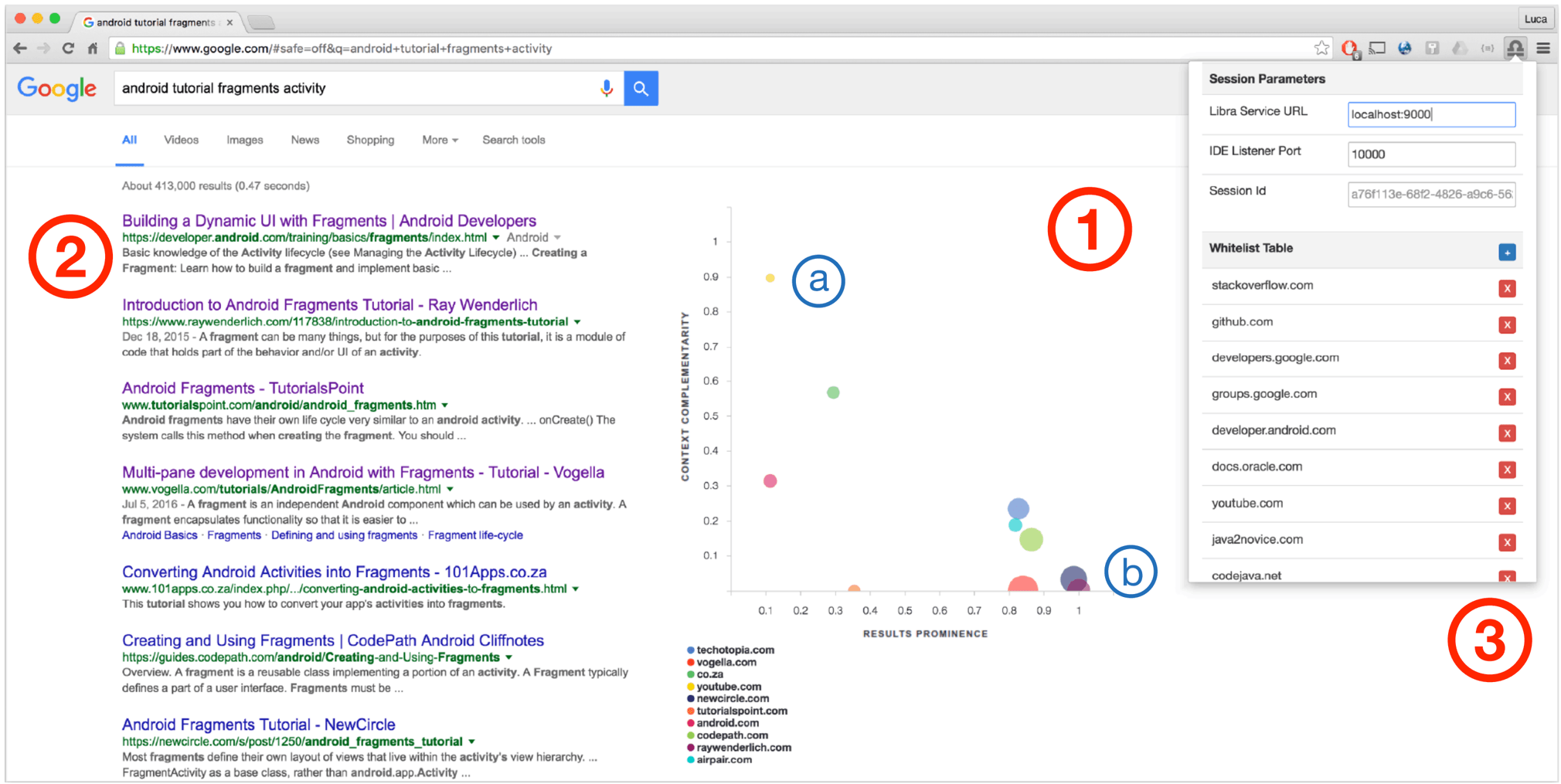
The promise of recommender systems is to provide intelligent support to developers during their programming tasks. Such support ranges from suggesting program entities to taking into account pertinent QnA pages. However, current recommender systems limit the context analysis to change history and developers' activities in the IDE, without considering what a developer has already consulted or perused, e.g., by performing searches from the Web browser. Given the faceted nature of many programming tasks, and the incompleteness of the information provided by a single artifact, several heterogeneous resources are required to obtain the broader picture needed by a developer to accomplish a task. We present Libra, a holistic recommender system. It supports the process of searching and navigating the information needed by constructing a holistic meta-information model of the resources perused by a developer, analyzing their semantic relationships, and augmenting the web browser with a dedicated interactive navigation chart. The quantitative and qualitative evaluation of Libra provides evidence that a holistic analysis of a developer's information context can indeed offer comprehensive and contextualized support to information navigation and retrieval during software development.
How to Gamify Software Engineering
Software development, like any prolonged and intellectually demanding activity, can negatively affect the motivation of developers. This is especially true in specific areas of software engineering, such as requirements engineering, test-driven development, bug reporting and fixing, where the creative aspects of programming fall short. The developers' engagement might progressively degrade, potentially impacting their work's quality. Gamification, the use of game elements and game design techniques in non-game contexts, is hailed as a means to boost the motivation of people for a wide range of rote activities. Indeed, well-designed games deeply involve gamers in a positive loop of production, feedback, and reward, eliciting desirable feelings like happiness and collaboration. The question we investigate is how the seemingly frivolous context of games and gamification can be ported to the technically challenging and sober domain of software engineering. Our investigation starts with a review of the state of the art of gamification, supported by a motivating scenario to expose how gamification elements can be integrated in software engineering. We provide a set of basic building blocks to apply gamification techniques, present a conceptual framework to do so, illustrated in two usage contexts, and critically discuss our findings.
The Tragedy of Defect Prediction, Prince of Empirical Software Engineering Research
If measured by the number of published papers, defect prediction has become an important research field over the past decade, with many researchers continuously proposing novel approaches to predict defects in software systems. However, most of these approaches have had a noticeable lack of impact on industrial practice. This lack of impact is because something is intrinsically wrong in how defect prediction approaches are evaluated.
Visualizing the Evolution of Working Sets
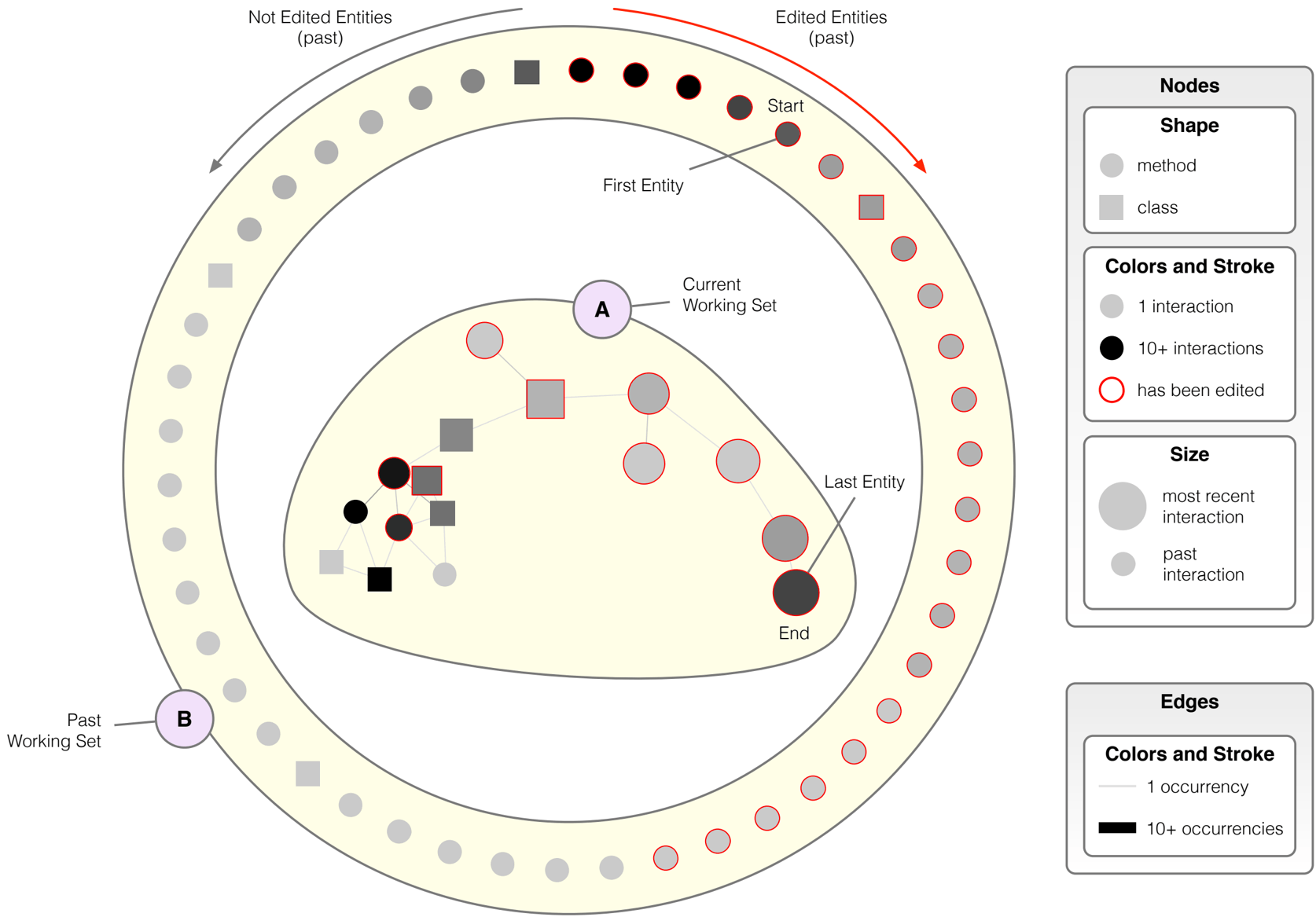
As part as their daily work, developers interact with Integrated Development Environments (IDE), generating thousands of events. Together with other aspects of development, this data also captures the modus operandi of the developer, including all the program entities she interacted with during a development session. This \"working set" (or context) is leveraged by developers to create and maintain their mental model of the software system at hand. Understanding how developers navigate and interact with source code during a development session is an open question. We present a novel visual approach to understand how working sets evolve during a development session. The visualization incrementally depicts all the program entities involved in a development session, the intensity of the developer activity on them, and the navigation paths that occurred between them. We visualized more than a thousand development sessions, and categorized them according to their visual properties.