Publications
Blended, Not Stirred: Multi-concern Visualization of Large Software Systems
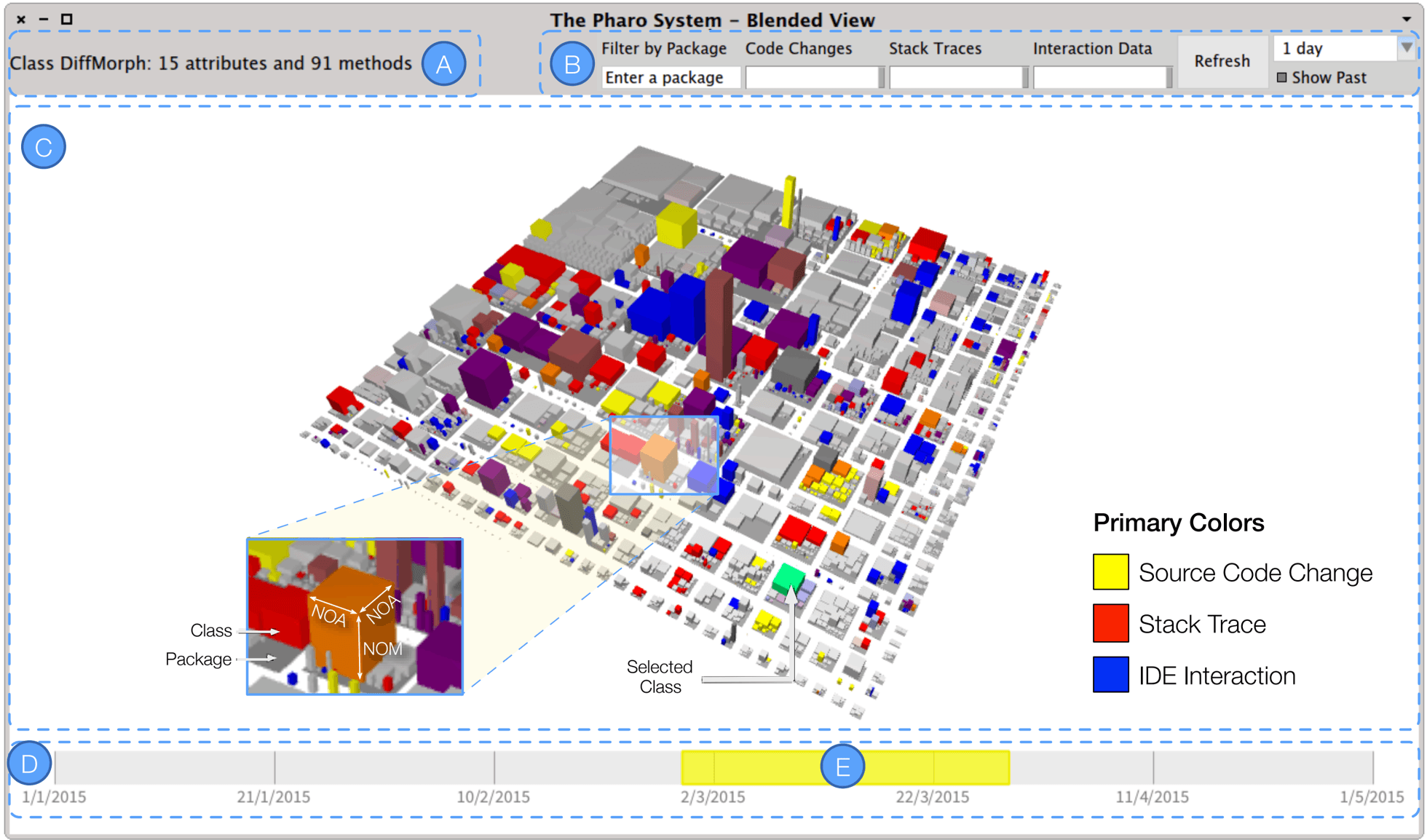
While constructing and evolving software systems, developers generate directly and indirectly a large amount of data of diverse nature, such as source code changes, bug tracking information, IDE interactions, stack traces, etc. Often these diverse data sources are processed and visualized in isolation, leading to a partial view of systems. We present a blended approach to visualize several data \"ingredients" at once, to give as complete an answer as possible to the question "What happened to the system in the last few days?". The goal is to enable a quick and comprehensive assessment of what happened to a software system in any given time frame.
I Know What You Did Last Summer -- An Investigation of How Developers Spend Their Time
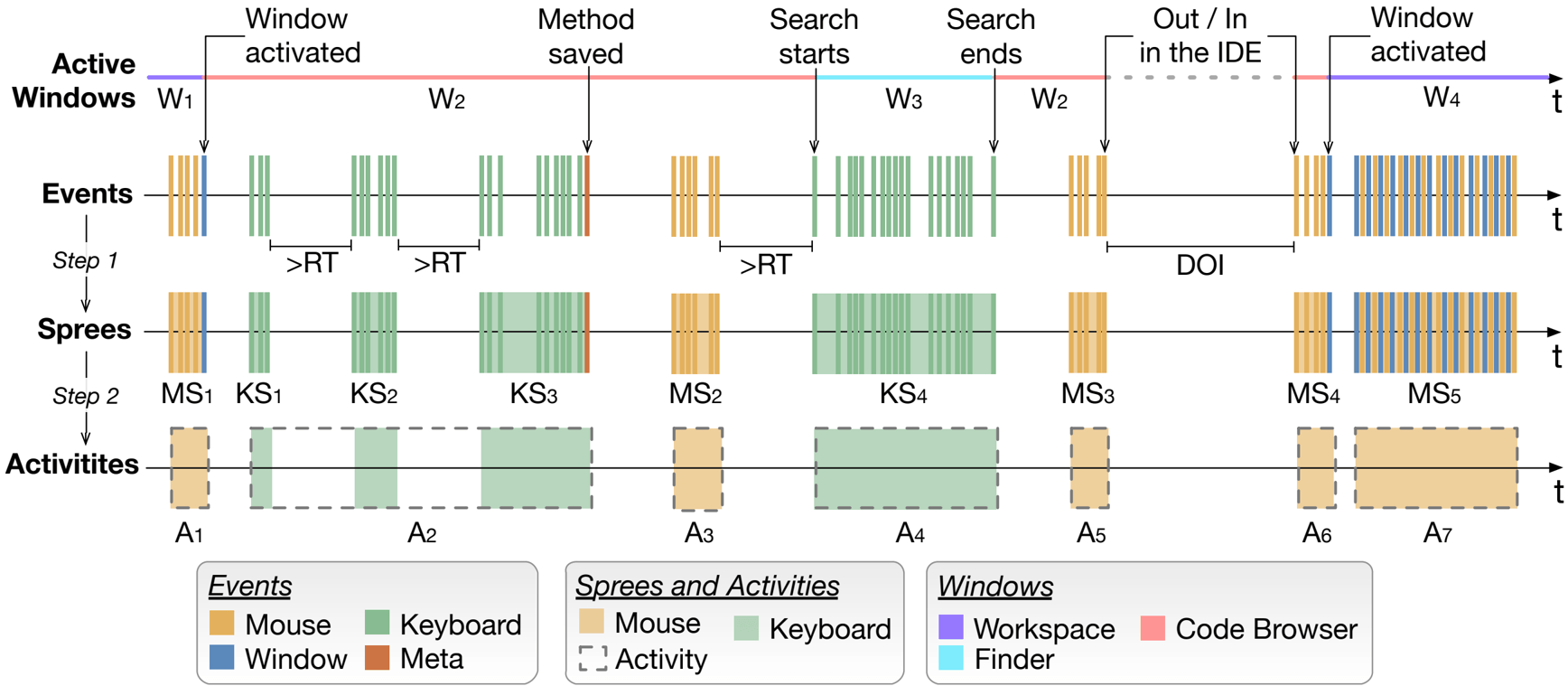
Developing software is a complex mental activity, requiring extensive technical knowledge and abstraction capabilities. The tangible part of development is the use of tools to read, inspect, edit, and manipulate source code, usually through an IDE (integrated development environment). Common claims about software development include that program comprehension takes up half of the time of a developer, or that certain UI (user interface) paradigms of IDEs offer insufficient support to developers. Such claims are often based on anecdotal evidence, throwing up the question of whether they can be corroborated on more solid grounds. We present an in-depth analysis of how developers spend their time, based on a fine-grained IDE interaction dataset consisting of ca. 740 development sessions by 18 developers, amounting to 200 hours of development time and 5 million of IDE events. We propose an inference model of development activities to precisely measure the time spent in editing, navigating and searching for artifacts, interacting with the UI of the IDE, and performing corollary activities, such as inspection and debugging. We report several interesting findings which in part confirm and reinforce some common claims, but also disconfirm other beliefs about software development.
The Plague Doctor: A Promising Cure for the Window Plague
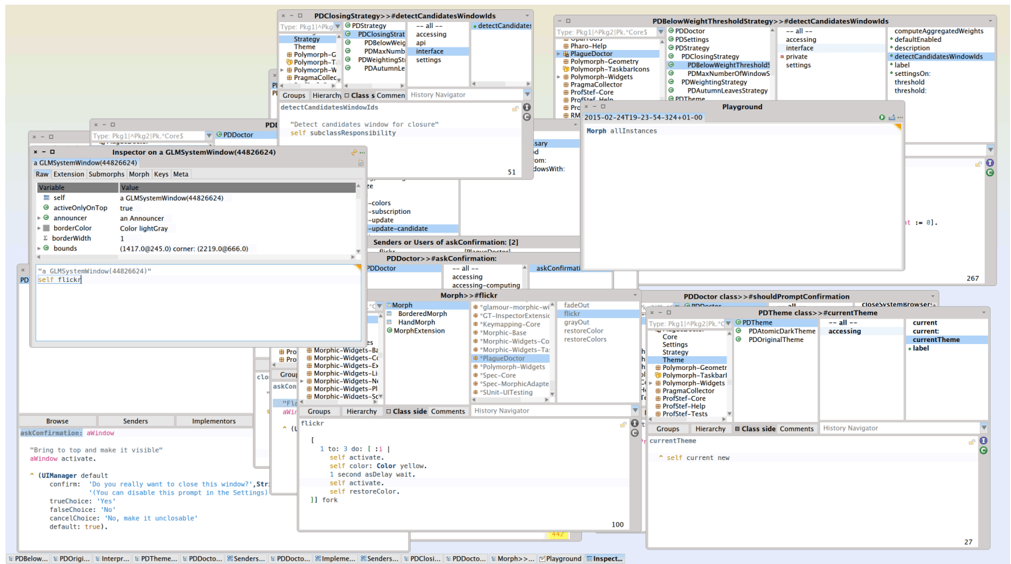
Modern Integrated Development Environments (IDEs) are often affected by the \"window plague", an overly crowded workspace with many open windows and tabs. The main cause is the lack of navigation support in IDEs, also due to the many - and not always obvious - complex relationships that exist between program entities. Researchers have shown that it is possible to mitigate the window plague by exploiting the data obtained by monitoring how developers interact with the user interface of the IDE. However, despite initial results the approach was never fully integrated in an IDE. In our previous work, we implemented DFLOW, an automatic interaction profiler that monitors all the fine-grained interactions of the developer with the IDE. Here we present a first prototype of the PLAGUE DOCTOR, a tool that seamlessly detects the windows that are less likely to be used in the future and automatically closes them. We discuss our long term vision on how to fully exploit the interaction data recorded by DFLOW to provide a more effective cure for the window plague.
Towards Visual Reflexion Models
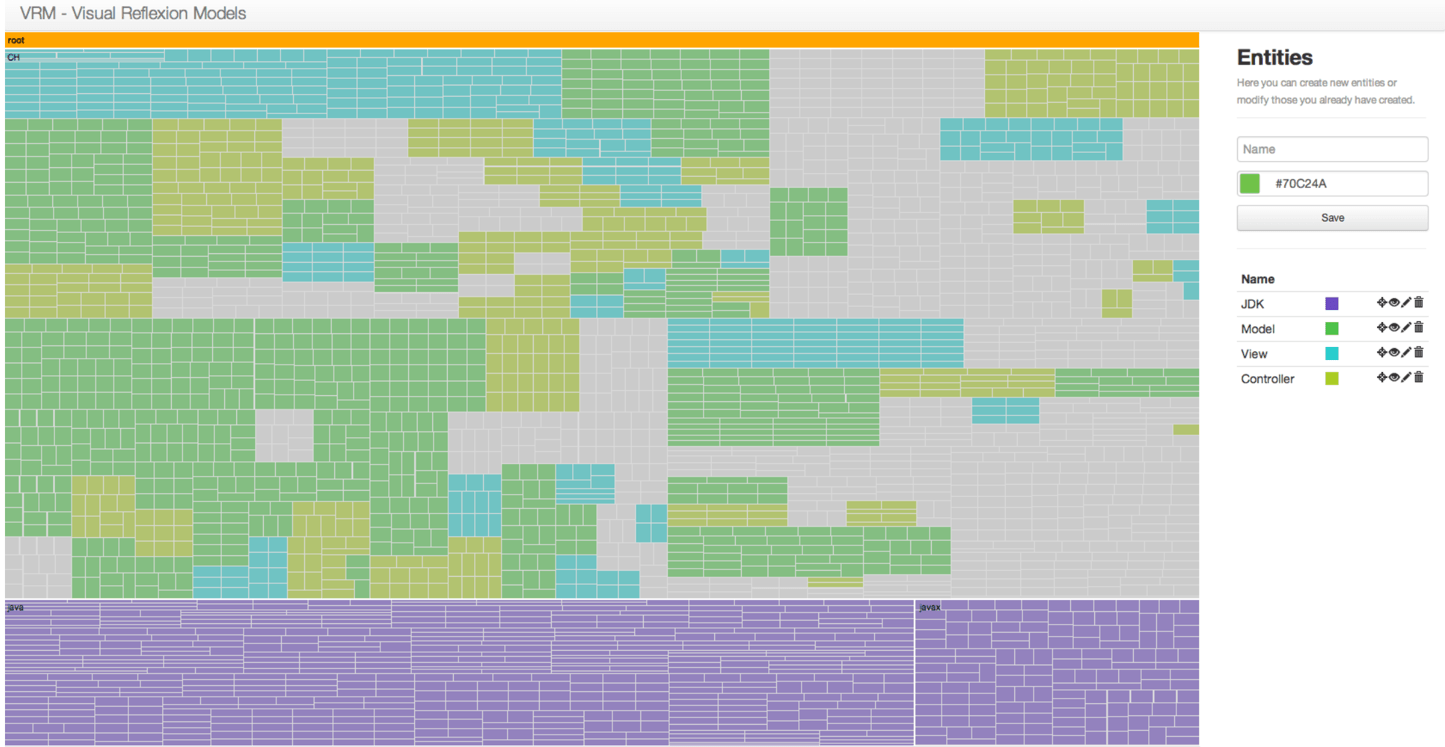
Source code and models of a software system, like architectural views, tend to evolve separately and drift apart over time. Previous research has shown that it is possible to effectively relate them through a reflexion model, defined as a \"summarization of a software system from the viewpoint of a particular high-level model". While effective, the process of constructing and analyzing reflexion models was supported by text-based tools with limited visual representation. With the original approach, it was relatively hard to understand which parts of the system were represented, and which parts of the system contributed to specific relations in the reflexion model. We present our vision on augmenting the construction and analysis of reflexion models with visual support, effectively providing the basis for visual reflexion models. We describe our approach, implemented as a web-based application, and two promising case studies involving two open-source projects.
Free Hugs: Praising Developers For Their Actions
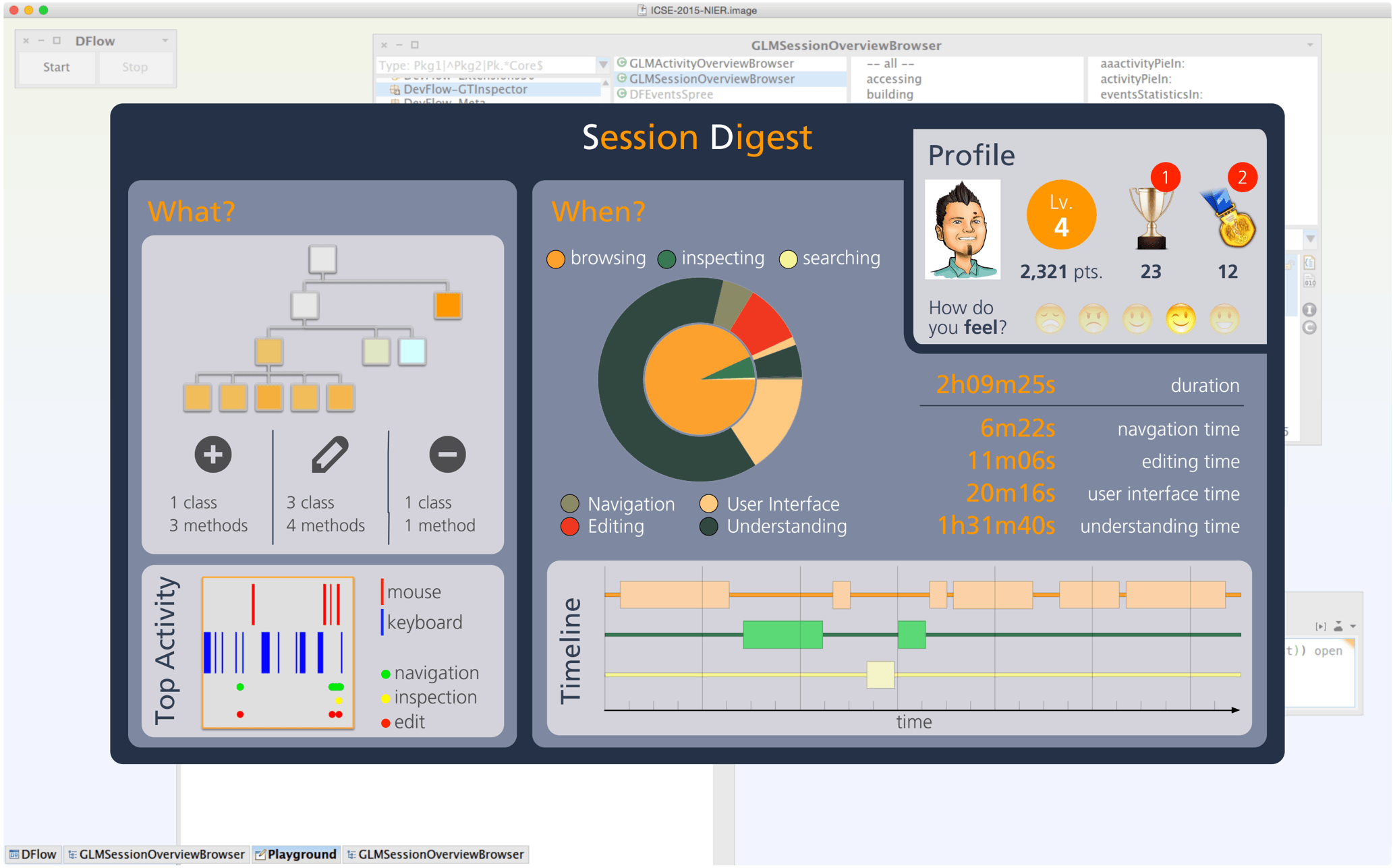
Developing software is a complex, intrinsically intellectual, and therefore ephemeral activity, also due to the intangible nature of the end product, the source code. There is a thin red line between a productive development session, where a developer actually does something useful and productive, and a session where the developer essentially produces “fried air”, pieces of code whose quality and usefulness are doubtful at best. We believe that well-thought mechanisms of gamification built on fine-grained interaction information mined from the IDE can crystallize and reward good coding behavior. We present our preliminary experience with the design and implementation of a micro-gamification layer built into an object-oriented IDE, which at the end of each development session not only helps the developer to understand what he actually produced, but also praises him in case the development session was productive. Building on this, we envision an environment where the IDE reflects on the deeds of the developers and by providing a historical view also helps to track and reward long-term growth in terms of development skills, not dissimilar from the mechanics of role-playing games.
StORMeD: Stack Overflow Ready Made Data
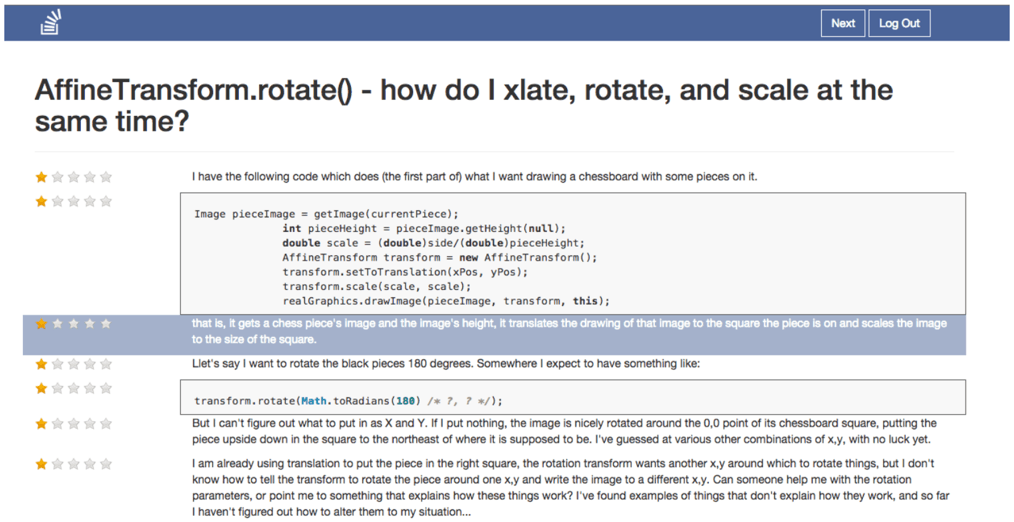
Stack Overflow is the de facto Question and Answer (Q&A) website for developers, and it has been used in many approaches by software engineering researchers to mine useful data. However, the contents of a Stack Overflow discussion are inherently heterogeneous, mixing natural language, source code, stack traces and configuration files in XML or JSON format. We constructed a full island grammar capable of modeling the set of 700,000 Stack Overflow discussions talking about Java, building a heterogeneous abstract syntax tree (H-AST) of each post (question, answer or comment) in a discussion. The resulting dataset models every Stack Overflow discussion, providing a full H-AST for each type of structured fragment (i.e., JSON, XML, Java, Stack traces), and complementing this information with a set of basic meta-information like term frequency to enable natural language analyses. Our dataset allows the end-user to perform combined analyses of the Stack Overflow by visiting the H-AST of a discussion.
Summarizing Complex Development Artifacts by Mining Heterogeneous Data
Summarization is hailed as a promising approach to reduce the amount of information that must be taken in by the person who wants to understand development artifacts, such as pieces of code, bug reports, emails, etc. However, existing approaches treat artifacts as pure textual entities, disregarding the heterogeneous and partially structured nature of most artifacts, which contain intertwined pieces of distinct type, such as source code, diffs, stack traces, human language, etc. We present a novel approach to augment existing summarization techniques (such as LexRank) to deal with the heterogeneous and multidimensional nature of complex artifacts. Our preliminary results on heterogeneous artifacts suggest our approach outperforms the current text-based approaches.
ViDI: The Visual Design Inspector
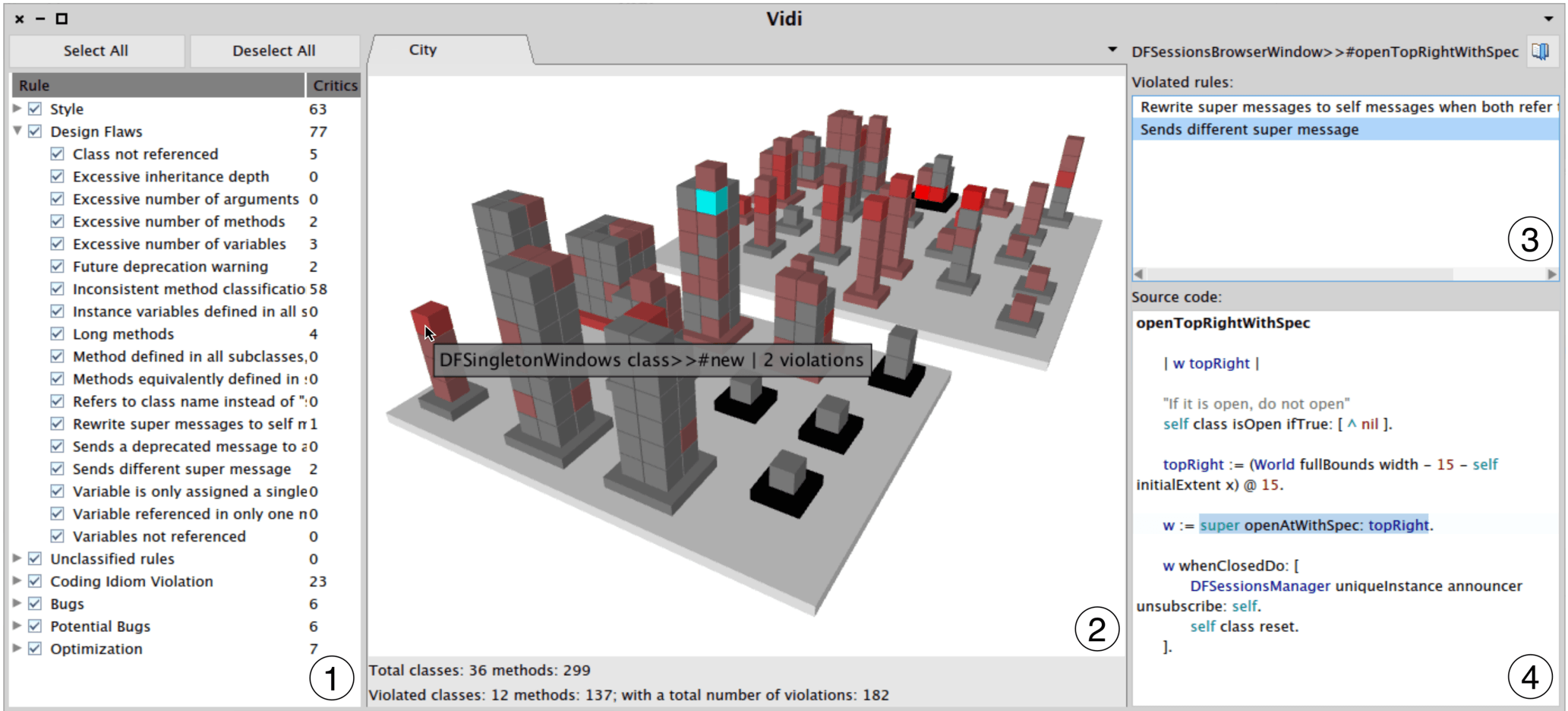
We present ViDI (Visual Design Inspector), a novel code review tool which focuses on quality concerns and design inspection as its cornerstones. It leverages visualization techniques to represent the reviewed software and augments the visualization with the results of quality analysis tools. To effectively understand the contribution of a reviewer in terms of the impact of her changes on the overall system quality, ViDI supports the recording and further inspection of reviewing sessions. ViDI is an advanced prototype which we will soon release to the Pharo open-source community.