Overview
The REFLEX project sets out to reconstruct 140 years of Swiss business activity from the Swiss Official Gazette of Commerce, a daily publication that has recorded business events — foundings, relocations, incorporations, acquisitions, bankruptcies, trademark registrations — since 1883. The source material is an archive of around 600GB of scanned documents, in which every fact of interest sits in semi-structured multilingual text.
Two pieces of software carry that work. The REFLEX Data Pipeline converts the scanned archive into structured, queryable data. REFLEXplorer is the web platform that makes the result usable by the economists, lawyers, and political scientists in the consortium.
The Data Pipeline
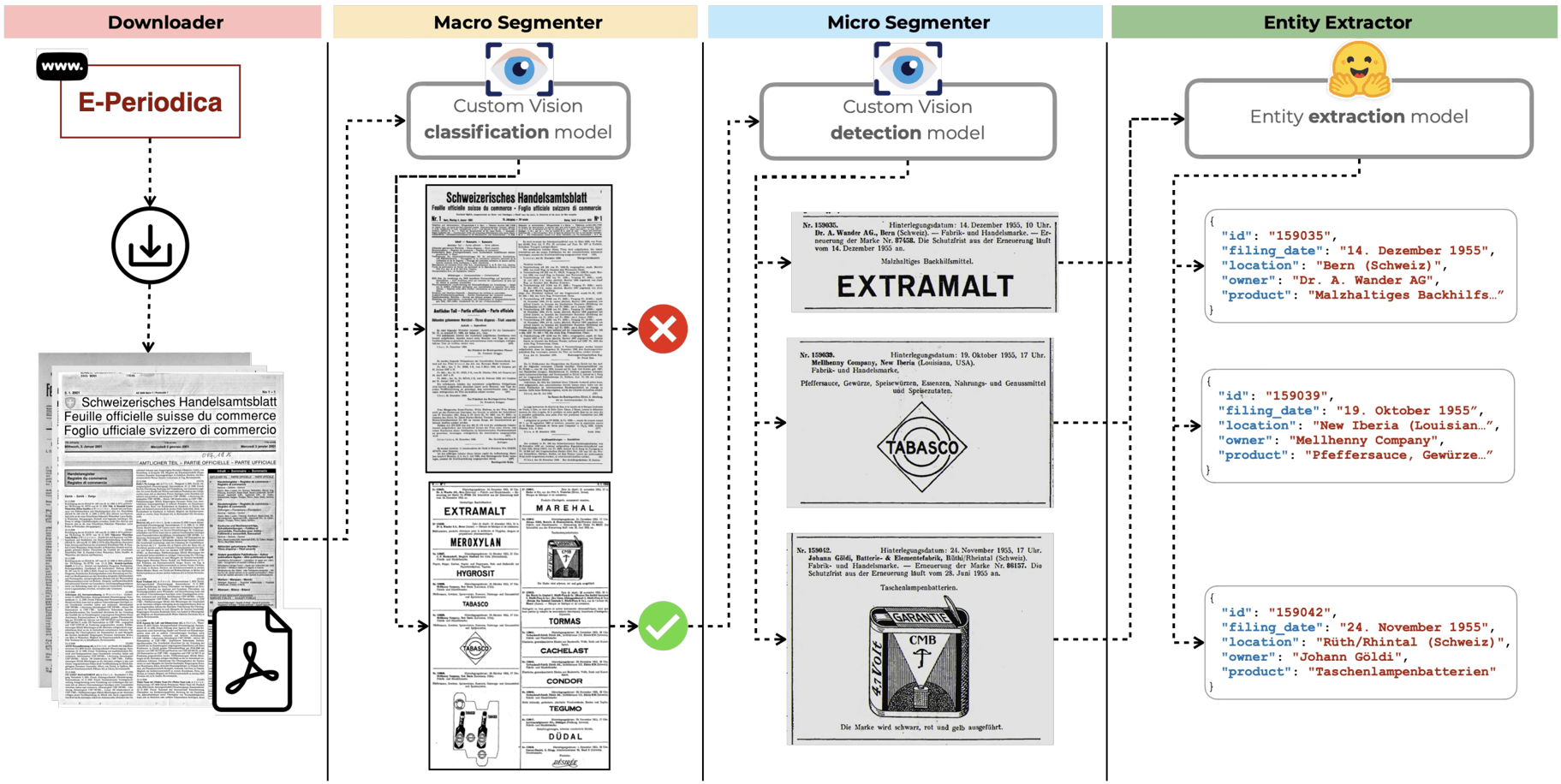
The pipeline is a chain of document-AI and NLP stages, each of which has to cope with a corpus whose layout and language change over more than a century of publications.
The document-AI end handles the scans: identifying which pages carry the material of interest, like the commercial registry entries, and then locating the region of a page corresponding to a single registration event, and extracting the text of that event. The NLP end turns those texts into facts, drawing on the usual components of a modern pipeline — tokenization and lemmatization, named entity recognition, coreference resolution, dependency parsing — with large language models plugged in where they help.
On top of extraction sits the harder problem of reconstruction: matching firms and people across events separated by decades to build coherent entity histories, geolocalizing firms from the addresses recorded in their events, and inferring demographic attributes from names. The output is a dataset of Swiss economic history that exists in no other form.
REFLEXplorer
REFLEXplorer exposes the extracted data as a searchable platform rather than a data dump. Its purpose is to serve the qualitative side of the research alongside the statistical one: finding a firm and following its history, tracing the people attached to it, and moving between the structured records and the scanned pages they were extracted from.
The platform is built on a GraphQL API over the pipeline’s PostgreSQL store, with Keycloak handling identity and access and MinIO serving the document archive behind the extracted records.
Status
Both are under active development. The project runs to 2027, and the pipeline continues to be extended to properly reconstruct company histories and networks of companies and people. At the moment, the platform is intended for internal use and it has been released only to the people from the consortium.