Author: Daniel Travaglia
Academic Year: 2022/2023
Defense Date: 19 June 2023
Institution: Università della Svizzera italiana
Faculty: Faculty of Informatics
Program: Master of Science in Software & Data Engineering

Author: Daniel Travaglia
Academic Year: 2022/2023
Defense Date: 19 June 2023
Institution: Università della Svizzera italiana
Faculty: Faculty of Informatics
Program: Master of Science in Software & Data Engineering
The Swiss Commercial Registry has been recording information regarding commercial activities in Switzerland since 1883, preserving the data in the form of periodic publications known as the Swiss Commercial Gazette of Commerce (SOGC). This information, currently accessible through a digitalized archive of scanned PDF documents, spans across heterogeneous cantonal registers and includes approximately 430,000 pages of text. These records are characterized by various details such as company acquisitions, founding events, relocations, bankruptcies, and trademark registrations from 1883 to 2001. This master thesis focuses on the specific events related to the registration of trademarks within this vast collection. The gathering and mining of this data hold significant importance for economic studies, enabling researchers to explore the notable economic development that Switzerland has witnessed over the past century. The objective of this work is to transform the wealth of unstructured information contained in these documents into a structured and queryable dataset to facilitate research activities. To accomplish this, we employ several state-of-the-art techniques to identify trademark sections, locate relevant entries, and extract associated information. Designing a comprehensive approach to achieve this goal involves addressing several challenges: (i) handling the extensive size of the collection, amounting to approximately 600GB; (ii) accommodating the evolving structure and information layout of the documents over time; (iii) managing the varying quality of the pages, including noise and artifacts; and (iv) dealing with the multilingual nature of the documents, incorporating entries in German, French, and Italian.
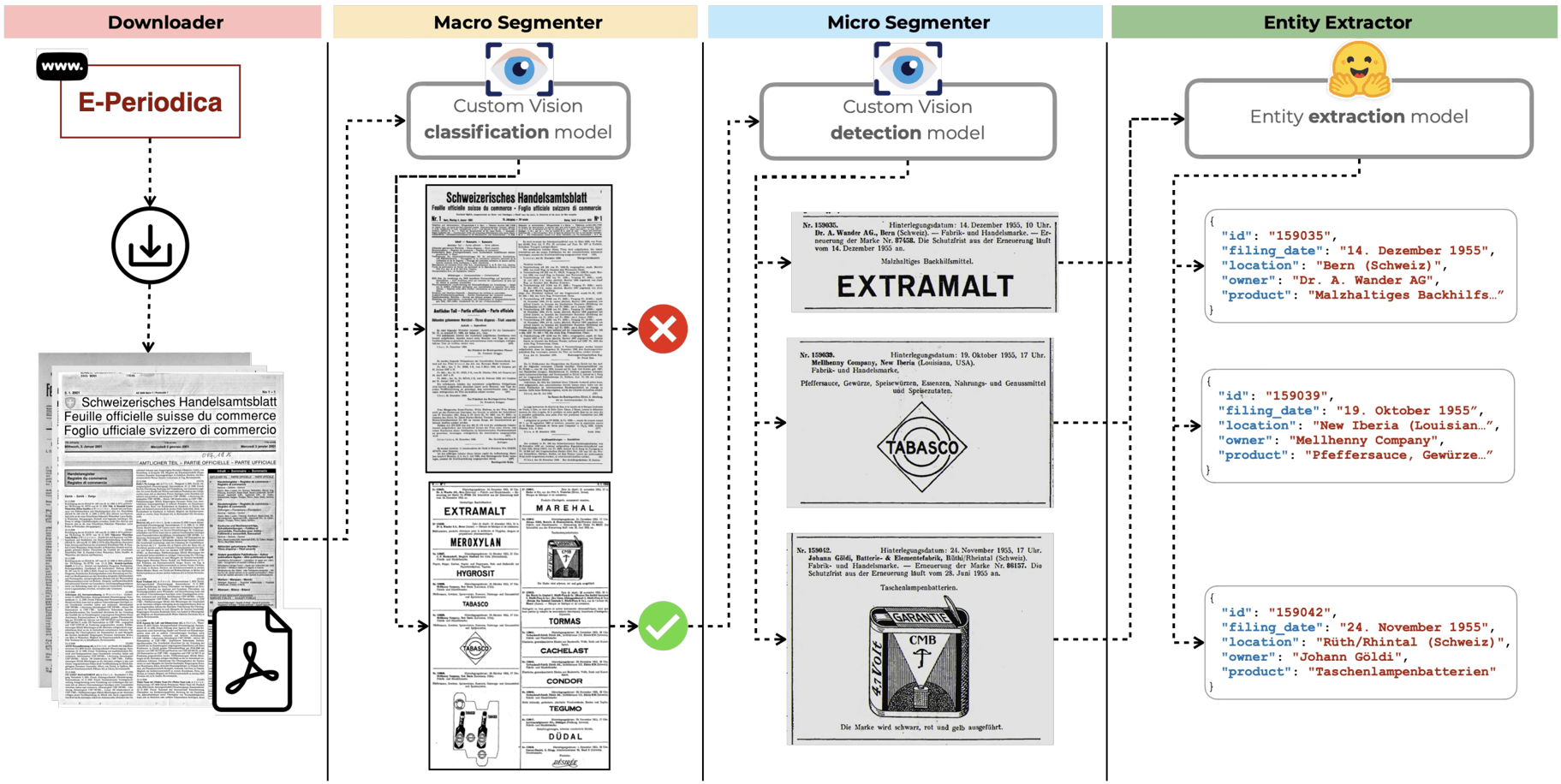
As the collection contains more than a century of publications, the disposition of the elements of these documents might change over time. Therefore, our methodology begins with a comprehensive layout analysis of the collection to understand its evolutionary structure. We decompose the timeline into periods where the document format and information contained are similar. This decomposition is supportive in the design of a pipeline that needs to be robust to the four challenges presented above and is characterized by three main steps: macro-segmentation, micro-segmentation, and information extraction. The macro-segmentation step involves identifying the trademark section within each document. The output of the macro-segmentation informs the micro-segmentation procedure, which aims to locate and extract individual trademark registration events. Finally, an image-to-text open-source model is employed to extract relevant information from each entry.
By processing the collection of documents using the proposed pipeline, we obtain a structured dataset of around 450,000 trademark registration events. This dataset is the first of its kind, offering a historical perspective on trademark registrations in Switzerland that is not available from any other source. By leveraging this resource, we provide answers and insights to several research questions, showcasing what can be achieved with the extracted information. Finally, we publish the information extraction groundtruth dataset, consisting of more than 3,000 manually extracted samples, to facilitate future research in this domain.

Università della Svizzera italiana, Switzerland
This paper presents an approach for extracting trademark registration events from the Swiss Official Gazette of Commerce (SOGC), an official daily journal published by the Swiss Confederation since January 1883. Until 2001, the data is only available as scanned documents, which constitute the target dataset of this study. Our approach is composed of a chain of three steps based on state-of-the-art deep learning techniques. We leverage image classification to identify pages containing trademarks (macro segmentation); we apply object detection to identify the portion of the page corresponding to a registration event (micro segmentation); last, we perform information extraction using a document AI technique. We obtain a dataset of ca. 500,000 trademark registration events, extracted from a corpus of 430,000 pages. Each step of our workflow has relatively high accuracy: the macro and micro segmentation steps show precision and recall greater than 95% on a manually constructed dataset. The dataset offers a unique historical perspective on trademark registrations in Switzerland that is not available from any other source. Showcasing what can be achieved with the extracted information, we provide answers to a set of preliminary economics questions.